


 By Anna
A dealer in one market receives an engine document that says “91 RON,” while the pump in front of the fleet coordinator says “87.” Both numbers may be correct, yet they are not the same measurement. The risk is treating them as interchangeable and recording a fuel decision that later cannot be explained.
Read the label as a measurement statement, not a single octane number. AKI is the average of RON and MON, so RON alone cannot produce one unique AKI value. Match the pump's system to the exact engine manual, record the market and manual revision, and escalate any comparison you cannot resolve.
This article is for dealer, fleet, and service coordinators who handle mowing equipment across markets. It explains how to read a real small-engine fuel statement, why RON and AKI are different measurements, how to compare a pump label with the exact manual, and why octane must stay separate from ethanol content and manufacturer approval. It does not recommend a fuel for any particular engine.
Lawn mower 87 octane 91 ron aki: Read a real small-engine fuel statement

Start with the document in front of you, not with a remembered number. A useful fuel statement usually names the measurement system, gives a minimum, and may give an equivalent in a second system. Your job is to capture all of that, plus the context that makes it meaningful.
A practical reading order is:
- Identify the engine and document. Record the engine family or model, the manual title, the revision or print date, and the market the document was written for.
- Copy the octane wording exactly. If it says “87 AKI / 91 RON,” write both values and the slash. Do not silently convert one into the other.
- Note what else the statement covers. Ethanol limits, fuel age, storage, and altitude notes are separate conditions, not part of the octane number.
- Note what the statement does not cover. A general engine-maker FAQ is not an approval for a specific mower model, a specific market's pump, or a specific fuel blend.
Briggs 2026 FAQ lists minimum 87 AKI / 91 RON for its stated context; record source and limits
The Briggs & Stratton fuel recommendations FAQ, as observed on 12 November 2026, lists a minimum of 87 AKI / 91 RON for the context it describes. That paired statement is a useful example of how a manufacturer presents two measurement systems together. It is also a reminder that the pairing belongs to that source, that engine maker, and that stated context.
Record it as: source name, page, observation date, the exact paired wording, and the engine context the page describes. Then record the limits. The FAQ is not a Super Mowers model approval, not a statement about every Briggs engine, and not a conversion rule you can apply to another brand. It also does not tell you what a pump in a particular country is actually selling, because pump labeling rules and typical grades vary by market.
Super Mowers publicly offers gasoline remote-controlled mowing equipment, but the specific engine brand fitted to a given model has not been verified in this material. So this article uses the Briggs statement as a documented example of paired labeling, not as a specification for a Super Mowers machine. For any actual unit, the engine manual supplied with that unit is the document to check.
Explain RON, MON and AKI without a universal conversion

Octane ratings describe a fuel's resistance to knock under a defined test method. The same fuel can carry different numbers because the tests differ. Three terms matter here:
- RON is the Research Octane Number, from a lower-severity test method.
- MON is the Motor Octane Number, from a higher-severity test method.
- AKI is the Anti-Knock Index used on US retail pumps, defined as the average of RON and MON.
The US Department of Energy and the National Renewable Energy Laboratory define AKI as the mean of RON and MON in their published work on high-octane fuel markets. That definition is the key to the whole problem: AKI depends on two inputs. If you have only RON, you have one input and one unknown.
DOE/NREL defines AKI as the mean of RON and MON; show two clearly hypothetical arithmetic examples with the same RON
The formula is simple: AKI = (RON + MON) ÷ 2. The difficulty is that MON is not printed on most retail pumps and is not derivable from RON alone. Two fuels with the same RON can have different MON values, and therefore different AKI values.
The examples below are hypothetical arithmetic illustrations only. The MON values are invented to show the math; they are not measurements of any real fuel, and they are not a conversion table.
| Illustration | RON (given) | MON (hypothetical) | AKI = (RON + MON) ÷ 2 | What this shows |
|---|---|---|---|---|
| Fuel A | 91 | 83 | 87.0 | Same RON as Fuel B, different AKI |
| Fuel B | 91 | 87 | 89.0 | Same RON as Fuel A, different AKI |
| Fuel C | 91 | 79 | 85.0 | A third possible AKI from the same RON |
All three rows share RON 91. The resulting AKI ranges from 85.0 to 89.0 purely because the hypothetical MON changed. That is why “91 RON equals 87 AKI” is not a conversion rule. It may describe one particular fuel or one manufacturer's paired statement, but it cannot be applied generally.
A second point follows. A fuel with RON 91 and a high MON could exceed 87 AKI, while a fuel with RON 91 and a low MON could fall below it. Without MON, you cannot tell which side of a minimum you are on. The honest answer is “unknown,” not a calculated guess.
Compare a pump label with the exact engine manual

A pump label is a retail statement about the fuel being sold in that market. An engine manual is a manufacturer statement about what that engine requires. They answer different questions, and comparing them requires care.
Application review
Discuss your mowing application.
Share the working condition, target market, product family and project scope.
Use this sequence for each machine or fleet fuel decision:
- Read the pump label in its own system. Note whether the number is presented as RON, as AKI (often written as “octane” on US pumps), or with both. Photograph the label if your records allow it.
- Read the engine manual in its own system. Copy the minimum and the system exactly as printed.
- Check that the systems match. RON against RON is a valid comparison. AKI against AKI is a valid comparison. RON against AKI is not, unless the source itself supplies a paired equivalence for that context.
- Check the market and revision. A manual written for one market may quote a system that the local pump does not use. A newer manual revision may change wording.
- Record the outcome as matched, unmatched, or unresolved. Do not force an unmatched pair into a yes or no.
The APR fuel guide is a useful illustration of why this matters. It presents a comparison table between octane systems, and it explicitly describes that table as a rough estimate. A rough estimate is helpful for orientation, but it is not a fixed conversion and should not be used as the basis for a compliance or warranty statement. If you cite it, cite it as an approximation with that caveat attached.
Record the measurement system, market and manual revision; escalate missing MON or an unresolved comparison
A short record prevents most confusion later. The table below is a template you can adapt; the “example entry” column shows the kind of wording to use, not real data from a specific machine.
| Field | What to record | Example entry (illustrative) |
|---|---|---|
| Engine / machine ID | Model or fleet unit number | Unit 014, engine family per manual cover |
| Document | Manual title and section | Fuel recommendations section |
| Revision / date | Print date or revision code | Rev. as printed on cover |
| Market | Country or region the manual targets | Market stated on manual |
| Octane statement | Exact wording and system | “Minimum 87 AKI / 91 RON” (example wording) |
| Pump label | Number and system as printed | “95 RON” (example wording) |
| MON available? | Yes / no / not stated | Not stated |
| Comparison status | Matched / unmatched / unresolved | Unresolved — systems differ |
| Escalation | Who was asked and when | Engine supplier enquiry, date logged |
| Decision | What was done and why | Hold comparison pending supplier reply |
Escalate when MON is missing and the comparison depends on it, when the manual quotes a system the local pump does not use, when the manual revision is unclear, or when two documents from the same maker disagree. The escalation route is the engine manufacturer or its local distributor, using the exact engine identification. A dealer's own opinion, a forum post, or a rough conversion table is not a substitute for that reply.
Keep octane separate from ethanol and manufacturer approval
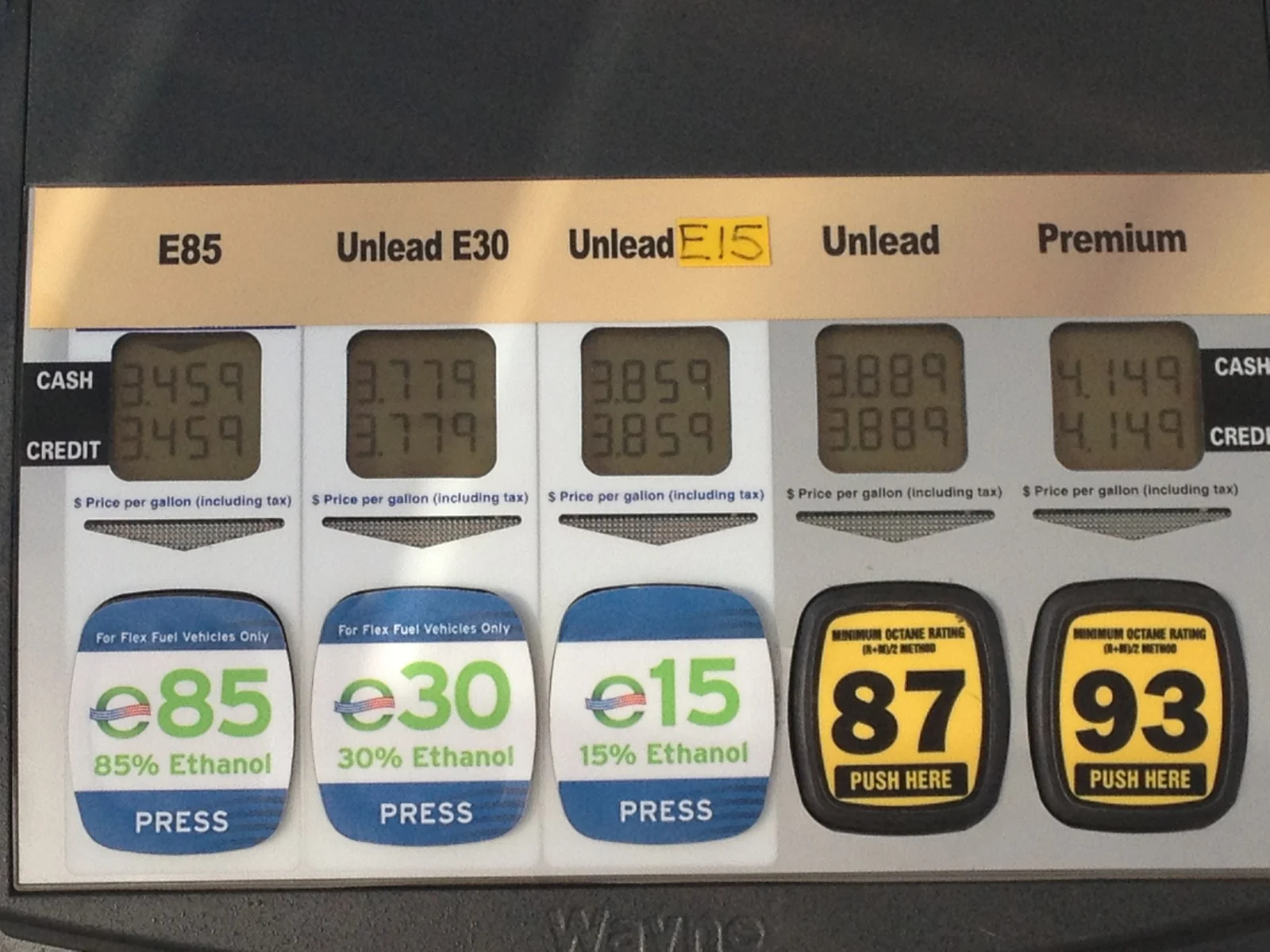
Octane and ethanol are different properties, and mixing them in one record causes errors. Octane describes knock resistance under a test method. Ethanol content describes the blend composition, usually shown as a percentage on the pump. A high-octane fuel is not automatically low-ethanol, and a low-ethanol fuel is not automatically a particular octane.
Three separate questions should stay separate in your records:
- Octane: does the fuel meet the engine manual's stated minimum, in the same measurement system?
- Ethanol: does the blend fall within what the manual permits? Many small-engine manuals set an ethanol limit, and that limit is independent of the octane number.
- Approval: does the engine manufacturer's documentation cover this engine, this market, and this fuel? A general FAQ does not approve a specific model, and one maker's guide does not approve another maker's engine.
A fourth question is often confused with these: storage and handling. Fuel age, container condition, and refueling practice affect whether a machine runs well, but they do not change the octane rating printed on the pump. Super Mowers has separate guidance on ethanol-free fuel for remote-controlled mower fleets and on gasoline refueling safety and crew handoff; those articles cover handling questions that this one deliberately leaves alone.
For fleet fuel cards and purchasing records, the practical rule is to store the octane number with its system attached. “91” alone is ambiguous; “91 RON” and “87 AKI” are not. If a supplier quotes a number without a system, ask which system before entering it anywhere. If a manual gives a paired statement, keep both halves together rather than reducing it to one number.
Finally, do not treat an octane value as proof of suitability. A number that meets a minimum does not by itself confirm ethanol tolerance, warranty coverage, altitude suitability, or approval for a particular machine. Those are separate confirmations from the engine documentation and the fuel supplier.
FAQ

Is 91 RON always exactly 87 AKI? No. RON 91 can correspond to different AKI values depending on MON, as the hypothetical examples above show. A paired statement such as “87 AKI / 91 RON” describes a particular source's context. It is not a universal equivalence, and the APR guide itself labels its cross-system table as a rough estimate.
Can RON alone establish AKI? No. AKI is defined as the mean of RON and MON. With RON alone you have one of two inputs, so the AKI cannot be calculated. If MON is not stated, record the comparison as unresolved and ask the engine supplier rather than estimating.
Does one manufacturer's guide approve fuel for another engine? No. A fuel statement belongs to the engine maker, engine family, and context it describes. The Briggs FAQ example does not approve fuel for a Super Mowers machine or for another brand's engine. Check the manual supplied with the exact engine, in the market where it operates.
Conclusion

Record octane with its measurement system, keep AKI and RON apart, and escalate comparisons you cannot resolve. Next, check the exact engine manual for one fleet unit and log its fuel statement using the template above.