
 By Anna
You are comparing snow blower listings for a commercial route and one number keeps appearing: snow blower intake height. Before you put a machine on a sidewalk contract or a parking-lot schedule, you need to know what that figure measures and whether it applies to your snow.
Intake height is a housing dimension, not a promise about snow depth. Match it to a job only after you confirm what was measured, under what conditions, and how the figure relates to clearing width, machine envelope, and the snow your route actually receives.
The sections below build a model-to-site check card. It keeps the structural opening, the working width, the overall machine size, the site snow record, and the manufacturer's stated conditions in separate fields, each with a source and a status. That structure is more useful than a single headline number, because a dimension alone cannot tell you how a machine will behave in wet, compacted, or drifted snow.
Snow blower intake height: What intake height describes on the specified machine

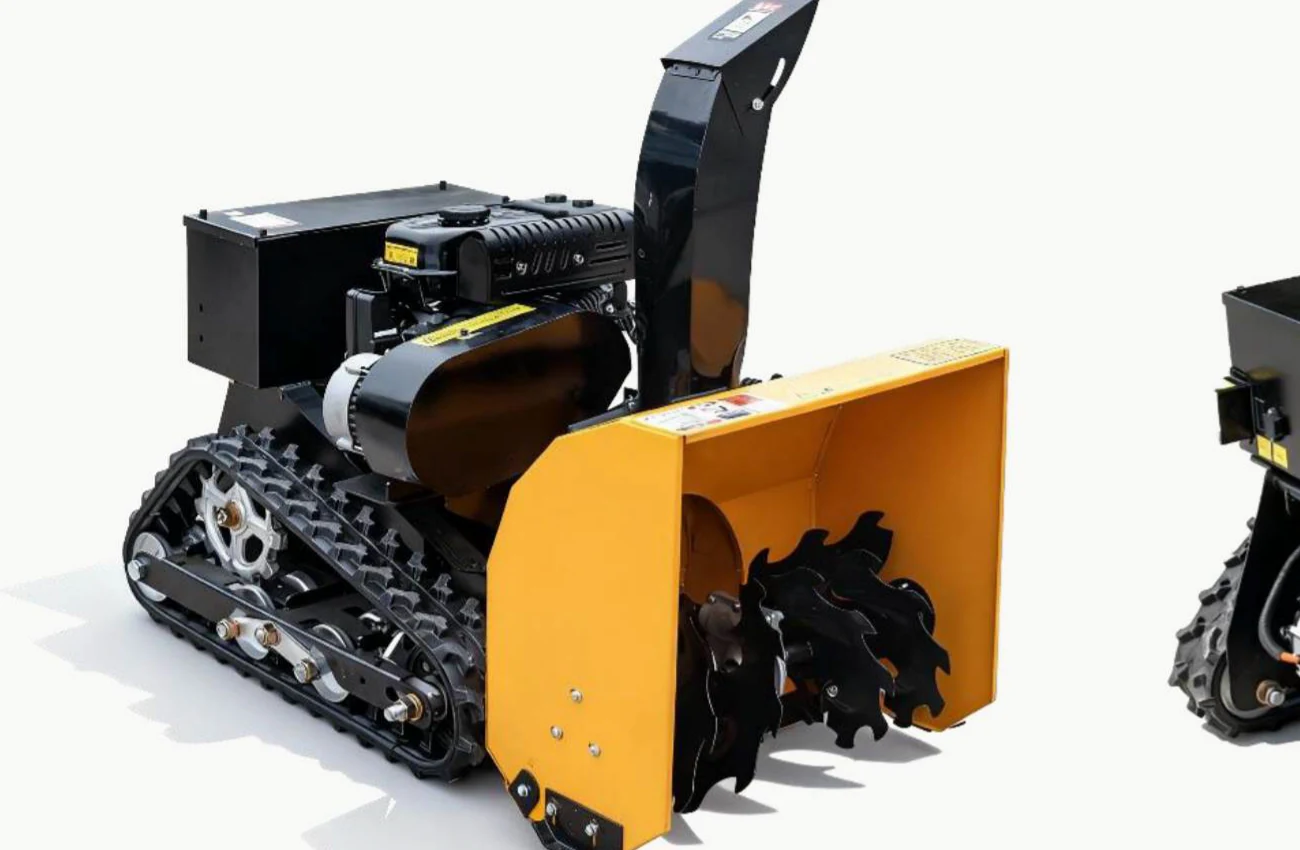
On a snow blower, the intake is the opening at the front of the auger housing where snow enters the machine. Intake height, read literally, is the vertical dimension of that opening. That is the definition to start from, and it is also where most specification sheets stop being precise. A listing may quote a number without saying whether it is the clear opening between the housing edge and the top of the intake, the height of the housing side wall, the auger diameter, or the height of the machine's front face. Those are different measurements, and they can differ by a meaningful margin on the same machine.
For procurement purposes, treat the figure as a structural dimension of the front housing until the seller confirms the measurement basis. That framing keeps the number useful without letting it stand in for performance.
Identify the auger housing, measured opening and specification conditions
When you read a spec line, ask three questions in order. First, which part is being measured: the auger housing, the opening itself, or the machine body? Second, what are the measurement endpoints: is the figure taken from the ground line, from the scraper bar, or between two housing edges? Third, under what conditions was it recorded: with the machine on level ground, with a particular attachment fitted, at a stated tire or track configuration?
A supplier may not have all three answers ready. That is normal at the enquiry stage, and it is exactly why the question belongs in writing. The answer you want is a sentence you can file, such as a reference to a dimensioned drawing or a manual page with a revision date. A number repeated in a sales email without a measurement basis is a starting point, not a verified specification.
Separate intake height from clearing width and overall height
Three dimensions get mixed together in buying conversations, and they answer different questions.
| Specification | What it describes | What it does not tell you |
|---|---|---|
| Intake height | Vertical size of the front opening or housing, as defined by the maker | Snow depth the machine can clear in one pass, or throughput |
| Clearing width | Horizontal swath the machine is designed to work | How deep the snow can be, or how fast you can travel |
| Overall height | Envelope of the complete machine, relevant to transport and storage | The size of the opening that receives snow |
| Overall width and length | Footprint for gates, ramps, trailers, and tight routes | Anything about snow handling |
A wide clearing width with a shallow intake and a tall machine with a narrow cut are both possible configurations. Each suits a different route pattern. Sidewalk work with frequent gates and tight corners puts a premium on the footprint and the turning envelope. Open lot work puts more weight on how the route is sequenced and how snow is stacked. Neither decision is settled by the intake figure alone.
For a broader comparison of how removal equipment fits different route types, see the site's discussion of snow blower versus snow plow for commercial sidewalks.
Read snow depth and site conditions as separate inputs
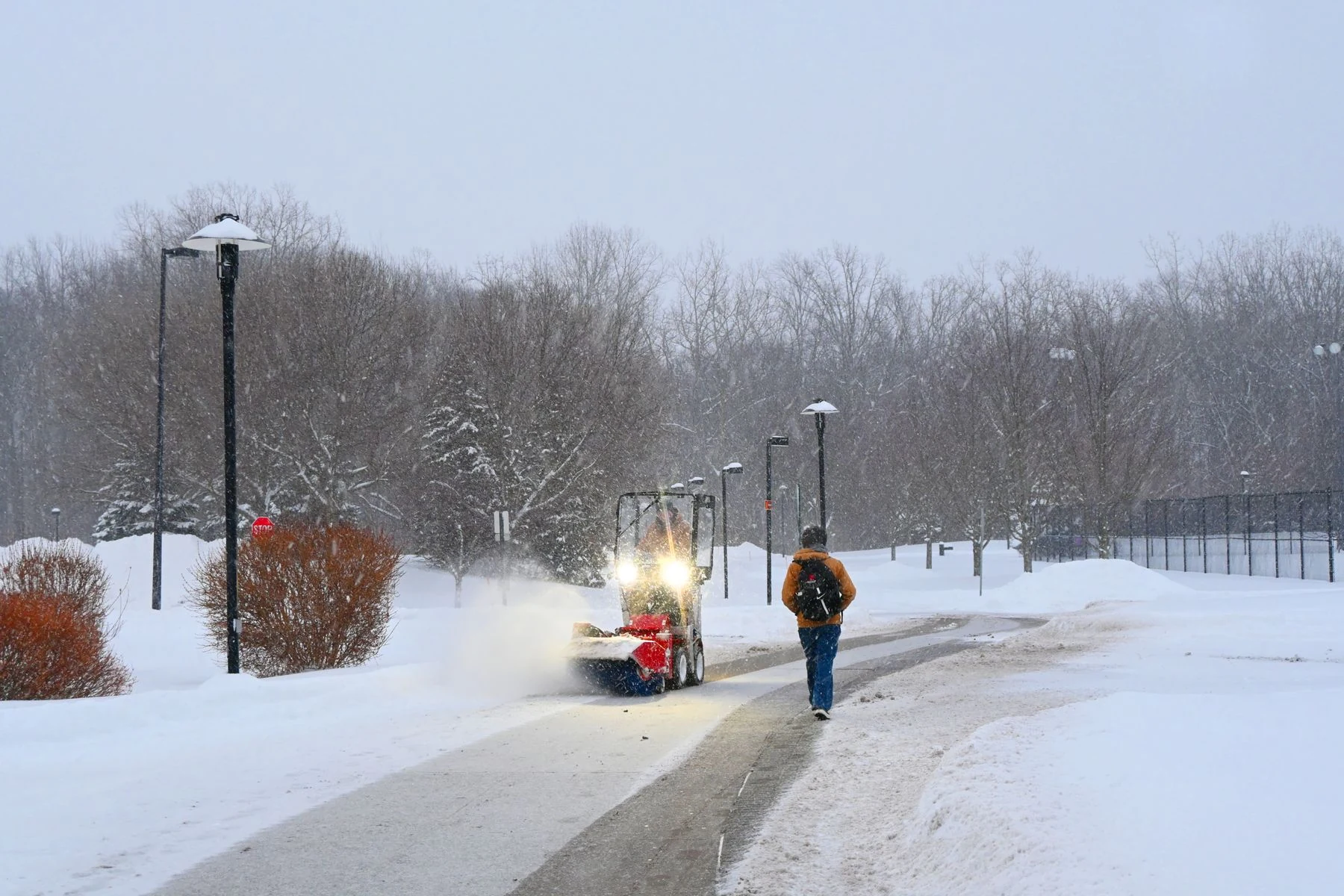
The snow on your route is not one number either. A forecast depth describes accumulation on undisturbed ground. What the machine meets on the second pass, at a plow line, or at a driveway apron is a different material: pushed, packed, refrozen, or mixed with grit and debris. Treat the site record as its own input, collected independently of any machine specification.
Record accumulation, wet or compacted snow and obstacles
Build the site record segment by segment, because a single route usually contains several different conditions. For each segment, note the typical and maximum accumulation you expect, the snow character you actually see (light and dry, wet and heavy, wind-packed, refrozen, or mixed with ice), and the fixed obstacles the operator will meet: expansion joints, curbs, bollards, planters, drainage grates, parked vehicles, and doorways.
Also record how snow arrives on the segment. Snow that falls evenly is handled differently from snow pushed into a windrow by a truck plow. A windrow is deeper than the surrounding accumulation and often denser. If your route includes handoff points where another crew leaves snow, that belongs in the record.
This is also where you note access. A machine that fits the opening but cannot turn at the end of a walkway is the wrong machine for that segment, regardless of its intake dimension. The site record should state the narrowest gap, the tightest turn, and the surface type, because these constrain the equipment choice as much as snow does.
Do not turn a housing dimension into a universal performance promise
It is tempting to read an intake height as a maximum working depth. Resist that step. A housing dimension describes geometry. Whether a machine clears a given depth in one pass depends on the snow's density and cohesion, the power available at the auger and impeller, the discharge configuration, the travel speed, the surface under the snow, and the operator's technique. None of those are captured by a single height figure.
This matters commercially. If you quote a client a service level based on a dimension, you are making a performance commitment the specification does not support. A safer approach is to describe the service in terms of passes, response time, and site conditions, and to keep the machine's stated limits as the boundary. Where the manufacturer states permitted conditions, those govern. Where it does not, the gap is a question for the supplier, not a licence to assume.
Compare model documentation and working constraints

Once you have a site record, the comparison work becomes concrete. You are no longer asking which machine is biggest; you are asking which documented configuration fits which segments, and what remains unconfirmed. Super Mowers' public catalogue includes the DY-620 remote snow blower and the DY-1000 remote snow blower. Both are remote-controlled machines. Remote control describes the control arrangement; it does not by itself establish a working distance, a slope limit, a stopping behaviour, or a snow-handling capability. Those must come from the model documentation.
Application review
Discuss your mowing application.
Share the working condition, target market, product family and project scope.
Ask for the exact manual, permitted conditions and any measurement drawing
A useful supplier request is specific and easy to answer. Ask for the manual edition that applies to the configuration being quoted, including the revision or publication date. Ask which conditions the manufacturer permits and which it excludes, in the manufacturer's own wording. Ask whether a dimensioned drawing exists for the front housing, and if so, which dimension on that drawing corresponds to the intake figure in the quotation.
Ask, too, how the figure should be read alongside the machine's other dimensions. If the seller cannot supply a drawing, ask them to state in writing what the number measures and where the measurement starts and ends. A written statement with a named source is far more useful than a number copied from a brochure, because it can be checked later against the delivered machine.
Mark unknown values instead of extrapolating from other brands
Published buying guides from other manufacturers can help you understand which questions matter. Troy-Bilt's guidance on choosing a snow blower width and Yarbo's sizing buying guide both discuss how machine size relates to the job. Use them to sharpen your enquiry, not to fill gaps in another maker's specification. A height, a width, or a performance figure published for one brand's model says nothing verifiable about a different brand's machine.
In your comparison sheet, give every unconfirmed field an explicit status: confirmed by manual, confirmed by drawing, stated by seller without source, or unknown. An unknown value is a legitimate entry. It tells the next reviewer exactly where the risk sits, and it prevents a guess from quietly becoming a planning assumption.
Use a route-specific supplier question record

A question record turns a scattered email thread into a decision document. It also makes the comparison fair, because every candidate model is asked the same questions and every answer is filed against the same site segments. Keep one row per site segment and one column per candidate model, or one row per model-segment pair if that is easier to sort.
Link site segment, stated specification, source version and decision owner
A practical record has five parts. The site segment identifies where the machine will work. The stated specification records the figure as the seller gave it, in the seller's units and wording. The source version records the manual edition, drawing number, or quotation reference and its date. The open question records what is still unresolved. The decision owner names the person who will accept the risk if the answer stays open.
| Field | Example entry | Why it matters |
|---|---|---|
| Site segment | North walkway, 1.2 m wide, two gate openings | Ties the specification to a real constraint |
| Stated specification | Intake height as quoted, with units and wording as received | Prevents silent conversion or paraphrase |
| Source version | Manual edition or drawing reference, with date | Allows rechecking after a revision |
| Open question | Measurement basis not stated; drawing requested | Keeps the gap visible |
| Decision owner | Named fleet or procurement lead | Assigns accountability for unresolved risk |
| Status | Confirmed / seller-stated / unknown | Shows how much weight the entry can carry |
This structure also supports handover. If the machine moves from procurement to an operations team, the record travels with it, and the operator can see which conditions were confirmed and which were assumed.
Recheck the quoted configuration before purchase or deployment
The configuration that arrives should match the configuration that was quoted. Before you commit, compare the quotation, the manual reference, and the order confirmation line by line. Check that the model designation, the control arrangement, and any stated attachment match. If a dimension was quoted from a drawing, confirm that the drawing reference still applies to the ordered build.
Before deployment, repeat the check against the delivered machine and the manual that came with it. If the delivered documentation differs from what you reviewed, treat the difference as an open question and resolve it before the machine enters the route schedule. This is ordinary diligence, not distrust, and it is the step that keeps a specification sheet honest over a multi-season contract.
For readers weighing control approaches, the site's comparison of remote-control and robotic snow blowers sets out the distinction in more detail.
FAQ

Is intake height the same as clearing width? No. Clearing width is the horizontal swath the machine is designed to work. Intake height is a vertical dimension of the front opening or housing, as defined by the manufacturer. They describe different axes and answer different route questions.
Does an intake height alone guarantee a particular snow depth can be cleared? No. A housing dimension describes geometry. Actual clearing depends on snow density and character, machine power and discharge configuration, travel speed, surface conditions, and the manufacturer's permitted operating conditions. Use the manual's stated limits, not the dimension, as the boundary.
What if the specification does not explain how it was measured? Ask the seller to state the measurement basis in writing, or to supply a dimensioned drawing or manual page with a revision date. Until then, record the figure as seller-stated or unknown rather than confirmed, and note the open question in your comparison record.
Conclusion

Treat intake height as one documented dimension among several. Record the site's snow and access conditions separately, confirm the measurement basis in writing, and keep unknown values visible until the manual or drawing resolves them.
Video: Two-Stage Snow Blowers by Intake Height for Driveways
