

 By Anna
Snow blower vs snow plow for commercial sidewalks: the better choice depends on route width, obstacles, snow-storage space, pavement conditions, and the deadline for reopening pedestrian access. A plow pushes snow toward an approved pile or collection point. A snow blower lifts and discharges it toward an approved destination. A remote-control snow blower adds a different operator-control arrangement, but it does not automatically clear faster, fit every sidewalk, or operate autonomously.
For facility managers, snow-removal contractors, municipal buyers, and equipment distributors, the most useful comparison is made zone by zone. This guide explains where each machine category may fit and provides a commercial purchasing checklist without assigning unsupported clearing rates, operating distances, slope limits, or safety claims to a specific model.
Snow blower vs. snow plow: what changes on a sidewalk?
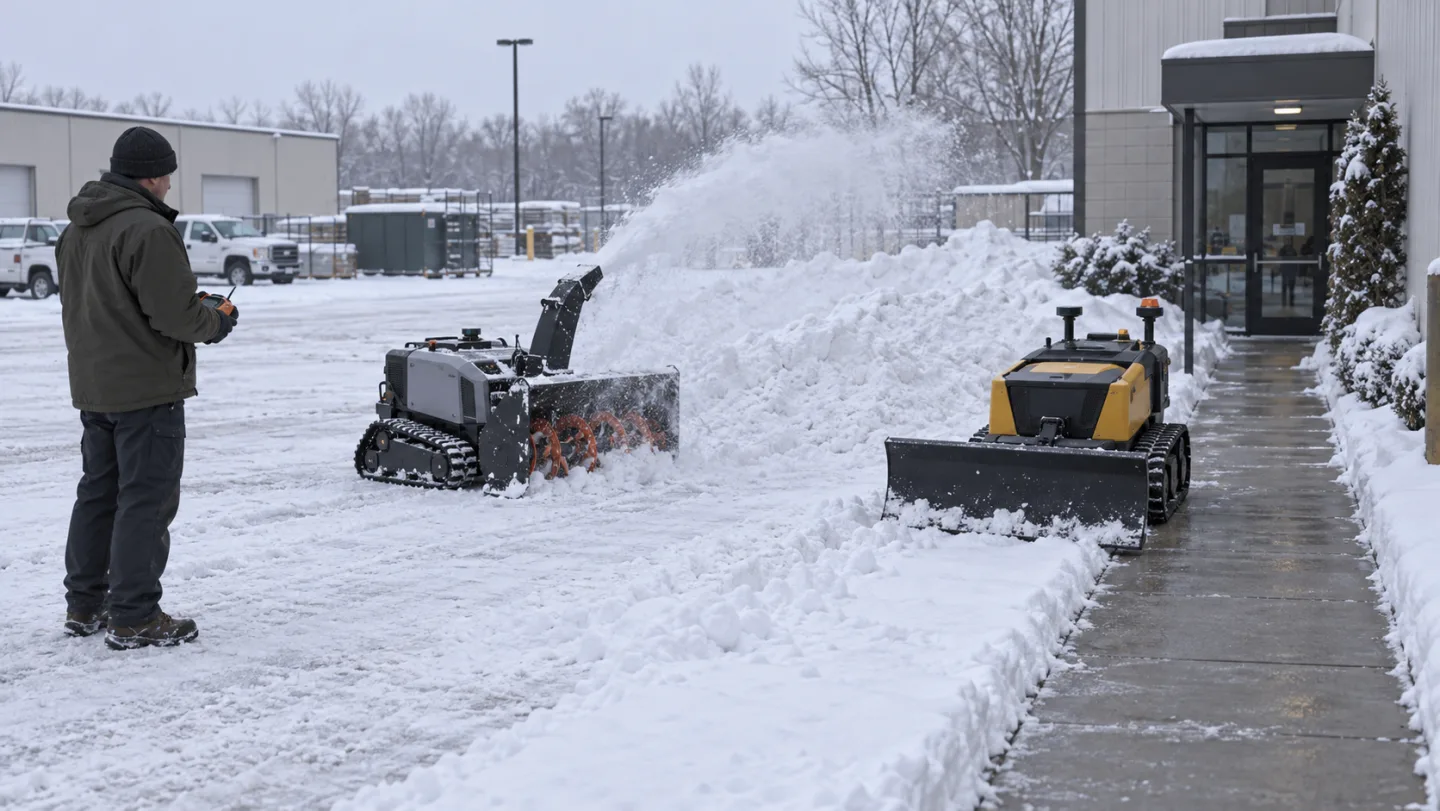
The mechanical difference matters because snow must be moved somewhere without blocking an entrance, crossing, accessible route, drain, road, or neighboring property.
- Snow plow: A blade moves snow along or off the surface. The quote needs a workable push route, turning space, a snow-pile or haul-off plan, and confirmation that the carrier can use the pavement and access points.
- Snow blower: An intake and discharge system moves snow away from the clearing path. The buyer must verify intake and clearing dimensions, discharge direction and destination, snow-condition limits, and manufacturer requirements for the surface.
- Remote-control snow blower: The operator controls a documented machine configuration from a transmitter rather than walking behind it. That changes the operator position and control questions, not the basic need to verify the route, snow destination, and machine limitations.
Do not assume every plow is a large truck-mounted unit. Compact plows and purpose-built sidewalk machines exist, just as snow blowers are offered in different sizes and drive types. Compare the proposed complete machine against the route instead of comparing generic labels.
When a commercial sidewalk snow plow may be a better fit
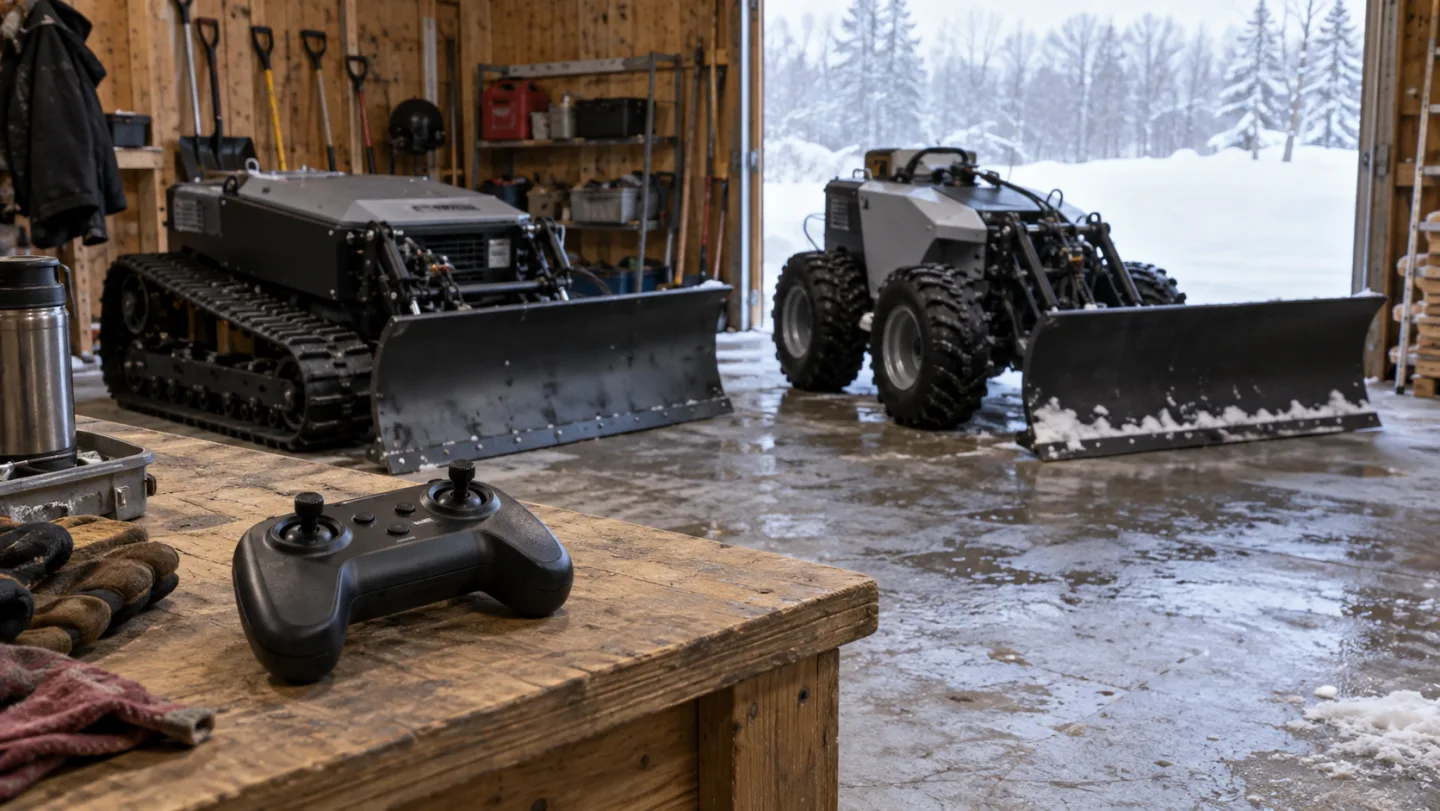
A plow may be suitable where a commercial property has wide, relatively open paved paths, a continuous push direction, and a designated place for displaced snow. Examples to evaluate include broad campus walkways, service courts, open plazas, and pedestrian areas that the site owner has confirmed can accommodate the quoted carrier.
Ask these questions before treating a plow as the default choice:
- Does the full plow-and-carrier width fit the narrowest approved route, not just the widest walkway?
- Are there gates, bollards, planters, steps, curbs, ramps, building corners, or parked vehicles that interrupt the push path?
- Where will each pass place the snow, and who approved that pile or removal location?
- Could accumulated piles reduce access later in the season or interfere with drainage, visibility, entrances, or pedestrian travel?
- Does the manufacturer approve the proposed blade, carrier, pavement type, and site conditions?
Procurement implication: A large cleared area does not make a plow suitable if the snow has nowhere acceptable to go. Include storage capacity, rehandling, and possible haul-off in the proposal rather than pricing blade passes alone.
When a snow blower may suit narrow or obstacle-filled routes

A snow blower may be easier to evaluate for a route where long pushing runs are interrupted by entrances, handrails, benches, gates, or other fixed objects. It can redirect removed snow without requiring the same continuous snow-push path as a plow, provided the destination and equipment configuration are approved.
That does not mean snow can be discharged anywhere a chute points. Adjacent roads, pedestrians, vehicles, glazing, landscaping, drainage structures, and neighboring properties may restrict the discharge plan. Confirm the destination before specifying a blower.
Check the clearing task, not only clearing width
- Snow conditions: Record expected depth, snow type, drifting, and the contractor’s actual service trigger. Ask which conditions the exact model’s instructions cover.
- Surface: Record concrete, asphalt, pavers, decorative surfaces, transitions, and any owner restrictions. Do not assume a particular scraper, track, or wheel setup is suitable.
- Access: Record gate openings, curb transitions, slopes, steps, loading areas, and the narrowest usable path.
- Discharge: Request the model’s chute controls and documented discharge characteristics under stated conditions; do not interpret a maximum throw-distance advertisement as the result on every site.
- After-clearing work: Keep residual snow, packed ice, deicing, and final walkway acceptance in the contract. A blower pass alone does not establish that a route meets the property’s reopening requirement.
Where a remote-control snow blower fits the equipment decision
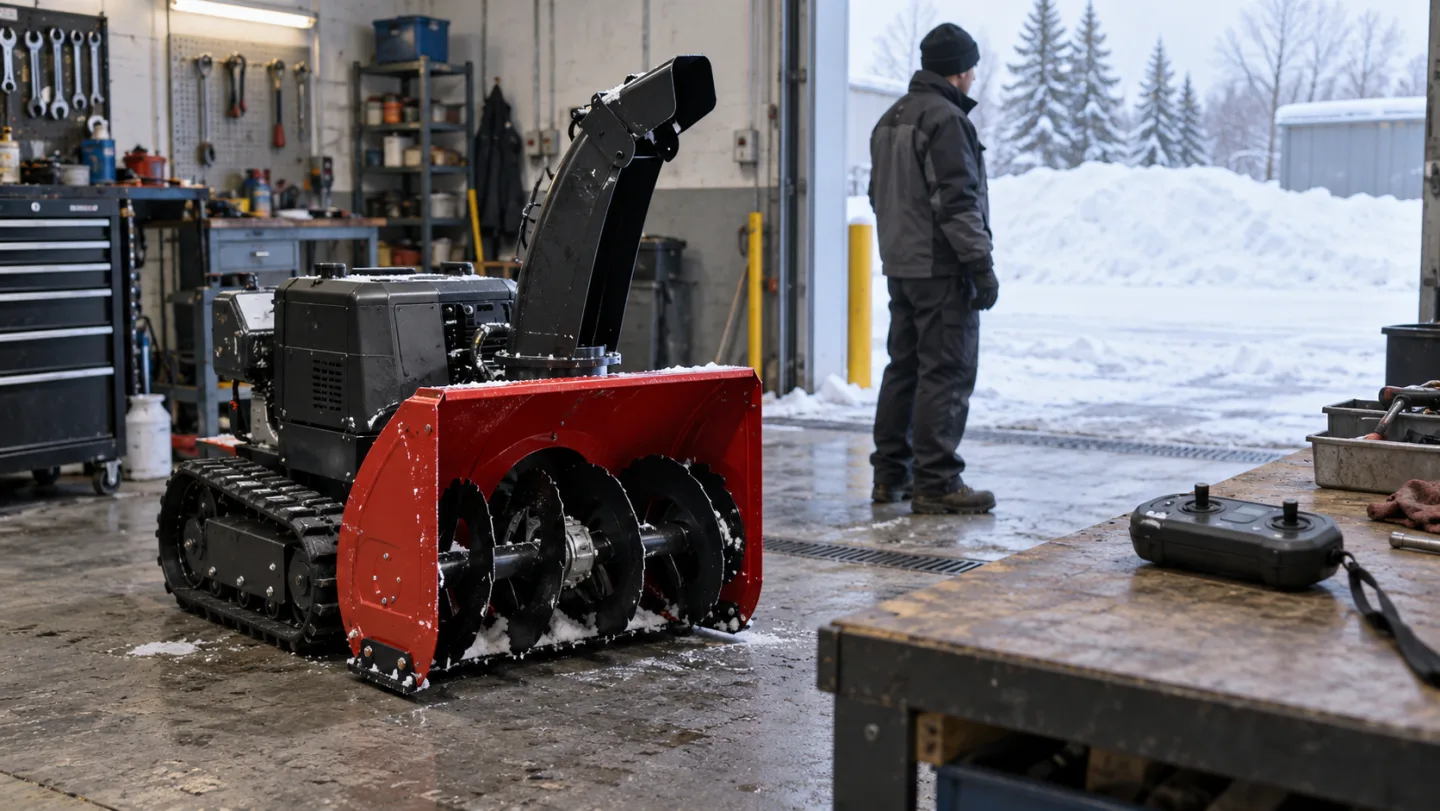
A remote-control snow blower is an option to investigate when a buyer wants machine-assisted clearing with the operator positioned separately from the machine. It should be considered as a control and equipment configuration, not automatically treated as a robotic or autonomous snow-removal system.
Remote control may be relevant to repetitive commercial routes or locations where the site’s responsible team wants a different operator arrangement. But the operator’s position alone cannot establish suitability, labor savings, safe exposure distance, or performance on an incline.
Remote-control features that need written confirmation
- Which exact functions the transmitter controls: travel, steering, snow intake, chute direction, deflector, and stop functions
- What the current manual requires for operator supervision, visibility, training, and positioning
- What happens when radio communication is lost, a fault occurs, or the stop control is activated
- Overall machine width, transport weight, track or wheel configuration, turning needs, and access limitations
- Clearing width and intake height for the proposed snow attachment or complete blower
- Fuel, battery, starting, charging, and service requirements in the intended winter conditions
- Who provides local training, replacement parts, warranty service, and technical support
For general snow-equipment precautions, the U.S. Occupational Safety and Health Administration’s winter-weather guidance discusses snow blower hazards and maintenance. Its guidance does not replace the exact manufacturer’s instructions or the employer’s worksite controls.
Commercial sidewalk snow-removal equipment comparison
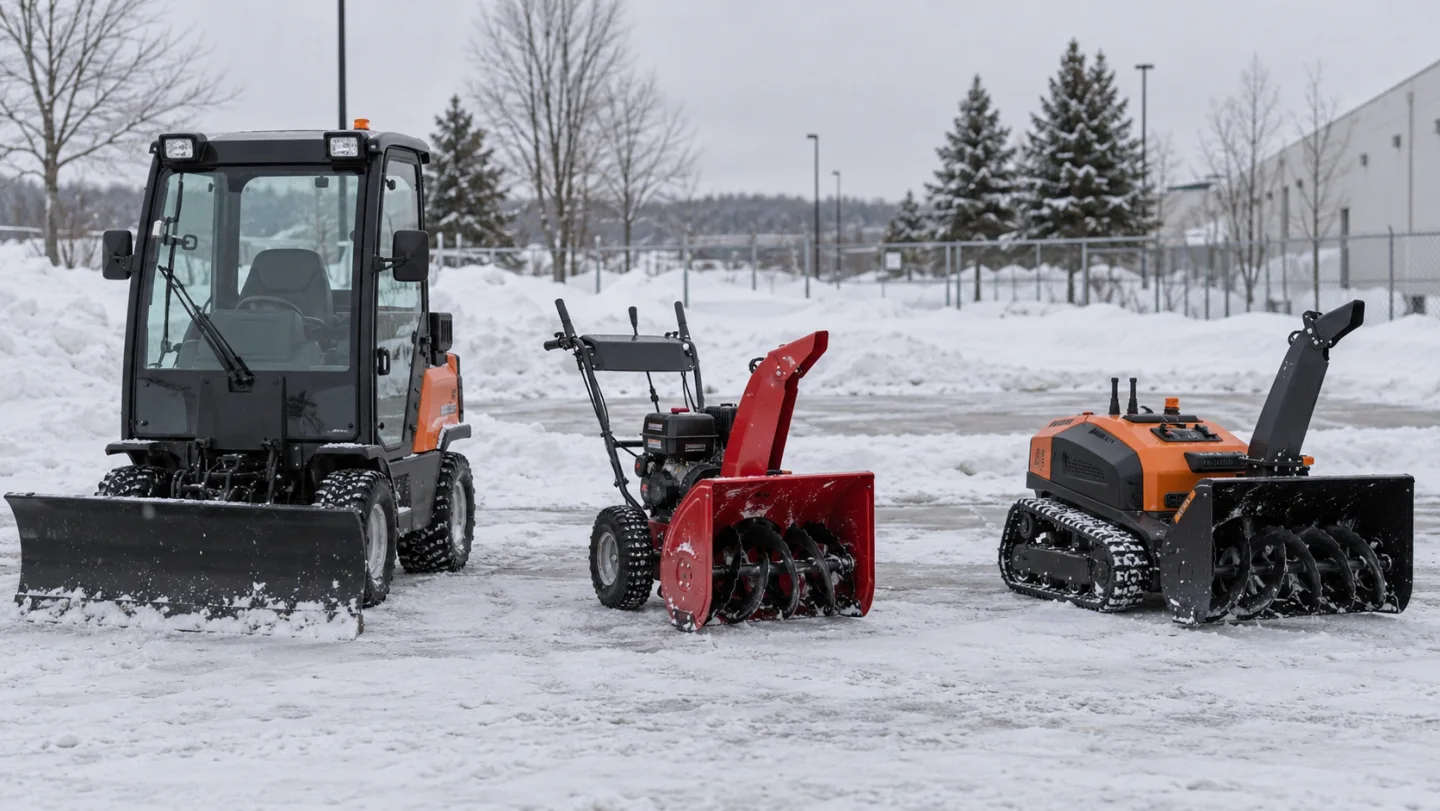
Use the table to decide which category deserves a model-specific quote. These are common comparison questions, not verified performance claims for any particular product.
Application review
Discuss your mowing application.
Share the working condition, target market, product family and project scope.
| Decision factor | Snow plow | Walk-behind snow blower | Remote-control snow blower |
|---|---|---|---|
| Snow-moving action | Pushes snow toward a designated location | Collects and discharges snow from the path | Collects and discharges snow under remote operator commands |
| Route to investigate | Open paved runs with an approved push path and storage space | Constrained pedestrian paths with an approved discharge destination | Routes requiring a separately positioned operator and documented remote control |
| Main space constraint | Full carrier/blade width, turns, pile locations | Housing width, turns, gates, chute discharge area | Full machine width, turns, operator position, discharge area |
| Operator arrangement | Depends on whether the plow is walk-behind, compact carrier, or vehicle-mounted | Operator walks with machine under its instructions | Operator uses the specified transmitter under its instructions |
| Key specification check | Blade and carrier fit, approved surface, stacking plan | Clearing width, intake, surface restrictions, discharge control | Same blower checks plus radio, stop/fault behavior and training |
| Commercial cost items | Equipment, labor, piles, rehandling, possible haul-off | Equipment, labor, discharge restrictions, transport, wear parts | Equipment, transmitter/control package, training, support, transport, wear parts |
A bigger clearing width or a longer published throw distance does not automatically make a quote better. Verify the conditions under which each figure was measured, and compare it with the actual route and contract requirements.
Questions to answer before requesting commercial sidewalk quotes

Collect the same information for every bidder. Separate the site’s requirements from what the supplier claims the machine can do.
- Pedestrian routes: Which sidewalks, entrances, transit connections, ramps, and access points must remain open, and who defines acceptable clearance?
- Measured dimensions: What are the narrowest usable widths, route lengths, turning areas, gates, and approved machine access points?
- Opening deadlines: What is the required completion time for each zone, including early-morning and repeat service?
- Snow conditions: What snow depth, density, drift, and temperature conditions are expected under the service agreement?
- Snow destination: Where may snow be pushed, blown, stored, rehandled, or hauled away under the owner’s rules?
- Pavement: Which sections use concrete, asphalt, pavers, decorative surfacing, or other materials that need equipment-specific review?
- Equipment evidence: Which current manual supports clearing width, intake height, discharge control, weight, operating restrictions, and maintenance intervals?
- Remote functions: If remote control is quoted, what supervision, communication-loss, emergency-stop, and operator-training requirements apply?
- Service continuity: What equipment, labor, and escalation plan covers a breakdown, blocked route, or snowfall beyond the quoted conditions?
- Acceptance: Who verifies completed pedestrian access and assigns any remaining snow or ice work?
Accessibility and snow storage are separate approval checks
The U.S. Access Board’s ADA Accessibility Standards address accessible routes between site arrival points and facilities. However, this article does not set a universal winter snow-clearance width or interpret local removal deadlines. Confirm the applicable property, public-right-of-way, accessibility, and contract requirements with the responsible authority.
Also document meltwater and snow-storage constraints. The U.S. EPA’s stormwater operation and maintenance material includes planning for where mechanically removed snow is stored and how winter materials are managed. The applicable requirements still depend on the site and its governing plan or permit.
Build the buying decision around sidewalk zones
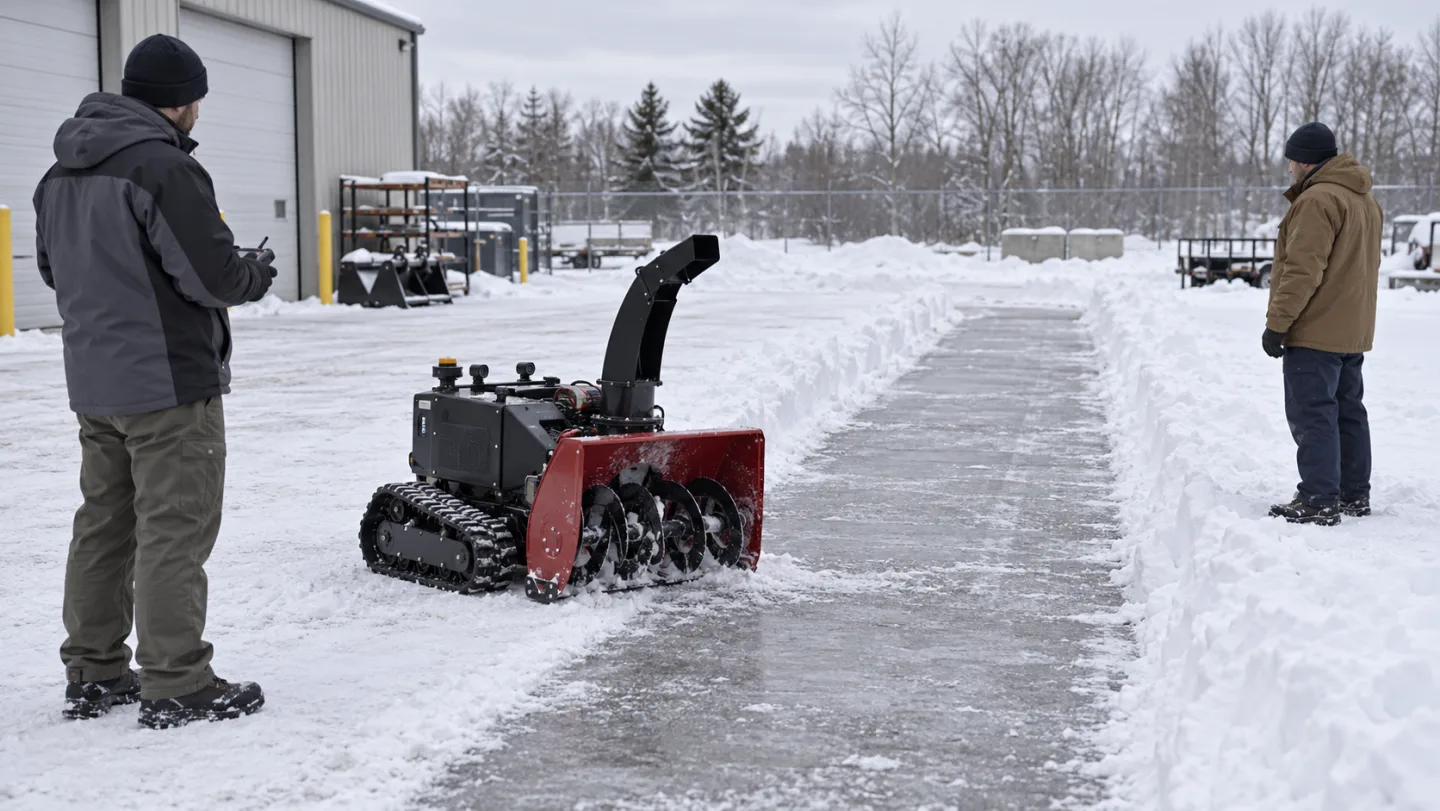
A single commercial property may use more than one machine category. A plow quotation for a large parking area does not automatically cover the adjacent sidewalks, and a blower quotation for narrow entrances does not automatically cover an open service court.
Use a zone-by-zone worksheet rather than asking which machine is best for the entire site.
| Example zone | Site inputs | Equipment category to evaluate | Question to resolve |
|---|---|---|---|
| Wide campus walkway | Usable width, surface, turns, approved snow storage | Compact plow or snow blower | Is a continuous push path possible without obstructing access? |
| Storefront or entrance corridor | Doors, glazing, bollards, ramps, pedestrian activity | Appropriately sized snow blower or other approved method | Is there an approved discharge destination and a workable access route? |
| Detached or exposed sidewalk | Access, surface, weather exposure, operator arrangement | Walk-behind or remote-control blower, subject to review | Does the exact model meet the site’s operating and control requirements? |
| Parking lot or service court | Vehicle access, traffic, stacking locations, haul-off | Plow and other site-approved snow equipment | What protects the connected pedestrian routes from displaced snow? |
These zones are illustrative, not machine assignments or operating approvals. Final choices need the current equipment instructions and the responsible site’s review.
For each zone, ask bidders to record the proposed model, full operating width, number of expected passes, transport and setup requirements, labor assumptions, snow destination, service trigger, backup equipment, and price basis. A cost-per-event figure is useful only when all bidders use the same scope and snow-event assumptions.
Tracked platforms, snow attachments, and the final procurement check

A tracked carrier is not automatically a snow blower. If a supplier proposes a multi-attachment platform, request the approved combination of carrier, snow-clearing attachment, controls, guards, power system, and winter operating instructions. Do not transfer a mowing attachment’s ratings to a blower or plow attachment.
Before approving the quote
- Confirm that every proposed machine fits the measured route and approved transport path.
- Confirm that both pushed and discharged snow have an acceptable destination.
- Compare the same defined snow conditions, service windows, and completion standard across quotes.
- Obtain current model and attachment documentation, including exclusions and control requirements.
- Identify who is responsible for accessible-route closeout, residual ice treatment, and stormwater-related restrictions.
- Confirm dealer support, operator training, wear parts, service response, and contingency equipment.
Bottom line: For snow blower vs snow plow for commercial sidewalks, begin with where the snow can go and how the pedestrian route must remain usable. Plows may fit open routes with approved stacking space; blowers may fit constrained routes with approved discharge space; remote-control blowers merit separate consideration when the documented operator arrangement and machine configuration match the contract. No category is automatically the best choice for every sidewalk.
Commercial buyers and distributors comparing winter equipment can start with the Super Mowers applications overview and send a site-specific equipment inquiry. Include a route map, measured sidewalk widths, surface types, expected snow conditions, discharge or stacking restrictions, and the required service window. Request written configuration and operating-limit confirmation for the exact product being quoted.
Scope note: This is a procurement and site-planning comparison, not a snow-removal operating procedure or legal compliance determination. It does not establish safe clearances, snow-discharge distances, slope limits, traffic controls, or accessible-route requirements for an individual site. Those decisions belong to the site authority, qualified personnel, applicable rules, and current machine-specific documentation.
Video: Yarbo Snow Blower with Plow Blade Attachment | Effortlessly Clears Heavy Wet Snow!
