

 By Anna
A supervisor arrives after overnight rain, sees dry-looking grass on top, and has to decide whether to send a remote-controlled mower onto a commercial site. The decision is not about the grass blade alone; it is about whether the ground beneath it can carry the machine, its route, and its turns without damage.
Wet grass and wet ground are separate observations. Leaf moisture affects cutting and discharge; soil moisture and bearing strength determine rutting risk. Before assigning a mower, confirm surface conditions on foot, check for standing water and prior marks, and pause for site-owner review whenever load-bearing capacity is uncertain.
This article sets out how a crew can separate those observations, what actually creates ruts, and how to record a pause so the schedule and the site record stay accurate. It does not set a waiting time, a soil-moisture threshold, or a slope limit; those depend on the specific machine, its published manual, the route, and the site's own risk assessment.
Mowing wet ground: Wet grass and wet soil are different

A site can look ready to mow and still be too soft to carry traffic. The practical question after rain is not "is the grass wet?" but "what is the surface under the grass doing when weight passes over it?" A crew that answers only the first question can send a machine onto ground that will not recover.
Define leaf moisture, saturation, rutting and why these are different observations
Leaf moisture is surface water on the grass blade and thatch. It affects how the cutting deck handles the material and how clippings behave, and Purdue Turfgrass guidance on mowing after rain treats it mainly as a mowing and clippings question. It tells you something about the canopy, not about the soil below.
Saturation is a soil condition. Water has filled much of the pore space between soil particles, so the ground loses some of its ability to spread load. Saturation is not visible from the driver's position or from a remote-control station; it has to be inferred from recent rain, drainage, low spots, soil type, and how the surface responds to foot traffic.
Rutting is an outcome. It is the visible deformation left when a machine's weight, traction forces, and turning forces exceed what the surface can carry. A rut is evidence that damage has already occurred, not a warning that it might. That is why the useful pre-work check looks for the conditions that produce ruts rather than waiting to see ruts appear.
These three observations lead to different decisions. Leaf moisture may call for a deck or discharge adjustment. Saturation calls for a bearing-capacity question. Rutting calls for stopping and reporting. Treating them as one "wet" condition is how crews end up mowing a site that should have been held.
Purdue and UMD provide context; neither sets a safe threshold for SM
The two extension references in this brief are useful for background, and it is important to state their limits. Purdue's guidance addresses mowing after rain from a turfgrass and clippings standpoint. University of Maryland Extension material on lawn problems not caused by pests or diseases covers soil compaction and repeated traffic as turf problems. Neither source sets an operating limit for a commercial remote-controlled mower, and neither provides a bearing-capacity figure a crew could apply to a specific site.
That distinction matters for how a supervisor uses the sources. They support the general causal chain: wet soil plus traffic can compact or deform turf, and repeated passes concentrate the effect. They do not authorize mowing, and they do not tell you whether a particular machine on a particular route is acceptable. For any model-specific question, the applicable operator's manual and the site owner's instructions take priority over general extension guidance.
A reasonable use of these references is to explain to a client why the crew is pausing: the concern is ground condition and repeated traffic, not cosmetic wetness. A crew should not cite an extension publication as if it approved the work.
What creates rutting and turf damage

Rutting is rarely caused by one factor. It appears where a soft surface, a loaded machine, a turning maneuver, and repeated passes combine. A crew that changes only one of those factors may still leave damage, which is why the assessment has to look at the whole job rather than a single number.
Explain repeated traffic, turning and soil moisture as interacting factors
Soil moisture is the underlying condition. When the ground is saturated, the same machine that leaves no mark on a dry day can deform the surface. The University of Maryland material on compaction and repeated traffic supports the general point that turf damage is often cumulative rather than a single-event problem.
Repeated traffic concentrates the effect. A first pass may look acceptable; the second and third passes over the same line, especially at gateways, along fence lines, and at the edges of the work area, can push the surface past its limit. Route planning therefore matters as much as the decision to start. Short, repeated passes over one strip are a different risk from a single wide pass.
Turning is often the highest-stress moment. A machine changing direction applies lateral forces in addition to its weight, and those forces act on the same soft surface. Headlands, corners, and tight access points are where ruts most often appear first. A crew can reduce turning stress by planning the route so that turns happen on firmer ground where the site allows it, but this is a planning choice, not a guarantee.
These factors interact. A dry, firm site tolerates repeated turning; a saturated site may not tolerate even a single pass. That is why a supervisor should not ask "how many passes are allowed?" in isolation, but "what does the surface tell us about whether any pass is appropriate today?"
Contrast tracks and wheels without promising either prevents damage
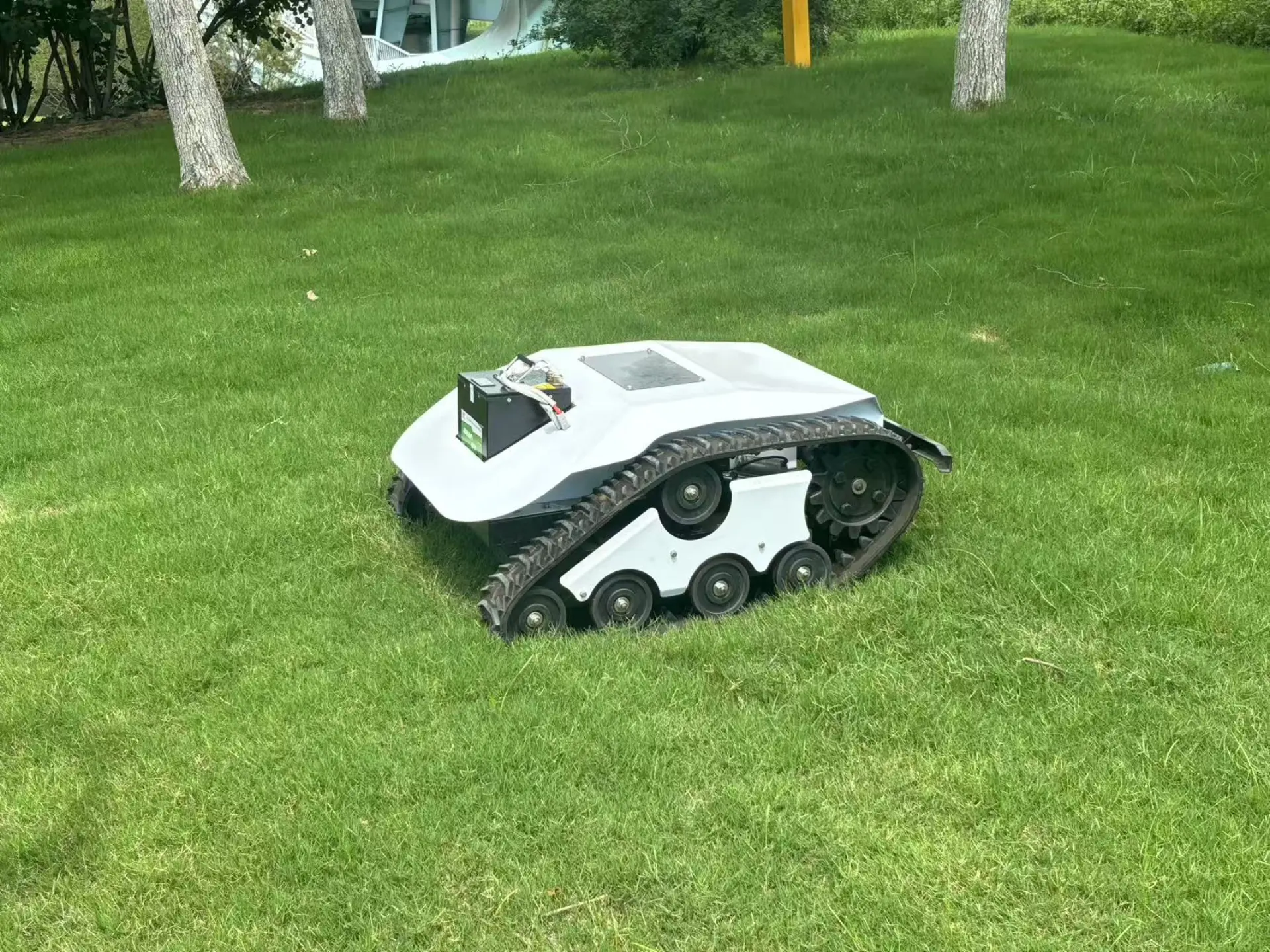
Super Mowers lists two remote-control mowing platforms: the wheeled DY-550L and the tracked DY-550D. It is tempting to treat the tracked platform as the wet-ground answer and the wheeled platform as the dry-ground answer. That shortcut is not supported.
Tracks and wheels distribute load and apply traction differently, and that difference can change how a given surface responds. But the outcome still depends on the actual machine configuration, its weight and load, the route, the number of passes, the turning pattern, and the specific soil condition. A tracked machine on saturated ground can still leave marks; a wheeled machine on firm ground may leave none. Neither design eliminates rutting, and neither should be promised as damage-free.
The practical use of the tracked-versus-wheeled distinction is as a question to raise during assessment, not as a permission slip. If a site is marginal, the supervisor should ask whether the platform under consideration has been assessed for that ground condition, and should consult the applicable manual and the site owner before proceeding. The comparison article on tracked versus wheeled remote-control mowers covers selection criteria; it is not a wet-ground operating approval.
A field observation and escalation sequence
A repeatable sequence helps a crew make the same decision twice and explain it later. The steps below are observation and escalation steps, not a technical soil test. They are designed to be completed before the machine is deployed, and to produce a clear handoff when the answer is uncertain.
Identify standing water, prior wheel marks, soft access and site constraints
Start with a walk of the route, not the whole property. The relevant area is where the machine will actually travel, turn, and enter. Look for standing water in low spots and along drainage lines; water that has not drained is a direct sign the surface is holding moisture. Check the access route, because a soft gateway can stop a job even when the main lawn looks firm.
Look for prior marks. Old ruts, compressed strips, and tire or track impressions from earlier work tell you how the surface has behaved under load. Fresh marks from a vehicle that crossed after the rain are stronger evidence than marks from last season. Note where they are and what produced them, if that is known.
Application review
Discuss your mowing application.
Share the working condition, target market, product family and project scope.
Check the site constraints that affect the decision: slopes, banks, ditches, buried services, irrigation heads, and areas the owner has marked as sensitive. These are not just safety items; they change where the machine can turn and therefore where stress concentrates. A site with limited turning space may need a different plan even when the ground is firm.
| Observation | What it suggests | Action before deployment |
|---|---|---|
| Standing water in low spots | Surface is holding moisture; drainage is slow | Pause that area; ask site owner to review |
| Fresh tire or track marks after rain | Surface has already deformed under load | Record location and pause the route |
| Soft or spongy ground underfoot | Bearing capacity may be reduced | Escalate to supervisor and site owner |
| Firm ground, wet grass only | Leaf moisture, not necessarily soil saturation | Proceed with deck/discharge checks per manual |
| Limited turning space on soft ground | Turning stress concentrated | Re-plan route or pause for review |
| Unknown drainage or buried services | Site-specific risk not assessed | Stop and obtain site guidance |
Stop and obtain site and manufacturer guidance when suitability is uncertain
When the observations are mixed or unclear, the correct action is to stop and escalate rather than to test the ground with the machine. "Testing" by driving onto a suspect area converts an uncertainty into possible damage, and it puts the crew in the position of discovering the limit after the fact.
The escalation should go to two parties. The site owner or manager can confirm the ground conditions, drainage history, sensitive areas, and whether the work can be deferred or re-routed. The manufacturer's published manual and support channel can confirm what the specific model is documented to do. Neither party should be asked to approve a condition the other has not seen; the supervisor's job is to present the observations clearly so both can respond.
A useful escalation message states what was observed, where, and when, and what decision is needed. For example: standing water at the north gateway, fresh tire marks along the access strip, soft ground underfoot at the turning head, machine not yet deployed, requesting site review before scheduling. That message gives the site owner something to act on and creates a record if the decision is disputed later.
Record the decision and recovery

A pause that is not recorded becomes a scheduling problem later. The record should separate what was seen on the ground from what happened to the job, so that a supervisor reviewing the week can tell whether the site was held for conditions, for access, or for another reason.
Separate a soil-condition observation from the schedule status
These are two different records and they answer two different questions. The soil-condition observation says what the crew saw: standing water, soft ground, prior marks, location, time, and who observed it. The schedule status says what happened to the work: paused, re-routed, partially completed, or reassigned. Mixing them produces a log that cannot be audited.
A simple structure works better than free text. The rain-delay log approach used for commercial scheduling can hold the schedule status, while a separate field note holds the condition observation. The point is not to create paperwork for its own sake; it is to make the next decision faster and to give the site owner a clear account.
| Record element | What to capture | Why it matters |
|---|---|---|
| Date and time of observation | When the site was walked | Shows conditions at decision time |
| Location | Specific area, gateway, or turning head | Allows targeted reassessment |
| Observed condition | Water, soft ground, prior marks, bare turf | Separates evidence from opinion |
| Machine status | Not deployed, paused, withdrawn | Confirms no work occurred |
| Schedule status | Paused, re-routed, deferred | Keeps the job record accurate |
| Who was notified | Site owner, supervisor, manufacturer contact | Establishes the escalation path |
| Reassessment owner | Named person and expected review point | Prevents the pause being forgotten |
Specify who reassesses and how to report damage without prescribing remediation
Every pause needs a named owner for reassessment. In most commercial arrangements that is the site supervisor, who confirms the ground condition has changed and authorizes the work to resume. The crew should not resume on its own judgment if the original pause was escalated, and the site owner should not be asked to approve a resumption they have not seen.
If damage is found, report it factually: location, extent, apparent cause if known, and whether it predates the crew's visit. Do not prescribe a repair method unless the site owner or a qualified turf professional has specified one. Compaction, rutting, and surface damage can require different responses, and the appropriate treatment depends on soil, turf species, season, and site use. The crew's role is to report accurately and to follow the site's instruction.
This is also where the limits of this article should be clear. It does not provide a waiting time after rain, a soil-moisture threshold, a load limit, or a slope rule. Those depend on the specific machine's manual, the site's own risk assessment, and the judgment of the responsible supervisor. The value of the sequence is that it produces a defensible decision and a record, not that it replaces site-specific guidance.
FAQ

Does wet grass always mean wet soil?
No. Leaf moisture and soil saturation are different conditions. Grass can be wet from dew or a light shower while the ground beneath remains firm, and ground can stay soft after the surface has dried. Check the surface underfoot and look for standing water and prior marks before deciding.
Do tracks eliminate rutting?
No. Tracks and wheels distribute load and apply traction differently, but rutting depends on the actual machine, its load, the route, turning, and soil condition. A tracked machine can still leave marks on saturated ground. Treat the platform choice as a question for assessment, not as a guarantee.
How long should a crew wait after rain?
There is no single answer. Waiting time depends on soil type, drainage, the amount and intensity of rain, the machine, and the route. This article does not set a waiting time; the supervisor should assess the specific site and consult the site owner and the applicable manual before resuming.
Conclusion

Wet grass is a mowing question; soft ground is a load-bearing question. Walk the route, look for water and prior marks, pause when the surface is uncertain, and record the decision with a named owner for reassessment.
For scheduling and handover context, see the commercial mowing rain delay log and the tracked versus wheeled remote-control mower comparison.