

 By Anna
Tracked vs wheeled remote control mower: neither chassis is automatically the best choice for every commercial property. Tracks can provide a useful contact area on some soft or uneven surfaces; wheels can offer advantages where turf finish, tire selection, and frequent hard-surface travel matter. But slope capability, traction, ground disturbance, and service costs depend on the actual mower model, its weight and drive system, the fitted cutting deck, and the conditions at the site.
This worksite selection guide helps landscape contractors, municipal grounds teams, and equipment distributors compare those factors before requesting quotes. It is a buyer’s comparison framework, not an operating procedure or an endorsement of a specific SuperMowers machine. Always verify the latest model manual and have the responsible site team review operating conditions before selecting equipment.
Start with the worksite, not the chassis label

Start by describing where the mower must work, what it must cut, and which problems cost your crew the most time. A chassis that performs well on rough roadside vegetation may not be the right choice for a high-visibility lawn, even if both machines have similar cutting widths.
- Fine or finished turf: Record the importance of appearance, existing turf condition, irrigation schedules, and the potential cost of scuffing or rut repairs.
- Soft, wet, or loose ground: Record the conditions in which work must occur, but do not treat a tracked undercarriage as permission to mow saturated or unstable soil.
- Slopes and uneven terrain: Map the actual grades, changes in direction, surface conditions, and obstacles. Request model-specific limits for the relevant configuration.
- Mixed routes: Include gates, hard paths, curb transitions, loading ramps, and any travel between separate mowing zones.
- Fleet operation: Account for service access, parts availability, transport weight, and the amount of time the machine will spend working versus moving between sites.
First decision: Is the main challenge a traction or access problem, a turf-quality problem, or a fleet logistics problem? Answering that question usually narrows the shortlist more effectively than choosing tracks or wheels by appearance.
Tracked vs wheeled remote control mower: the comparison that matters

These are potential design tradeoffs, not guaranteed performance advantages. Compare them using current manufacturer documents and a demonstration on comparable ground.
Important: Wider contact does not guarantee less turf damage. A tracked machine may spread load over a larger area yet still disturb grass during a tight turn. A wheeled machine may cause rutting if its weight, tires, and ground conditions are poorly matched. Neither chassis is inherently better without a configured model and worksite to compare.
Five worksite conditions that can change the answer

1. Finished lawns, parks, and sports grounds
For maintained turf, the question is not simply whether the mower can drive across the grass. Ask how it turns, whether its tires or tracks mark the surface, and how the deck affects finish quality. A wheel-equipped model with turf tires may be worth reviewing, but a properly configured track mower may also be suitable.
Request a demonstration that includes normal turns and the same cutting pattern planned for the site. Check the surface afterward under the site’s approved review process. Do not accept a claim of “no turf damage” without seeing the behavior of the proposed machine.
2. Soft ground, drainage areas, and variable soil
Tracks may be considered where a buyer needs more distributed contact or where the ground varies across a route. However, flotation also depends on total machine mass, the actual contact patch, soil moisture, and travel conditions. Wheels with suitable tires can also work on some soft sites.
Ask for comparable contact or ground-pressure information, noting how each manufacturer calculated it. Ground pressure alone does not settle traction or whether a particular surface can support a machine.
3. Slopes, embankments, and roadside vegetation
Do not assume a tracked remote mower can use a steeper slope than a wheeled one. Some wheeled remote-control mowers are designed specifically for slope work. For example, the manufacturer’s SPIDER ILD02 product information describes four-wheel drive and an integrated hydraulic winch. Conversely, Agria’s 9500-90 product information describes a tracked remote-control mower and publishes its own model-specific slope and chassis data. These are examples of different designs, not a controlled performance comparison.
A slope figure must be read with its test or operating conditions: surface, moisture, direction of travel, configuration, and any required stabilizing system. A brochure maximum must not be treated as permission to operate at that angle on an unreviewed site. Ask for the current operator manual and any certification or test notes applicable to the exact model.
4. Pavement, curbs, gates, and trailer ramps
For contractors who move a mower between campuses or customer properties, chassis choice can affect loading and site access as much as mowing. Record the narrowest gate, trailer opening, ramp specification, surface transitions, and the machine’s actual transport configuration.
Check the full outside width, not only cutting width. Confirm whether the installed tracks, tires, guards, and cutting attachment affect fit. Any loading, ramp, or transport arrangement must follow the manufacturer and trailer instructions.
Application review
Discuss your mowing application.
Share the working condition, target market, product family and project scope.
5. Multi-site fleets with limited service support
Do not assume tire repairs are always inexpensive or that tracked systems always cost more to maintain. The relevant comparison is the parts and labor required by the quoted machines, expected use, and dealer support in your region.
Request replacement tire or track prices, drive-system service items, inspection intervals, estimated part lead times, and the nearest qualified service contact. A lower purchase price may be less attractive if seasonal downtime disrupts several customer contracts.
Compare manufacturer specifications on the same basis

Two quotes are only useful side by side when their configurations and definitions are clear. If a supplier offers different decks, power systems, or stabilizing accessories, record those differences instead of attributing every performance change to the chassis.
Manufacturer information also shows why wheel and track specifications should not be treated as generic categories. RAYMO’s TORPEDO platform, for example, documents several tire options for its wheeled platform. Agria publishes track-machine data for its own models. Ask each vendor to specify the exact version being quoted; a feature available on one configuration is not automatically available on another.
Keep remote mowers separate from other tracked machines
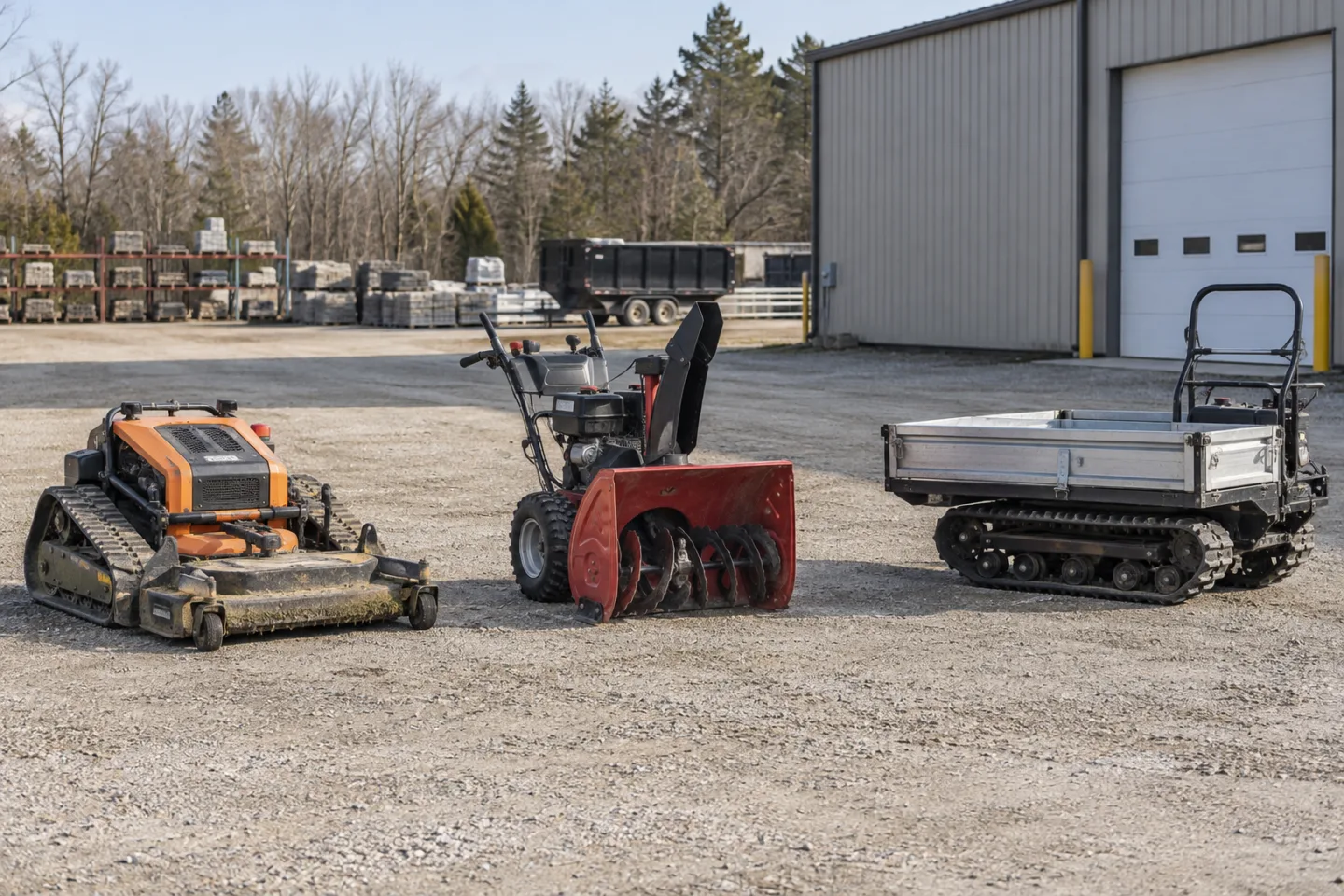
A tracked chassis does not turn a mower into a snow blower or a general-purpose tracked carrier. The applicable controls, guarding, attachments, weight distribution, and maintenance requirements can differ substantially between these equipment classes.
- Dedicated remote-control mower: Compare the specified cutting system, travel chassis, remote control, and limits in the mower manual.
- Tracked carrier with a mower attachment: Verify that the manufacturer approves the exact deck, attachment interface, control functions, and operating configuration.
- Snow or non-mowing equipment: Create a separate evaluation; do not transfer mower slope, traction, or safety assumptions to snow-clearing tasks.
If a quotation bundles multiple applications, ask the supplier to separate them into distinct configurations with their own manuals, permitted uses, and prices.
A six-step selection process for contractors and distributors

- Map the work package. Record mowing zones, surfaces, vegetation, obstacles, access widths, and the proportion of work on finished turf or rough ground.
- Identify the costly failure. Is it loss of traction, rut repair, inaccessible gates, unsuitable cutting performance, or maintenance downtime?
- Choose comparable candidates. Shortlist at least one tracked and one wheeled model when both are genuinely available and suitable for the job. If not, record why.
- Verify the documents. Compare model and attachment details, operating limits, manuals, service schedules, and support—not generic category claims.
- Arrange a controlled demonstration. With the supplier and responsible site personnel, agree on the representative conditions and what evidence can be recorded. Do not use a demo to bypass the manual or site restrictions.
- Document the decision. Record the selected configuration, the remaining limitations, the approving authority, and how the fleet will obtain service and parts.
For repeat purchasing, keep the same worksite fields and evaluation criteria across all bids. This gives procurement teams a defensible explanation for why one chassis was selected for a particular route without claiming it is the best choice everywhere.
Manufacturer sources and a quote-ready inquiry

The following manufacturer pages illustrate why chassis choice must be linked to a specific model. They are examples for research, not an independently tested head-to-head ranking:
- SPIDER ILD02 model information — a wheeled remote-control slope mower with model-specific drive and stabilizing-system details.
- Agria 9500-90 model information — a tracked mower with published chassis, ground-pressure, and cutting specifications.
- RAYMO TORPEDO platform information — a wheeled platform with manufacturer-described tire configuration options.
For a useful tracked vs wheeled remote control mower quotation, send suppliers these details: property or contract type; mapped terrain and surface conditions; required cutting task and deck; narrowest gate and trailer constraints; expected annual use; and local service requirements. Ask them to identify the exact model, applicable manual revision, and any unresolved suitability questions in writing.
Bottom line: Compare the actual machines, not just tracks versus tires. The right commercial remote mower is the one whose documented cutting capability, site access, ground interaction, operating limits, and service plan fit your work package. A chassis label is a starting point—not a purchase specification.
Video: Ventrac: Tires Vs Tracks | Full Comparison on Real Terrain (third-party)
