
 By Anna
You want to stop bagging every week, or you want a cleaner finish before an event, and the choice between mulching vs bagging grass suddenly matters. The real decision is not which method is easier, but which one fits this lawn, this week’s growth, and your mower’s approved setup.
Returning clippings usually suits a healthy, evenly growing lawn cut at the right height, while collection helps when clippings clump, grass is long, or a known problem area needs cleaner removal. Neither method works unless the mower is configured as the manufacturer specifies for that model.
This guide separates the horticultural question from the equipment question, because both decide the result.
Mulching vs bagging grass: What mulching and bagging actually change

Mulching and bagging differ in where the clippings end up, and that single difference drives most of the practical consequences. Returning clippings keeps the cut material on the surface; bagging removes it from the lawn. Everything else — nutrient cycling, surface appearance, thatch questions, and equipment requirements — follows from that.
Terminology matters here. “Mulching” is often used loosely for two different things:
- Returning clippings: the mower discharges cut grass back onto the lawn, where it dries and breaks down.
- Mulching as a cutting function: a deck or attachment designed to cut clippings into smaller pieces and distribute them within the canopy, rather than leaving them in a visible row.
A standard side-discharge deck that leaves clippings on the lawn is returning clippings. It is not automatically a mulching deck, and removing a collection bag does not convert one into the other. Whether a specific mower supports a mulching configuration depends on its manual and approved attachments, not on how the deck looks with the bag off.
Bagging, by contrast, is straightforward in principle: clippings travel into a collection system and leave the lawn. The tradeoffs are handling, volume, and what you do with the material afterward.
| What changes | Returning clippings | Collecting clippings |
|---|---|---|
| Where clippings go | Stay on the lawn surface | Removed into a bag or container |
| Visible residue | Usually light if grass is short and dry | Minimal on the lawn surface |
| Handling work | None beyond mowing | Emptying, transporting, disposing or composting |
| Nutrient return | Clippings remain in the system | Material leaves the lawn |
| Equipment requirement | Deck must be set up as the manual allows | Collection bag or system must be approved for the model |
| Main risk | Clumping when grass is long or wet | Extra labor and material to manage |
Neither column is universally better. The useful question is which one matches the lawn condition in front of you.
When returning clippings fits the lawn

Returning clippings fits best when the lawn is actively maintained, the grass is cut before it gets long, and the clippings can spread thinly enough to dry. University of Minnesota Extension notes that lawn clippings are commonly recycled on the lawn, and that this practice returns nutrients and organic matter rather than sending them to waste (University of Minnesota Extension).
That general guidance comes with conditions. Clippings that sit in thick, wet clumps shade the grass beneath them and look untidy. The practical signals that returning clippings is working include:
- Clippings scatter across the surface rather than forming rows or lumps.
- Grass is dry when cut.
- The cut removes roughly a third or less of the blade height, so the removed material is modest.
- The lawn is growing evenly, without large patches of overgrown grass.
- The deck is set up for the discharge pattern you are using.
Texas A&M AgriLife Extension’s mowing guidance for warm-season turfgrasses treats mowing frequency, cutting height, and clipping dispersal as connected decisions, and notes that conditions such as weed propagules can affect how clippings should be handled (Texas A&M AgriLife Extension). In other words, returning clippings is a maintenance habit that depends on regular cutting, not a one-time switch.
What returning clippings does not guarantee
Leaving clippings is not a claim that a lawn needs no other care. It does not replace appropriate fertilization, watering, or thatch management decisions. It also does not mean every lawn should stop collecting; the practice fits normal maintenance, not every situation.
When collection needs consideration

Collection deserves consideration when the clippings cannot be left in a thin, dry layer. The most common triggers are practical rather than technical:
- Heavy clumping. Long, wet, or thick grass produces clumps that smother the surface and look poor.
- Overgrown sections. If part of the lawn got away from you, the first cut produces far more material than the surface can absorb.
- Known problem areas. Where a lawn disease or weed issue has been identified, removing clippings may be part of the recommended response. Identification and any treatment decision belong with appropriate local expertise and product labels, not with a mowing article.
- Appearance requirements. Some properties, events, or clients expect a clean surface with no visible residue.
- Material handling needs. Sometimes the clippings are wanted elsewhere, such as for compost.
University of Minnesota Extension’s guidance supports recycling clippings as the usual approach while recognizing that clumping, disease concerns, and equipment requirements can justify collection. That framing is useful: collection is an exception with reasons, not a default that must be justified.
A practical test before switching methods
Before deciding to collect, look at the lawn after a pass with clippings returned. If you see distinct rows, dense lumps, or clippings stuck to the surface in mats, the material load is too high for the current cutting routine. The response can be either to collect that cut, or to adjust the cutting routine — shorter intervals, a different height, or drier conditions — so returning clippings works again. Both are legitimate; the choice depends on what the lawn needs and what the equipment allows.
Application review
Discuss your mowing application.
Share the working condition, target market, product family and project scope.
| Signal after mowing | What it suggests | Possible response |
|---|---|---|
| Thin, scattered clippings that dry quickly | Returning clippings is working | Keep the current routine |
| Rows or lumps of clippings | Material load too high for the pass | Collect this cut, or cut more often |
| Wet clippings stuck in mats | Grass too long or too wet | Wait for drier conditions or collect |
| Clippings in a known problem patch | Site-specific concern | Confirm the issue with local expertise before deciding |
| Clean surface required | Appearance or client expectation | Collect and manage the material |
Check the mower’s approved configuration

The equipment side is where assumptions cause the most trouble. Collection bags, discharge chutes, mulching plugs, and mulching kits are model-specific. Whether a mower can collect, return, or mulch clippings depends on what its manual and approved attachments specify for that exact model and configuration.
Three points are worth keeping straight:
- A collection bag is an approved accessory, not an optional extra you can improvise. If your mower is set up to collect, the bag or container specified for it is part of the machine’s intended configuration.
- Removing the bag is not the same as enabling mulching. On many mowers, taking the bag off changes where clippings discharge, but it does not create a mulching function. A mulching plug or kit, where offered, is a separate approved part.
- Guards and deflectors stay in place. Discharge chutes, deflectors, and other protective components exist for a reason. Do not remove or bypass them to change how clippings behave. If you want a different clipping pattern, the correct route is the manufacturer’s approved configuration for your model.
Super Mowers publishes model and attachment documentation through its resources section; use the documents for your specific machine rather than assuming a feature carries across a product family. If you are still choosing equipment, the product catalogue is the place to check each model’s stated configuration — feature by feature, not by category.
A configuration checklist
| Question | Where the answer comes from | Why it matters |
|---|---|---|
| Does this model support a collection bag? | Model manual and approved accessory list | Confirms collection is an intended configuration |
| Is a mulching plug or kit offered for this deck? | Model manual and parts documentation | Distinguishes real mulching from bag removal |
| What discharge setup does the manual specify? | Model manual | Keeps the deck in an approved state |
| Are guards and deflectors fitted as delivered? | Manual and machine inspection | Protective components must remain in place |
| What does the manual say about cutting height and conditions? | Model manual | Connects the setting to the clipping result |
If any answer is unclear, treat it as unconfirmed rather than assuming. A quick check of the manual is faster than managing a deck in a configuration it was not designed for.
Use a short decision table for the next visit

A brief record before each cut keeps the decision practical and repeatable. It is not a disposal policy or a composting guide; it is a way to match the method to the lawn on the day.
| Record | Example entry | Why record it |
|---|---|---|
| Grass length and condition | Short and dry / long after rain | Drives clumping risk |
| Clipping dispersal last cut | Scattered / rows / clumps | Shows whether returning works |
| Purpose of this cut | Routine maintenance / pre-event cleanup | Sets the appearance target |
| Mower configuration | Bag fitted / discharge as manual specifies | Confirms approved setup |
| Items to confirm | Mulching kit availability for this model | Flags open questions |
For lawn owners, this can be a note on the phone. For landscape maintenance crews and buyers configuring decks, the same fields become a handover record: which machine, which attachment, which setting, and what still needs confirming with the manual or supplier. That record is also useful when a client asks why clippings were collected on one visit and left on another.
FAQ

Do clippings always need a special mulching mower to stay on the lawn?
No. Many mowers return clippings through their normal discharge setup, and the clippings break down on the surface. A dedicated mulching configuration — a plug or kit designed to cut clippings finer and distribute them — is a separate feature. Check your model’s manual to see what it supports.
Does leaving grass clippings automatically cause thatch?
No. Thatch is a layer of undecomposed stems, roots, and debris between the grass and the soil surface, and its development depends on several factors, not clippings alone. Clippings that are spread thinly and break down are part of normal nutrient cycling. Heavy clumps are a different problem: they smother grass and look poor, which is a reason to adjust cutting or collect, not proof that clippings cause thatch.
Can the collection bag simply be removed?
Removing the bag changes where clippings go, but it does not give the mower a mulching function. Whether a bag-off configuration is acceptable, and whether a mulching plug or kit is available, depends on the specific model’s manual and approved attachments. Never remove guards or deflectors to change the discharge pattern; use the configuration the manufacturer specifies.
Conclusion

Match the method to the lawn: return clippings when grass is short and dry, collect when clumps or conditions call for it, and confirm your mower’s approved setup in its manual before changing anything.
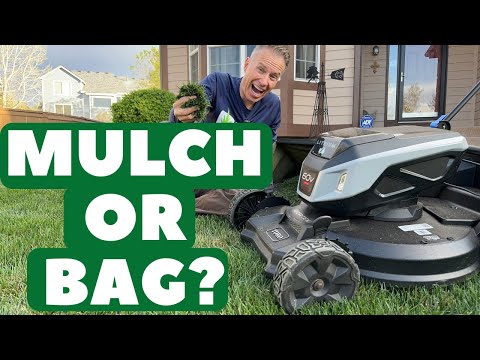
Video: Mulching vs. Bagging Grass Clippings: Which is Better for Your Lawn?