

 By Anna
Commercial self-propelled electric lawn mowers can reduce dependence on gasoline equipment, but the right machine depends on the work area, operator arrangement, battery system, and verified terrain limits. A battery-powered walk-behind mower, an electric remote-control slope mower, and an autonomous robotic mower are different equipment categories. Buyers should identify which one the job requires before comparing cutting width, slope ratings, runtime, or fleet cost.
This guide explains the technical specifications to request, how to read slope claims, and how to build a comparable fleet procurement request. It is intended for commercial landscaping contractors, municipal grounds teams, solar-site maintenance buyers, and equipment distributors. It is a purchasing framework—not a field operating procedure, terrain approval, or statement of specifications for any unverified Super Mowers model.
What counts as a commercial self-propelled electric lawn mower?
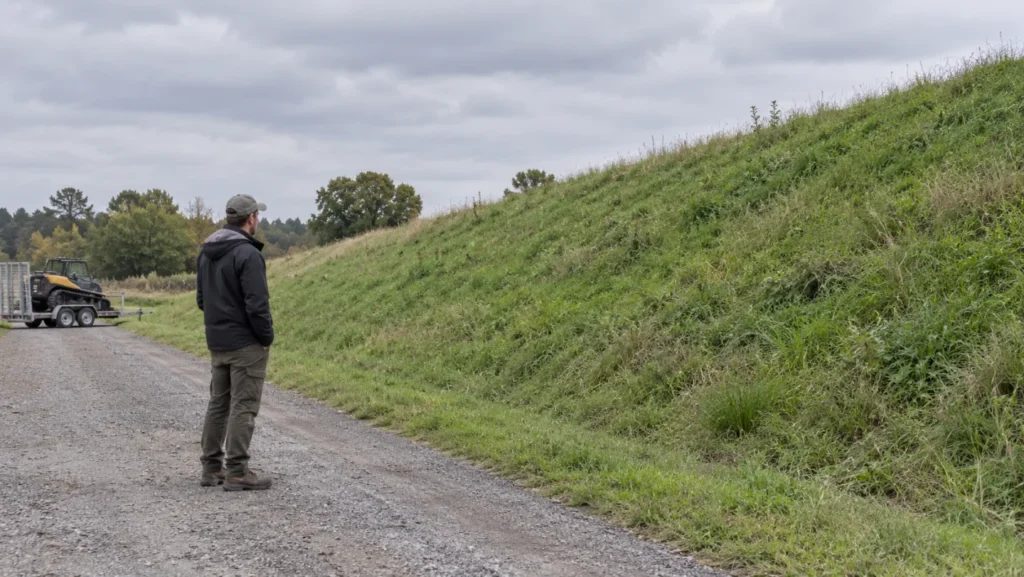
Self-propelled means the mower’s drive system moves the machine rather than requiring the operator to supply all its forward motion. The term alone does not say whether the machine is guided from a handle, remotely steered, or navigates autonomously. Likewise, an electric drive system does not automatically establish that the cutting system is electric or that the machine is entirely battery-powered.
For a real walk-behind example, Husqvarna lists the W520i as a battery-powered commercial mower with variable-speed self-propulsion and a 20-inch cutting width. By contrast, Raymo describes its TORPEDO platform as a remotely controlled, four-wheel-drive carrier with mower-deck and electric or plug-in hybrid power options. Neither example proves the capabilities of another manufacturer’s machine.
Procurement rule: Specify the mower class first. Do not attach a tracked slope mower’s advertised capabilities to a conventional walk-behind machine simply because both are electric and self-propelled.
Electric mower specifications commercial buyers should verify
A usable quotation identifies the exact machine, cutting configuration, batteries, and operating mode. Labels such as “heavy duty,” “high torque,” and “industrial grade” are not substitutes for measurable data.
Do not confuse rated power, peak torque, and cutting performance
A brushless motor may offer responsive electronic speed control, but that does not guarantee constant blade speed in dense or wet vegetation. Request the manufacturer’s continuous-power information, controller limits, deck details, and test results at representative cutting loads. The interaction between motor, battery, blade, and vegetation matters more than a peak wattage or torque claim standing alone.
How to read commercial electric mower slope capabilities
Slope capability deserves a separate review because a published number may describe different tests or operating conditions. A maximum climbing claim, a static stability figure, and a permitted mowing slope are not interchangeable. A remote controller can place the operator away from the mower, but it does not eliminate a machine’s loss-of-traction, sliding, overturning, bystander, or thrown-object hazards.
Some supplier literature gives slope in degrees; other literature uses percent grade. These are different units. For reference, a 45-degree slope equals a 100% grade; a 30% grade is approximately 16.7 degrees. Always record the unit before comparing models.
Raymo’s manufacturer discussion of slope ratings cautions that some high advertised ratings refer to static stability or require a tether, and that wet grass affects traction. The precise limit for any proposed mower still has to come from its current manual and the intended work conditions.
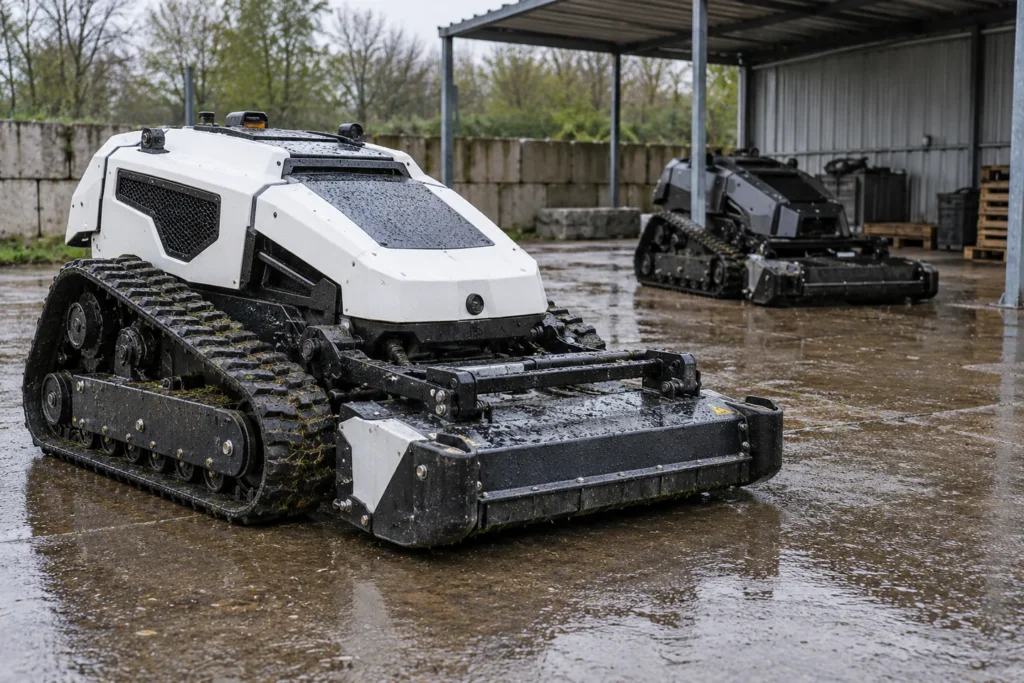
Do not assume that a battery-powered motor permits operation at every machine angle. The mower’s stability, traction, battery and cooling systems, deck lubrication or gearboxes if installed, and other model-specific components still impose limits. Similarly, a gasoline mower’s approved slope cannot be reduced to one universal number.
Wheels vs. rubber tracks: traction and turf impact
Wheel and track configurations both appear in commercial remote-mowing equipment, but neither automatically wins on every surface. Track designs can distribute weight across a larger nominal contact area; actual ground pressure and turf effects depend on operating weight, track contact, soil condition, and how the mower turns. Tight counter-rotation may disturb turf even when nominal ground pressure is low.
For a soft-ground or solar-site project, request the ready-to-work mass, effective ground-contact dimensions, turning method, and any documented surface-impact testing. Do not accept claims such as “no rutting,” “zero erosion,” or a precise pounds-per-square-inch rating without test conditions and model-specific evidence.
Battery runtime, charging, and the full commercial shift
Battery energy and usable cutting time answer different questions. A battery specification in watt-hours indicates stored energy, but runtime depends on cutting load, propulsion load, grass condition, temperature, travel time, and the machine’s control strategy. Manufacturer estimates may not reproduce on a particular contract.
STIHL explicitly notes in its battery working-range chart that estimates vary with application and use. The same caution should shape any remote mower or commercial fleet quote.
Build a shift-level energy worksheet
- Record the cutting area and representative vegetation for each route.
- Ask the supplier for usable battery energy, measured runtime, and area covered under stated conditions.
- Separate actual blade-on mowing time from travel, repositioning, setup, and waiting.
- Record charger input requirements and recharge time for the quoted battery configuration.
- Calculate spare-battery, charger, or additional-machine needs from the expected shift—then confirm them in a controlled demonstration under the applicable safety plan.
Simple planning relationships: Estimated energy per acre = measured charging energy (kWh) ÷ acres completed. Electricity cost per acre = energy per acre × the site’s electricity price per kWh. These are accounting formulas, not predicted performance figures. Include charging losses when using energy measured at the electrical outlet.
Match the mower category to the commercial application
Routine commercial lawns and managed grounds
For campuses, office parks, and maintained turf, a variable-speed battery walk-behind may be a useful candidate where the site, shift length, mowing width, and operator requirements fit. Compare the cutting finish, bagging or discharge options, battery changes, and ease of transporting multiple machines between stops.
Application review
Discuss your mowing application.
Share the working condition, target market, product family and project scope.
Solar facilities and low-clearance areas
A low-profile remote mower may warrant review where access is constrained. Record the actual lowest panel or structure clearance, gate widths, cable and foundation locations, approved exclusion zones, and vegetation conditions. Do not assume a quoted mower fits beneath arrays simply because its chassis is described as low profile. Under-panel access and nearby electrical assets remain subject to the facility owner’s rules.
Embankments, retention basins, and utility rights-of-way
These applications require documented site segmentation and owner-defined constraints. Before asking for slope-mower prices, identify the work that is genuinely mechanical mowing, the locations requiring specialist review, and any traffic, utility, drainage, environmental, or public-access restrictions. Remote operation does not itself authorize work near roads, railways, utility infrastructure, or water.
Noise-sensitive sites
Electric machines remove engine exhaust at the point of use, and their acoustic profile may differ from combustion mowers. However, blades, decks, tracks, wheels, and other moving components still make noise. Compare measurement conditions and actual site limits instead of relying on an unsupported decibel claim or an assumption that all electric mowers may operate during restricted hours. The US EPA notes electric lawn equipment as one option for reducing pollution compared with gasoline alternatives; this does not mean electricity generation or battery production has no environmental impact.
Electric vs. gasoline: use a fair fleet comparison
A useful fleet analysis compares machines performing the same work at acceptable quality—not unlike deck sizes, different terrain classes, or one manufacturer’s best-case test against another’s worst-case result.
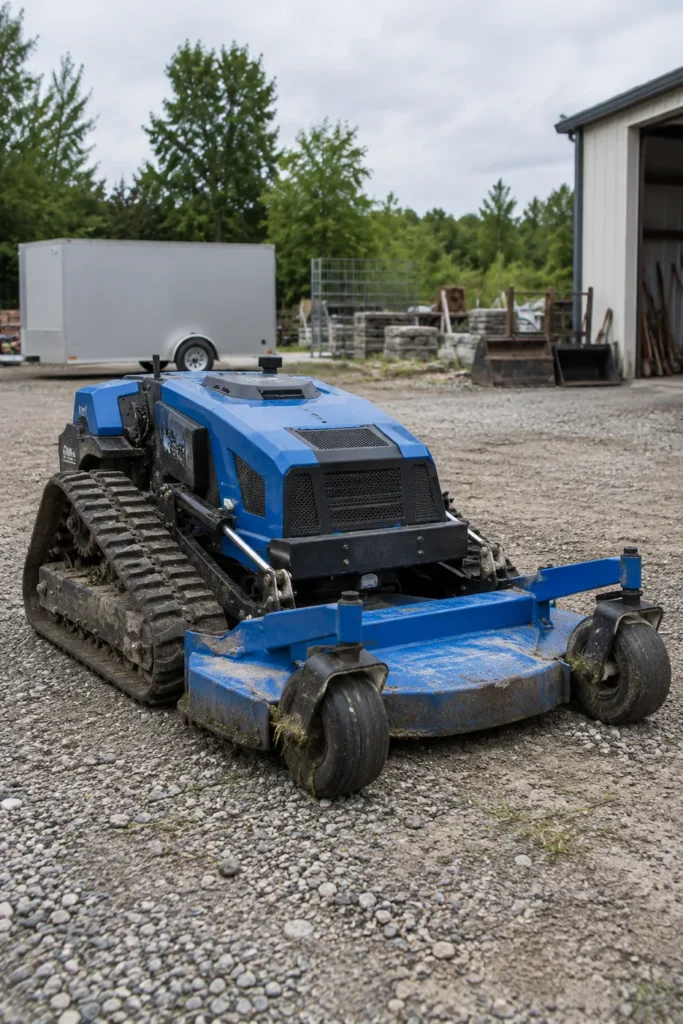
A battery-electric mower may avoid engine oil changes and spark-plug service, but it is not maintenance-free. Cutting systems, bearings, transmissions or gearboxes if installed, drive hardware, controls, batteries, and charging equipment still require inspection or servicing according to the manual.
How to calculate total ownership cost without an invented payback claim
Do not assume a fixed electricity saving, a three-person labor replacement, or payback within the first season. Results depend on local energy prices, actual acres cut, equipment cost, battery life, staffing, maintenance, and utilization. The US Department of Energy’s acquisition guidance recommends considering operating, maintenance, replacement, and end-of-life costs in addition to the initial purchase.
For every shortlisted mower, estimate a defined ownership period using the same scope:
- Initial investment: mower, battery packs, chargers, accessories, delivery, and training.
- Annual operating expense: measured electricity or fuel, paid crew hours, transport, routine consumables, and insurance or other site-specific costs where applicable.
- Maintenance and downtime: planned service, repair labor, parts, replacement packs, downtime hours, and backup capacity.
- End-of-period value: expected resale or residual value and any disposal or recycling charges.
Total ownership cost = acquisition + operating costs + maintenance and replacement + downtime costs − residual value, using the same ownership horizon and consistently defined inputs. Divide by actual or forecast acres completed over that period to obtain a cost-per-acre comparison. State clearly which values are verified and which are assumptions.
Fleet demonstration and supplier acceptance checklist
Before a fleet-wide purchase, ask the supplier to demonstrate the exact offered configuration on representative, authorized work areas with a qualified operator and approved safety controls. A trial should be scoped and documented, not used to test unapproved slopes or bypass site restrictions.
- Confirm the demonstrated unit matches the quoted deck, battery, drive, and control configuration.
- Record the site’s authorized test area, grass conditions, and measured site constraints.
- Measure usable work output, cut finish, battery or fuel use, and interruptions.
- Check machine access and transport dimensions against the actual gates, staging areas, and trailer configuration.
- Review the maintenance schedule, replacement blade and battery supply, warranty exclusions, service response, and expected parts lead times.
- Identify operator training, current manuals, labels, and any model-specific documentation required for the intended market.
- Record open questions and obtain written supplier clarification before acceptance.
Commercial electric mower RFQ: what buyers should send
A clear request for quotation (RFQ) saves time because it lets suppliers identify suitable configurations—or explain why a proposed mower cannot be approved for part of the work.
- Organization and location: country, operating region, delivery location, and service expectations.
- Machine class: walk-behind self-propelled, operator-driven remote mower, or autonomous robotic mower.
- Workload: site types, acres or square meters per shift, mowing frequency, vegetation, and required cut finish.
- Terrain and access: surveyed slopes, surface conditions, gate width, under-structure height, obstacles, and transport plan.
- Power and logistics: battery preference, site electrical availability, target work window, and charging or replacement-pack needs.
- Required evidence: model manual, measured performance, permitted slope conditions, dimensional drawing, relevant compliance documents, and warranty.
- Commercial terms: quantity, sample or demonstration request, spare-parts package, lead time, training, and after-sales support.
For original equipment manufacturer (OEM) or distributor discussions, request a written model-level specification sheet before advertising custom deck widths, hot-swappable batteries, radio range, slope angles, or market certifications. Features shown on a competitor’s mower or a generic product image are not verified specifications for the quoted machine.
Frequently asked questions
Are commercial self-propelled electric lawn mowers all remote controlled?
No. Many are walk-behind mowers whose drive system assists the person steering at the handle. Remote-controlled and autonomous mowers are separate control arrangements; verify which one the product offers.
Can an electric lawn mower safely cut a 45-degree slope?
A 45-degree incline is a 100% grade, but no universal electric mower rating applies. The actual permitted working slope, direction, surface conditions, and any additional restrictions must be established by the exact manufacturer documentation and an appropriate site review. Do not use a promotional maximum as a safe working limit.
Do rubber tracks prevent ground damage?
No. Track width and contact area are only part of the result. Machine weight, soil moisture, turning method, and vegetation condition determine whether rutting or turf disturbance occurs.
Will a commercial electric mower always cost less to run than gasoline?
Not necessarily. Electricity expenditure may be attractive for some duty cycles, but total costs also include acquisition, batteries, chargers, staffing, downtime, maintenance, transport, and eventual replacement. Compare actual work completed over a consistent ownership period.
Next step: request a model-specific fleet comparison
For a commercial grounds-maintenance fleet, the most useful next step is a model-specific electric mower comparison based on your site conditions and daily workload. Send the machine class, cutting requirements, measured access dimensions, documented slopes, operating hours, expected quantity, and charging constraints through the product inquiry form. The supplier can then confirm available configurations and supporting evidence without guessing at terrain performance, safety limits, or return on investment.