
 By Anna
A dealer's parts desk receives a call for a "track wheel" on a remote-controlled tracked mower. The caller is not sure whether the worn part drives the track, guides it, or simply carries the machine's weight. Ordering the wrong one costs a return, a delay, and possibly a second failure.
The three parts do different jobs. The drive sprocket turns the track and transmits power; the idler guides the track at the opposite end; the lower track rollers support the machine's weight along the ground run. Identify each one from the specific machine's parts diagram and revision before ordering.
This article uses two separately named machines — the McConnel RoboCut and the Vigorun MTSK1200 — to show how undercarriage parts are documented, and a Caterpillar multi-terrain loader document only as general background on how a track drive and support system is arranged. None of these sources establishes the layout, roller count, or part interchangeability of any Super Mowers machine.
Remote mower tracked undercarriage drive sprocket idler roller: Identify the drive sprocket, idler and lower rollers in the named McConnel RoboCut parts documentation

The McConnel RoboCut operator and parts manual (revision 09.10.13, as published at that link) is the anchor example for this article because it documents track components in a parts-diagram format. For a parts desk, the useful discipline is to work from that diagram rather than from a verbal description of a "wheel."
A track undercarriage is a closed loop. The track is a belt of linked plates or a rubber band with internal lugs. Something has to pull that loop around, something has to hold its far end in line, and something has to stop the lower run from sagging under the machine's weight. Those three jobs map to the drive sprocket, the idler, and the lower track rollers.
Keep part identity with diagram revision
A parts diagram is only valid for the revision it belongs to. The RoboCut manual is identified as revision 09.10.13 in its filename, and that identifier should travel with any part enquiry taken from it. If a machine has been through a design change, a diagram from a different revision may show a different item number, a different quantity, or a different assembly breakdown for the same functional location.
Practical rules for the parts desk:
- Quote the manual revision alongside the item number in any internal note or supplier email.
- Check whether the diagram shows the part as a single item or as part of a sub-assembly with its own number.
- Note the quantity shown per machine, because a diagram may list several identical rollers under one item number.
- Keep a copy of the diagram page with the order record so a later query can be checked against the same source.
None of this replaces the supplier's confirmation. It simply makes the question precise enough for the supplier to answer without guessing.
Separate drive and support functions
When a customer describes a problem, the functional category narrows the search quickly. A drive sprocket is in the power path: it is connected to the final drive and its teeth engage the track. An idler is a guide: it is normally at the end of the track loop away from the drive and rotates freely. A lower roller is a support: it runs along the bottom of the track and carries load.
That distinction matters for diagnosis as well as ordering. A worn drive sprocket and a worn idler can both produce noise or track misalignment, but they are not the same part and are not ordered under the same number. A collapsed lower roller shows up differently again, often as a rough ride or a track that no longer sits evenly.
| Functional position | Job in the track loop | Typical location | What the parts desk should confirm |
|---|---|---|---|
| Drive sprocket | Engages the track and transmits drive | Connected to the final drive | Item number, tooth count or size as listed, diagram revision |
| Idler | Guides and tensions the track loop | Opposite end from the drive | Item number, whether supplied as an assembly, diagram revision |
| Lower track roller | Supports the machine along the ground run | Underside of the undercarriage | Item number, quantity per machine, diagram revision |
| Upper roller or carrier (where shown) | Holds the upper track run | Above the lower rollers | Whether the machine has one at all — confirm from the diagram |
This table is a functional framework, not a parts list for any specific machine. The right-hand column is deliberately written as questions, because the answers must come from the named machine's documentation.
Compare the named Vigorun MTSK1200 drive description with the diagram
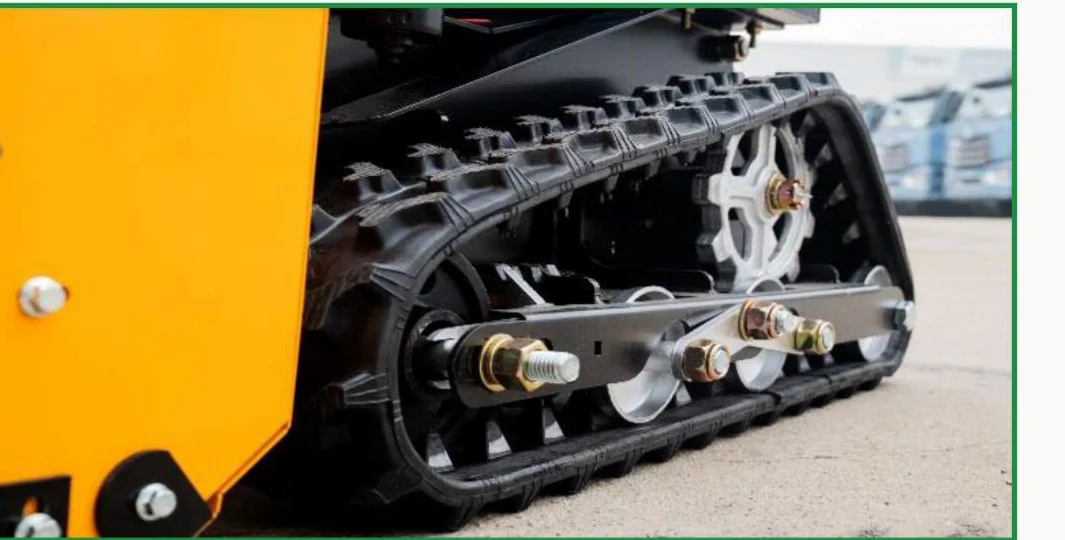
The second named example is a Vigorun MTSK1200 page that describes the machine's drive sprocket. Its value here is as a cross-check on vocabulary: a manufacturer describing a drive sprocket in prose and a manufacturer drawing it in a parts diagram are describing the same functional position, but the words and the numbering do not automatically match.
When a dealer handles more than one brand, this is where errors creep in. A customer says "sprocket," a page says "drive sprocket," a diagram says "item 14," and a supplier catalogue says "drive wheel." The functional position may be the same; the part identity is not transferable until the specific machine's documentation confirms it.
Keep each model separate
The McConnel RoboCut manual and the Vigorun MTSK1200 description are two separate sources about two separate machines. Nothing in one validates a part number, a roller count, a tooth count, or an assembly breakdown in the other. A parts desk should treat each machine as its own file.
A workable internal convention:
- One folder or record per machine model, not per brand.
- The manual revision or page date stored with the record.
- A short note of which functional positions the diagram actually shows.
- A note of which positions the diagram does not show, so nobody assumes they exist.
That last point is the one most often skipped. If a diagram does not show an upper carrier roller, that is not proof the machine lacks one; it may simply be drawn on another page. The correct action is to check the rest of the document, not to conclude either way.
Do not infer SM roller layout
Super Mowers' public product pages list remote-controlled tracked equipment, including the remote 50 gasoline mower and the wider product range. Those pages establish that tracked remote-controlled machines are part of the range. They do not establish the number of lower rollers, the drive arrangement, the idler design, or whether any part is shared between models.
Application review
Discuss your mowing application.
Share the working condition, target market, product family and project scope.
For a dealer, the practical consequence is simple: do not populate an SM parts record by analogy with the RoboCut, the MTSK1200, or a track loader. Ask Super Mowers or the supplying distributor for the model-specific parts documentation, and record what comes back.
The Caterpillar multi-terrain loader undercarriage document is useful only at the level of general arrangement: it describes a track system with a drive, a front idler, and a run of lower rollers carrying the machine. That is background vocabulary for someone new to track systems. It is not a parts reference for a mower, and a track loader's roller count or part numbers say nothing about a remote-controlled mower.
Request the correct replacement using the machine and parts catalog

A replacement request is only as good as the identification behind it. The most common causes of a wrong part arriving are a missing serial number, a diagram from the wrong revision, and a description of the symptom rather than the part. All three are avoidable with a short, standard request format.
Before contacting the supplier, the parts desk should be able to state: the machine model, the serial number, the manual revision used, the diagram page, the item number, the quantity required, and the observed condition of the part. If any of those is missing, the request is not yet ready.
Record model and serial
Model alone is often not enough. Within one model name there can be build variations, and the serial number is what lets the supplier tie the machine to the correct parts list. Record it exactly as stamped or plated on the machine, including any prefix or suffix.
A useful request record contains:
| Field | What to enter | Why it matters |
|---|---|---|
| Machine model | Full model designation as marked | Narrows the parts list |
| Serial number | Exact characters from the machine plate | Ties the machine to a build range |
| Manual revision | Revision identifier from the document used | Prevents diagram mismatch |
| Diagram page and item | Page reference and item number | Gives the supplier a checkable reference |
| Quantity | Number required, per the diagram | Avoids short or excess supply |
| Observed condition | What the customer reported and what was found | Helps the supplier advise on related parts |
| Photos | Clear images of the part in place and of any markings | Supports identification where numbers are unreadable |
Where a part carries a cast or stamped number, photograph it. Where it does not, photograph the position and the surrounding assembly. Neither replaces the item number, but both help the supplier confirm rather than guess.
Escalate compatibility and installation to the supplier
This article does not describe how to remove or fit a sprocket, idler, or roller, and it should not be read as installation guidance. Track undercarriages involve stored tension, heavy components, and, on a mower, a cutting attachment nearby. The correct escalation path is the machine's own manual and the supplier's technical contact.
Three questions are worth asking explicitly on every undercarriage parts enquiry:
- Is this item the current part for this serial number, or has it been superseded?
- Does the item come as a bare part or as an assembly with bearings, seals, or fasteners included?
- Are there related parts that should be inspected at the same time, according to the manual?
Those questions keep the conversation inside the supplier's responsibility and out of guesswork. They also build a record that is useful the next time the same machine needs a part.
For fleet context, the flail mower maintenance checklist and fleet record article covers record-keeping practice that applies equally to undercarriage parts, and the tracked versus wheeled remote-control mower comparison explains why track systems are chosen in the first place.
FAQ

Does every tracked mower use the same number of rollers? No. Roller count is a design decision that varies by machine, track length, and load distribution. The number shown on one machine's diagram is not a rule for another. Confirm the quantity from the specific model's parts documentation, and record it per machine.
Is an idler the same part as a drive sprocket? No. They sit at different positions in the track loop and do different jobs. The drive sprocket is in the power path and engages the track to move it; the idler guides the loop and is normally at the opposite end. They are separate items with separate part numbers in the documentation that shows both.
Can a roller from another mower be substituted? Not on the basis of appearance or a similar model name. Substitution requires confirmation from the machine's supplier that the part is correct for that model and serial number. A roller that looks similar may differ in dimensions, bearing arrangement, or mounting, and this article cannot verify any cross-model fit.
Conclusion
Name the functional position, then prove the part identity from the specific machine's diagram and revision. Record model, serial, and revision before ordering, and let the supplier confirm compatibility.