
 By Anna
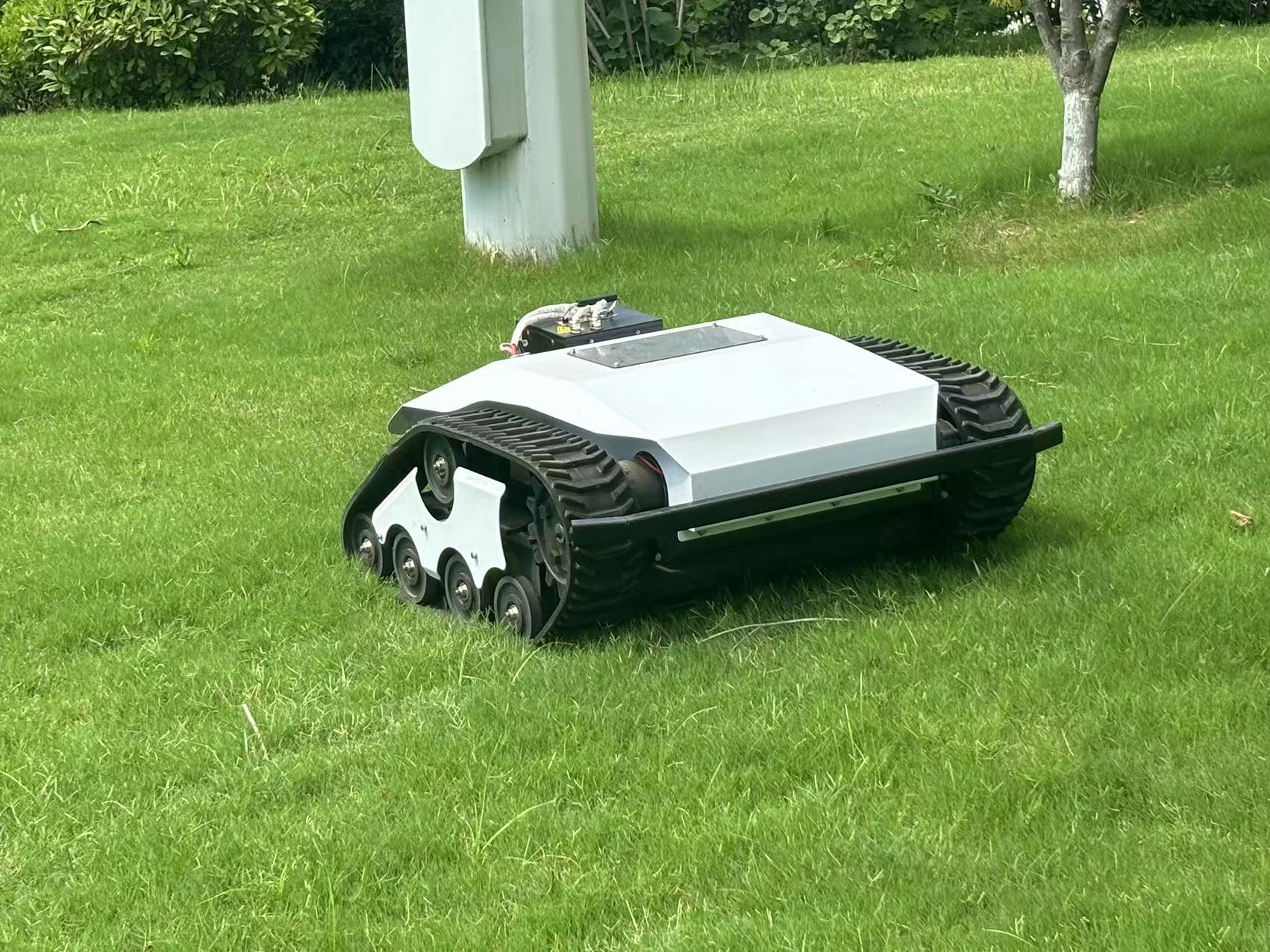
Direct Answer: Maintaining steep embankments, retention basins, and utility infrastructure presents severe safety and mechanical risks for standard wheeled equipment. A commercial-grade self propelled electric lawn mower built on a heavy-duty continuous rubber track platform replaces labor-intensive walk-behind operations with remote-controlled, high-torque electric powertrain technology. Operating on slopes up to 45 degrees with zero direct emissions, low ground pressure, and zero rollover risk for the operator, these tracked electric mowers substantially lower total cost of ownership (TCO) while meeting strict environmental and occupational safety mandates.
1. The Transition to Tracked Electric Vegetation Management

Commercial groundskeeping contractors, solar farm operators, and municipal highway authorities are actively transitioning from legacy internal combustion equipment to heavy-duty electric platforms.
Standard push mowers and ride-on units face critical operational bottlenecks on uneven terrain. The modern commercial self propelled electric lawn mower solves these challenges through three primary engineering advancements:
- Eliminating Rollover Injuries: Industrial wireless remote control decouples the operator from the machine, allowing crews to manage hazardous embankments from a safe standoff distance of up to 200 meters.
- Overcoming Incline Lubrication Limits: Unlike conventional gasoline engines that experience oil starvation, hydraulic cavitation, and stalling when operating past a 20-degree tilt, sealed brushless electric motors and solid-state battery systems maintain uninterrupted peak power at any angle.
- Low-Compaction Flotation: Continuous heavy-duty rubber tracks distribute the vehicle mass over a broad contact area, preventing turf tear, rutting, and soil erosion on sensitive drainage swales and retention banks.
Engineering Architecture: At a Glance
| Design Metric | Conventional Gas Push / Ride Mowers | Tracked Self-Propelled Electric Mowers |
| Center of Gravity | High center of gravity; prone to tipping | Ultra-low, ground-hugging chassis profile |
| Operator Safety | Walk-behind / on-board operator risk zone | 150m+ wireless remote standoff safety |
| Slope Capability | Engine oil starvation past 20 degrees | Continuous peak torque on slopes up to 45 degrees |
| Powertrain Upkeep | Frequent fluid, filter, and belt maintenance | Direct-drive brushless motors; zero fluids |
| Ground Disturbance | High wheel compaction; ruts on soft turf | Broad crawler tracks; sub-3.5 PSI footprint |
2. Key Engineering & Powertrain Advantages
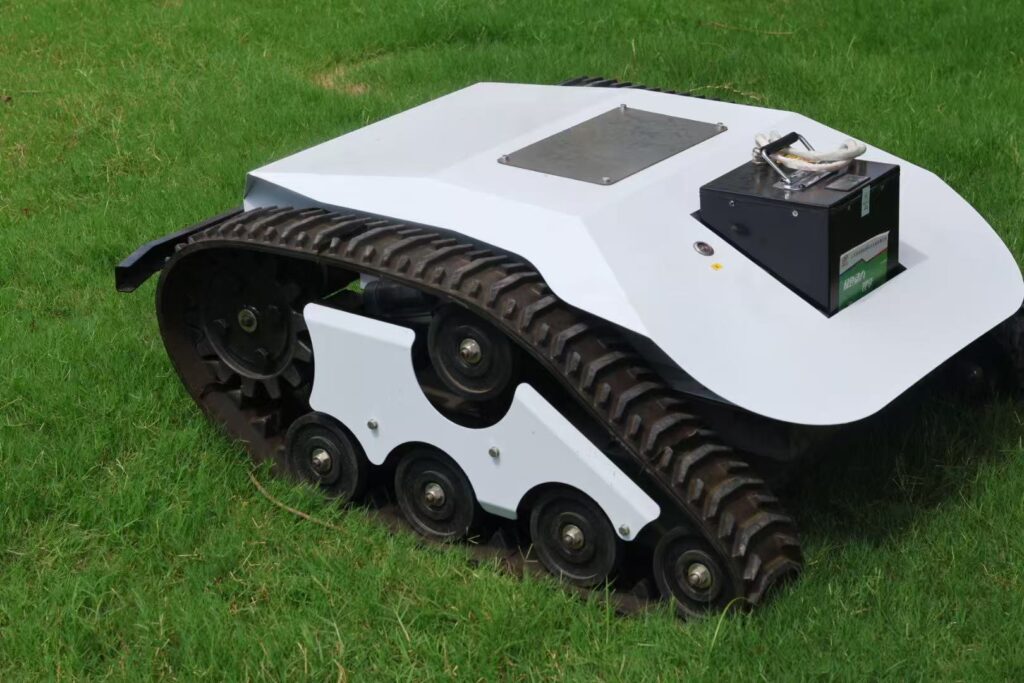
Continuous Rubber Crawler Tracks vs. Standard Wheels
A conventional wheeled self propelled electric lawn mower concentrates vehicle weight onto small contact patches, leading to wheel slippage on damp slopes and severe tire rutting.
Our industrial tracked chassis incorporates:
- Sub-3.5 PSI Low Ground Pressure: Disperses total weight across reinforced rubber tracks, protecting soil integrity and preventing the mower from sinking in marshy retention areas.
- Deep-Lug Directional Traction: Aggressive chevron-pattern treads bite firmly into loose gravel, wet grass, and heavy brush.
- Zero-Turn Counter-Rotation: Dual independent electric drive motors execute rapid 360-degree turns on the spot without tearing the turf canopy.
High-Torque Brushless DC (BLDC) Cutting System
Brushless electric motors provide instantaneous maximum torque from a dead stop. When encountering thick reeds, heavy weeds, or fibrous brush, the cutting deck maintains consistent blade tip speed without the bogging down or belt slippage typical of combustion engines.
Low-Profile Chassis & Impact Protection
The low-clearance chassis design (overall height under 550 mm) allows seamless mowing beneath utility-scale photovoltaic (PV) solar panels and low tree branches. The heavy-duty steel front bumper deflects rocks, tree stumps, and hidden surveyor stakes, protecting internal electronic control units (ECUs) and wiring harnesses.
3. Commercial Application Scenarios

Application review
Discuss your mowing application.
Share the working condition, target market, product family and project scope.
- Utility-Scale Solar Farms: Smoothly passes beneath fixed-tilt and single-axis tracker solar panels where tractors cannot access and manual line-trimming is cost-prohibitive.
- Highway & Railway Embankments: Handles highway overpasses, drainage swales, and bridge abutments without requiring lane closures or exposing operators to traffic hazards.
- Stormwater Retention Basins: Safely cuts saturated, steep retention slopes without risking machine entrapment or turf destruction.
- Municipal & Noise-Sensitive Zones: Quiet electric operation allows early-morning vegetation maintenance around corporate campuses, hospitals, universities, and residential communities with noise curfews.
4. Technical Comparison: Tracked Electric vs. Traditional Gas Mowers
| Feature / Metric | Commercial Tracked Self-Propelled Electric Mower | Commercial Gas Walk-Behind / Zero-Turn |
| Maximum Operating Slope | Up to 45 degrees (100% grade) | 15 to 20 degrees maximum |
| Drive Architecture | Dual independent electric hub motors + tracks | Hydrostatic / belt drive with turf tires |
| Ground Compaction | 2.0 to 3.5 PSI (High flotation) | 8.0 to 15.0 PSI (High compaction) |
| Tailpipe Emissions | Zero direct emissions | Carbon monoxide, NOx, unburned hydrocarbons |
| Acoustic Signature | Under 72 dB(A) at 7 meters | 95 to 105 dB(A) (Requires mandatory hearing PPE) |
| Operator Safety Position | Remote control standoff (150 to 200 m) | Direct machine contact (Hand-arm vibration / Rollover zone) |
| Powertrain Maintenance | Sealed electrical system; blade sharpening only | Oil changes, air/fuel filters, spark plugs, belt tensioning |
5. Site-Scope to Equipment Specification Matrix
Use this matrix to match your facility requirements with machine specifications before submitting a purchase request:
| Project Parameter / Requirement | Site Condition / Client Requirement | Equipment Supplier Specification |
| Maximum Slope Gradient | Embankments with grades ranging from 25 to 45 degrees | Low center-of-gravity tracked chassis; dynamic stability rated to 45 degrees |
| Under-Structure Clearance | Solar racking clearance down to 600 mm above grade | Ultra-low vehicle profile (520 mm overall machine height) |
| Vegetation Type | Thick weeds, tall reed grass, woody saplings up to 20 mm | High-torque brushless cutting motor with hardened swing-type brush blades |
| Operator Safe Distance | Unstable terrain or busy roadside traffic zones | Industrial 2.4 GHz FHSS remote control system with automatic deadman failsafe |
| Acoustic Standards | Municipal noise ordinances (< 75 dBA at property line) | Electric powertrain operating at < 72 dBA at 7 meters |
| Logistics & Handling | Rapid loading onto standard service trailers or pickup beds | Integrated lifting points and auxiliary winch tie-down brackets |
6. Total Cost of Ownership (TCO) & Payback Analysis
While high-capacity lithium battery systems represent an initial investment, the lifecycle economics of a commercial self propelled electric lawn mower deliver positive ROI within the first operating season:
- Energy Cost Reduction: Electricity charging costs per acre are approximately 70% to 85% lower than commercial gasoline and diesel fuel consumption.
- Labor Productivity Gains: A single remote operator clears overgrown hillsides at the rate of a 3-to-4-person crew equipped with manual brush cutters and string trimmers.
- Maximized Fleet Uptime: Eliminating carburetors, oil changes, spark plugs, hydraulic hoses, and drive belts significantly reduces maintenance downtime during peak growing seasons.
7. Request Equipment Configurations & Fleet Inquiries
We engineer commercial slope mowers for international groundskeeping contractors, solar facility maintenance providers, and specialized equipment distributors.
OEM & Distributor Inquiry Checklist:
- CAD Drawings & Clearances: Request full dimensional schematics for solar farm array planning.
- Custom Deck Configurations: Available in cutting deck widths from 600 mm to 1000 mm.
- Battery & Power Options: High-capacity LiFePO4 battery configurations with hot-swap options.
- Export Compliance: CE, ISO, and regional safety certification documentation available for container-load orders.
Video: Remote Controlled slope mower
