 By Anna
Remote control mower range is worth checking before a commercial equipment purchase, but a catalog distance is only one part of the decision. Buyers searching for remote control mower line of sight range need to know how a figure was measured, which control system it covers, what the operator must be able to see, and how the exact machine is documented to respond if communication is interrupted.
This guide gives procurement teams six documentation checks for comparing remote-control mowers. It does not set a safe working radius, authorize operation beyond direct visibility, or replace the manufacturer’s current instructions, site risk assessment, or qualified operator training.
What Does a Remote Control Mower Range Figure Actually Mean?
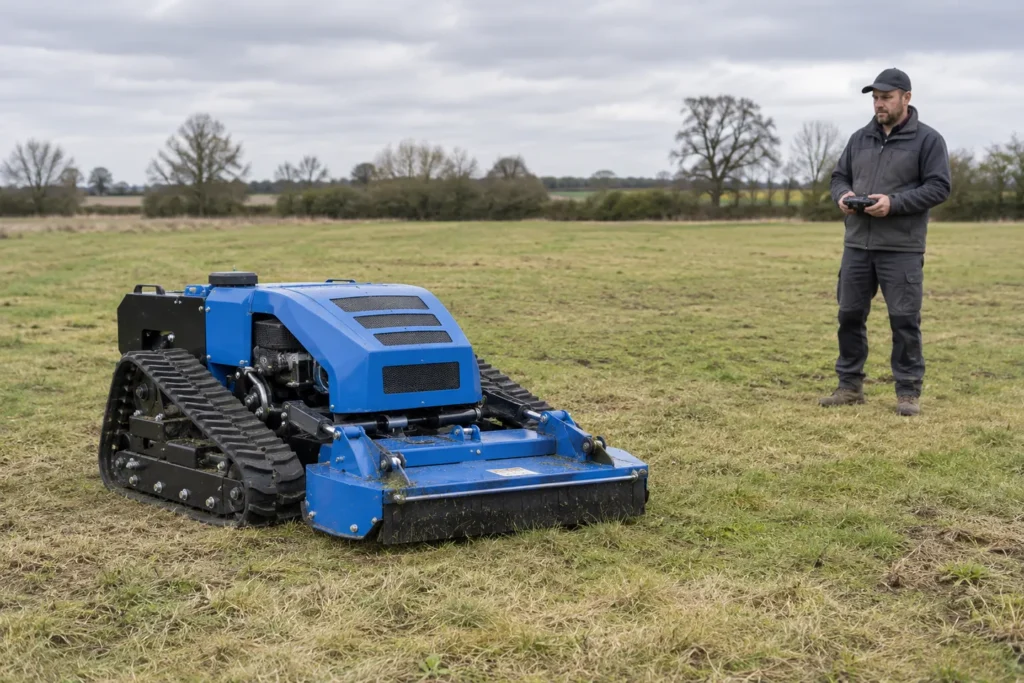
Specifications may use terms such as remote-control distance, radio range, or line-of-sight range. Those terms are not enough to tell a buyer whether the number means a maximum communication distance, a distance achieved in a particular test, or a manufacturer-recommended operating limit. Ask the supplier which meaning applies to the exact model and controller.
- Advertised control range: a published distance associated with the radio or control system, subject to its stated conditions.
- Operator’s visual line of sight: the operator’s ability to observe the machine and relevant work area, which is separate from whether a radio signal reaches the receiver.
- Authorized operating distance: the limits and operator-position requirements established by the applicable manufacturer documentation and site operating controls.
A radio path may be affected by obstructions and equipment configuration, while a person may lose a clear view of the machine for different reasons. A strong radio link does not establish that the operator has adequate visibility or that the machine can safely work at that distance. If the range definition and test basis are missing, record the specification as not verified—request documentation.
What Commercial Buyers Should Verify Beyond the Published Range

1. Operator Visibility and Site Geometry
Describe the locations from which the operator would need to view the mower. Berms, stockpiles, mature trees, buildings, tall vegetation, and changes in elevation may obstruct the view or affect the radio path. The two concerns should be recorded separately rather than treated as one line-of-sight measurement.
Ask the manufacturer or authorized supplier what operator-position requirements apply. A catalog figure alone cannot resolve visibility, exclusion-zone, or site-access questions for the intended work.
2. Radio Range Test Conditions and Control-System Version
Request the source and conditions behind the published distance. Useful fields include the specific mower and transmitter/receiver configuration, applicable software or firmware version where identified, test setting, antenna arrangement, and whether obstacles were present. Do not assume that the same advertised number applies across product revisions or attachment configurations.
If the supplier cannot provide the testing basis, retain the number as a manufacturer-published claim awaiting verification. Do not turn it into a guaranteed site performance distance in a purchase comparison.
3. Signal-Loss and Emergency-Stop Response
Ask what the exact model is documented to do when the control link is lost and what conditions must be met before operation can resume. Obtain the current operator manual or another approved manufacturer document rather than assuming that every remote mower uses the same stop sequence or response time.
As an example of why equipment-specific instructions matter, Alamo Industrial publishes an operator manual for its TRAXX remote-control equipment that addresses radio-signal interruption and emergency-stop behavior. That documentation belongs to the models it covers; it is not evidence for another manufacturer’s machine.
4. Direct-View Control Versus Camera-Assisted Operation
If a proposed system includes a camera or remote display, verify whether that system is manufacturer-approved for the intended operation and what viewing requirements still apply. The radio-control link, video link, and operator’s ability to judge machine position are different things. Video delay or an obscured image may affect situational awareness even while control commands are still received.
Do not infer that a camera permits operation outside direct visual line of sight. Record any camera-assisted mode as a separate, model-specific approval and documentation question.
5. Separate Mowers, Snow Equipment, and Multi-Function Platforms
A range figure should follow the actual machine and working configuration, not just a shared radio-controller brand or a tracked chassis. Mowing, snow removal, and carrier tasks may present different visibility and application questions:
Application review
Discuss your mowing application.
Share the working condition, target market, product family and project scope.
- Remote-control mowers: confirm the view needed to monitor machine location, cutting area, and work-zone boundaries.
- Snow removal equipment: document the intended visibility and surface conditions, including whether the approved operating instructions cover the application.
- Tracked or multi-function platforms: identify the exact working system, attachment configuration, and task approval rather than applying a mower’s range claim automatically.
For category context, the Super Mowers catalog lists remote lawn mowers, snow blowers, and multi-function tracked equipment separately. Each proposed model still needs its own current technical record before a range or compatibility claim is used for procurement.
Six-Point Remote Control Mower Range Verification Checklist

Use this table for document requests and comparison records. A completed field means the evidence has been reviewed; it does not independently establish an acceptable operating distance.
| Check | Evidence to request | If evidence is missing |
|---|---|---|
| 1. Exact model and control system | Model, configuration, controller/receiver identity, and applicable document or software revision | Record the configuration as unverified |
| 2. Published range definition | Whether the figure is a radio-link limit, test result, or recommended working limit; stated test conditions | Request the manufacturer source |
| 3. Visual line of sight and site obstacles | Operator-position requirements and a site layout identifying visibility or radio-path obstructions | Keep the site review open |
| 4. Signal-loss response | Current instructions describing the documented response, emergency-stop provisions, and restart conditions | Request the applicable operator manual |
| 5. Camera or video link, if fitted | Approved operating mode, viewing limitations, and whether the camera link has a separate documented range | Do not assume camera-assisted operation is permitted |
| 6. Application and acceptance review | Intended task, site conditions, qualified reviewer, and any manufacturer-authorized demonstration or approval record | Leave the procurement decision conditional |
Add a document reference, reviewer, date, and open-action owner for each unresolved check. Do not try to establish a maximum distance by deliberately interrupting the radio link or operating outside the approved instructions. Any practical demonstration should be arranged and controlled by the responsible qualified parties.
Questions to Send to the Supplier Before Buying

Send the same questions for every shortlisted model so the replies can be compared on a consistent basis:
- What exact mower, controller, and configuration does the advertised remote control mower range apply to?
- Is the published distance a tested communication limit or a manufacturer-recommended operating distance?
- Which test conditions, antenna arrangement, and document revision support the figure?
- What direct-visibility and operator-position requirements apply to the intended task?
- What does the current manual say about signal interruption, emergency stopping, and resuming operation?
- If a video system is offered, is it approved for the proposed use and subject to separate range or visibility limitations?
- What documents or supervised demonstrations can support a site-specific purchasing review?
Attach a concise site brief showing terrain, major obstructions, work-zone layout, target market, and the distance question that needs answering. Ask the supplier to identify which answers are documented and which remain pending technical review.
Bottom Line: Do Not Buy on Range Alone

A higher published range does not, by itself, establish a safer or more productive remote-control mower for a commercial property. Buyers should distinguish a documented specification from a verified site requirement and from an authorized operating limit.
For each candidate, record one of three procurement outcomes: documentation received for review, decision pending specific evidence, or proposed use not supported by the available records. Keep the exact source and review scope beside the decision; do not turn a pending answer into an approved operating claim.
If you are comparing equipment for a commercial site, send the machine category, intended terrain, visibility constraints, target market, estimated quantity, and required document list through the Super Mowers equipment enquiry form. That gives the supplier a useful starting point for a model-specific review without promising a safe distance from a catalog number.
The best range comparison is the one that shows what has been verified and what is still unknown. Use the six checks above to build that record, then rely on current manufacturer instructions and qualified local review for the actual operating decision.