 By Anna
Remote control mower TCO, or total cost of ownership, combines the cost of buying, operating, maintaining and eventually selling or retiring a mower. To compare commercial machines fairly, use the same mowing workload, comparison period and cost categories—not purchase price alone.
Use this blank-input worksheet to collect written quotes, service schedules, site-test results and your own operating records. Mark missing supplier information “not quoted”. Keep forecasts clearly labeled as assumptions rather than treating them as guaranteed costs or performance.
1. Define the Mowing Job and Comparison Period
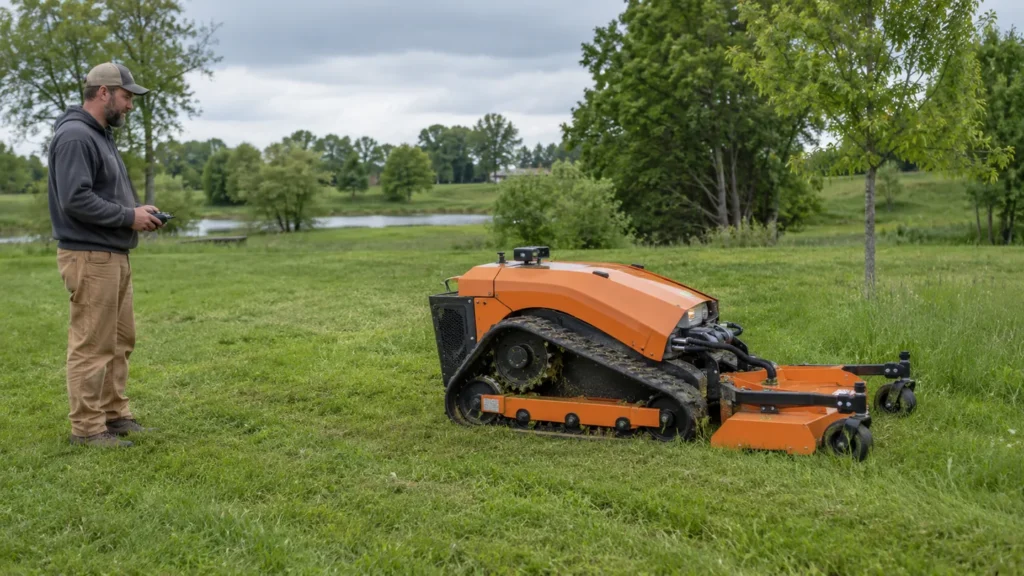
Before comparing remote control mower TCO, specify the machine configuration, holding period, currency, annual area to maintain and mowing frequency. Record vegetation, terrain, access restrictions and the required cutting finish. Only compare configurations suitable for the job under their applicable operating instructions. Convert other currencies using a recorded exchange rate and date.
Use the remote lawn mower catalogue to identify candidate configurations, then request the exact mower deck, power system, controller and accessories included in each bid.
Use the same workload—not necessarily the same number of machine hours. Two mowers can require different amounts of time to complete the same area. Compare their costs against the same completed work, while using each machine’s own documented productivity.
Machinery costing separates ownership expenses from operating expenses. Mississippi State University Extension’s machinery cost guide includes labor, fuel and repairs alongside ownership costs. Its framework is useful here; its tractor examples and assumed rates are not remote-mower quotations.
2. Complete the Remote Control Mower TCO Worksheet

Fill both supplier columns using the same units. In the evidence column, record separate document references and dates for Supplier A and Supplier B. Use your payroll, utility, insurance and facility records where the supplier cannot provide the relevant cost.
Label each input quoted, measured, owner record or assumption. “Not quoted” means missing information—not zero cost. Use “not applicable” only with a recorded reason. This is a blank comparison worksheet, not a claim about typical market prices.
| Cost category | Data to collect | Unit | Supplier A | Supplier B | Evidence / date |
|---|---|---|---|---|---|
| Delivered mower package | Machine, deck, controller, freight, setup and applicable nonrecoverable taxes or import charges | USD | ____ | ____ | Itemized quotes A/B; dates |
| Required supporting equipment | Extra batteries, charger, charging setup, trailer or other required equipment; allocated share if shared | USD | ____ | ____ | Supplier quotes / owner records |
| Financing | Interest and fees over the holding period; exclude loan principal already included in purchase cost | USD / period | ____ | ____ | Lender schedules A/B; dates |
| Warranty — reference only | Covered parts and labor, exclusions, travel, claim conditions and year/hour limits | Years / hours; terms | ____ | ____ | Warranty documents A/B |
| Energy | Measured fuel or purchased electricity, corresponding operating hours and local unit price | US gal or L; kWh; USD/unit | ____ | ____ | Tests, receipts / utility tariffs |
| Operating labor | Paid operating and support hours; loaded hourly rate including employer costs | Hours; USD/hour | ____ | ____ | Time study / payroll records |
| Consumables | Blades, belts, filters and lubricants; quantity and replacement basis | USD / interval | ____ | ____ | Parts lists and service manuals |
| Scheduled maintenance | Service tasks, applicable intervals, labor hours, rates and travel charges | Hours; USD / service | ____ | ____ | Manuals / service quotes |
| Major replacements | Battery packs, tracks or other major items; estimated timing and installed cost | USD / event | ____ | ____ | Quotes plus labeled timing assumptions |
| Unscheduled repairs | Repair history, parts and labor estimates; documented reserve assumptions | USD / period | ____ | ____ | Service records / written estimates |
| Transport | Site travel, loading, unloading and recovery; exclude costs already recorded elsewhere | USD / move; moves | ____ | ____ | Transport quotes / route records |
| Training and safety equipment | Initial instruction, refresher training and job-specific equipment costs | USD / period | ____ | ____ | Training quotes / owner records |
| Insurance | Premium attributable to the mower and its use—not just a coverage certificate | USD / year | ____ | ____ | Insurer quotes A/B; dates |
| Storage and security | Allocated yard, building or security costs using a consistent basis | USD / month | ____ | ____ | Facility records / allocation method |
| Required software or connectivity | Subscriptions, data plans or licenses, if required by the configuration | USD / period | ____ | ____ | Written supplier terms |
| Downtime contingency | Additional backup rental or contractor costs under a stated downtime scenario | USD / day; days | ____ | ____ | Rental quotes plus assumptions |
| Residual value | Written buyback terms or estimated resale proceeds, net of selling costs | USD at end of term | ____ | ____ | Buyback agreement / resale evidence |
| Decommissioning | Applicable battery, fluid or equipment disposal and removal costs | USD at end of term | ____ | ____ | Disposal quotes / stated assumptions |
Keep warranty terms as supporting information, not an extra cost to add automatically. Count a separately priced warranty extension once. Likewise, do not count the same battery, track, service part or labor hour under several rows.
3. Calculate Remote Control Mower TCO per Hour and Acre
For an outright-purchase or financed-purchase comparison, use the following undiscounted planning model. Total every expense over the same holding period; do not add a monthly rate to an annual total without converting it. State whether recurring costs use constant prices or annual forecasts, and apply that choice consistently.
Period TCO = acquisition and setup + financing interest and fees + operating and ownership expenses + repair and downtime allowances + decommissioning − net residual value.
Operating and ownership expenses include energy, paid labor, consumables, scheduled maintenance, planned replacements, transport, training, insurance, storage and required subscriptions. Enter every included cost once, using the worksheet to show its source and timing.
Do not add depreciation on top of purchase cost minus residual value. That would count the same loss in equipment value twice. Similarly, do not add loan principal again after including the purchase price. A lease comparison or discounted life-cycle analysis requires a separately defined cash-flow model.
Choose a consistent definition of productive time
For this worksheet, define productive mowing hours as time spent completing the mowing operation, including normal turns and overlap, but excluding off-site travel, loading, charging, repairs and unrelated attachment work. Record those excluded activities separately and retain their relevant costs.
TCO per productive hour = period TCO ÷ productive mowing hours during that period.
Do not substitute engine hours, key-on hours or the operator’s entire paid shift without explaining the difference. Apply the same time definition to both machines, but allow the measured hours to differ.
Compare cost per completed acre or season
TCO per acre serviced = period TCO ÷ total acres serviced during that period.
Count each completed mowing visit. For example, a 10-acre site mowed 12 times represents 120 acre-services, not 10. Do not count overlap or corrective rework as extra completed acreage. Iowa State’s machinery selection guide similarly accounts for repeated operations by multiplying area by the number of passes.
Average TCO per season = period TCO ÷ seasons in the holding period.
State the area and mowing frequency associated with that seasonal average. For equipment completing the same contract, cost per acre serviced is generally the more direct comparison: a lower hourly cost alone does not show how much work was completed.
4. Separate Mowing from Other Attachment Costs
Application review
Discuss your mowing application.
Share the working condition, target market, product family and project scope.
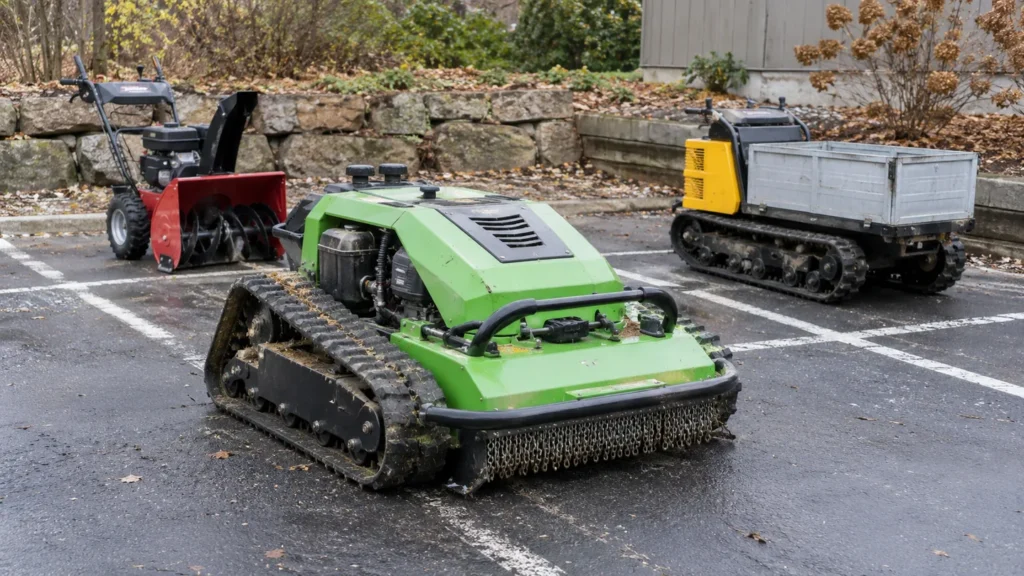
When a tracked platform also carries a snow blower or utility attachment, keep a mowing-only cost view. Assign mower blades, deck wear, mowing energy and mowing labor directly to that activity. Keep snow-specific and non-mowing attachment costs separate.
Allocate genuinely shared platform, transport, storage and insurance costs using a documented method. Logged usage can be one allocation basis where it reasonably reflects how the asset is used. Apply the same method to both suppliers.
Do not divide mower costs by combined mowing and snow-clearing hours. That makes the mower appear cheaper by adding unrelated work to its denominator. Where shared-use assumptions materially improve the result, also show a mowing-only scenario without that assumed utilization.
5. Verify Labor, Energy and Maintenance Inputs

Include the operator and support work
Remote control does not mean autonomous operation. As Kawasaki Engines explains, a remote-control mower is operated by a person using a controller. Do not assume zero operating labor or unattended multi-machine working without applicable documentation.
Labor cost = total attributable paid hours × loaded hourly labor rate.
Include operating, setup, checks, cleaning and other attributable support time, while avoiding labor already included in transport or service charges. Iowa State’s machinery cost publication explains why labor time can exceed field machine time. Use your time records rather than importing its illustrative labor multiplier.
Measure purchased energy under representative conditions
Fuel cost = fuel consumed over the period × price per matching fuel unit.
Electricity cost = purchased charging kWh over the period × applicable price per kWh.
The kWh-times-tariff calculation follows Virginia Cooperative Extension’s energy-cost guidance. Include any additional charges attributable to the charging arrangement where applicable.
For a forecast, multiply measured consumption per operating hour by operating hours measured on the same basis. Record grass condition, cutting height, terrain, idle time and test duration. Specify US gallons or liters so the consumption and price units match.
For battery equipment, prefer measured energy supplied to the charger rather than battery capacity alone. Charging-input measurements already include charging losses; do not add those losses twice. On a fuel-electric machine, electricity generated from its fuel is not an additional grid-electricity purchase.
Price service tasks and separate repair assumptions
Request the current service schedule for the exact model. Identify the applicable hour, calendar or condition-based triggers; required parts; service labor; and dealer travel charges. Check whether batteries, tracks, belts and cutting components have separate warranty terms.
A parts price list shows replacement cost, not how often a failure will occur. Support repair allowances with relevant service history or clearly labeled scenarios. Iowa State’s repair-cost guidance emphasizes past repair records and differences in working conditions; it does not establish a universal repair percentage for remote-control mowers.
6. Test Assumptions Before Ranking Suppliers

A remote control mower TCO result is only as useful as its input coverage. Supplier efficiency and runtime claims can help design a test, but they are not substitutes for comparable site measurements or contractual terms.
Before accepting a ranking, recalculate with lower annual utilization, higher repair or energy costs, and a lower resale value. Use documented ranges where available. Otherwise, identify the ranges as your planning assumptions—not supplier guarantees. When utilization changes, update the related energy, labor and maintenance costs as well as the hours.
Treat a contractual buyback differently from an estimated resale price. Record its conditions, including hours, condition, timing and transport. When residual value is uncertain, a zero-resale downside scenario can reveal how dependent the comparison is on that assumption.
Record downtime, backup-rental costs and output boundaries consistently. Do not count the same recovered work as both lost revenue and a replacement-service expense. Keep speculative lost revenue separate from the ownership-cost worksheet.
If an important field remains “not quoted,” the result is incomplete. Do not let a blank cell become zero in a spreadsheet total. Identify the missing categories beside the subtotal and request the information before claiming that one bid has a lower total cost.
7. Request Comparable, Itemized Quotes

Send every supplier the same job description and ask for written answers to these questions:
- What exact mower configuration is included, and which freight, setup, accessories or other charges are separate?
- What are the warranty exclusions, claim conditions, year/hour limits and service-travel charges?
- Which service tasks, intervals, replacement parts and labor rates apply to this model?
- What measured productivity and energy data are available, and under what cutting conditions?
- What training, local support, parts lead times and recovery arrangements can be documented?
- Is the end-of-term value a binding buyback offer or a resale estimate, and what conditions apply?
To complete the remote control mower TCO worksheet, provide your holding period, expected acreage and mowing frequency, site conditions, transport requirements, local labor and energy rates, and preferred machine configuration. Ask suppliers to identify anything they cannot quote rather than leaving an apparently complete total.
For a SANYANG configuration review, request an itemized remote mower quote and include the same operating brief used for the other bids. Request the supporting documents before completing the comparison.
A useful remote control mower TCO comparison makes missing costs and assumptions visible. Compare complete cost categories against the same mowing workload, retain the evidence for every input, and use the results to ask better purchasing questions—not to turn an unsupported efficiency claim into a guaranteed saving.