

 By Anna
A roadside or commercial site rarely fails because the operator forgot the hazard exists. It fails because a stone, a piece of scrap metal, or a loose fitting leaves the discharge path while a pedestrian, cyclist, or vehicle is passing through the same space. Lawn mower thrown objects safety therefore starts with a decision made before the engine turns: who can reach the work area, how they will be kept out, and who has the authority to stop the job.
Thrown-object risk is managed by controlling what enters the cutting path, where material can travel, and who can reach that area — not by assuming a remote operator is far enough away. Keep approved guards fitted, map people and vehicles against the actual site, and stop work when someone enters the zone.
This article is written for supervisors and operators running remote-controlled mowers on roadsides, commercial grounds, and public spaces. It explains how objects become projectiles, how to map exposure, why guards and work-area controls matter, and what to do when a person appears. It does not set a universal safe distance, because no single figure applies across mower models, attachments, and sites.
Lawn mower thrown objects safety: How objects become projectiles

A rotary mower cuts by spinning a blade at speed. Anything loose in the grass that the blade contacts can be picked up and thrown. The hazard is not limited to obvious rocks. Safety guidance on mowing projectiles from Mississippi State University Extension describes the general mechanism: mower blades can strike and launch objects found in the turf, and the resulting projectiles can injure people nearby. That is a general explanation of the hazard, not a specification for any Super Mowers model.
The practical implication is that the risk begins with site conditions, not with the machine alone. Grass height can hide debris. Recently disturbed ground, gravel shoulders, mulch beds, and areas where maintenance crews have left fasteners or wire can all introduce objects into the cutting path. A site that looks tidy from the cab or the remote-control position may still contain material the blade can reach.
Explain debris and discharge paths using safety-agency sources
US Consumer Product Safety Commission guidance on rotary power mowers identifies thrown objects as a recognized hazard type for rotary mowers and stresses that users should clear the work area of objects the blade could strike. That framing is useful for supervisors because it separates two questions: what is in the grass, and where can material go once it leaves the deck.
The discharge direction depends on deck design, blade rotation, and the direction of travel, and it can change as the machine turns or the terrain changes. A single pass does not have a fixed throw zone. For planning purposes, treat the area around the deck — not only directly behind the machine — as potentially exposed, and confirm the specifics against the model's manual and any guards or discharge configuration actually fitted. Do not carry over figures from consumer mower guidance to a commercial or remote-controlled machine.
Remote operation changes operator position, not the hazard
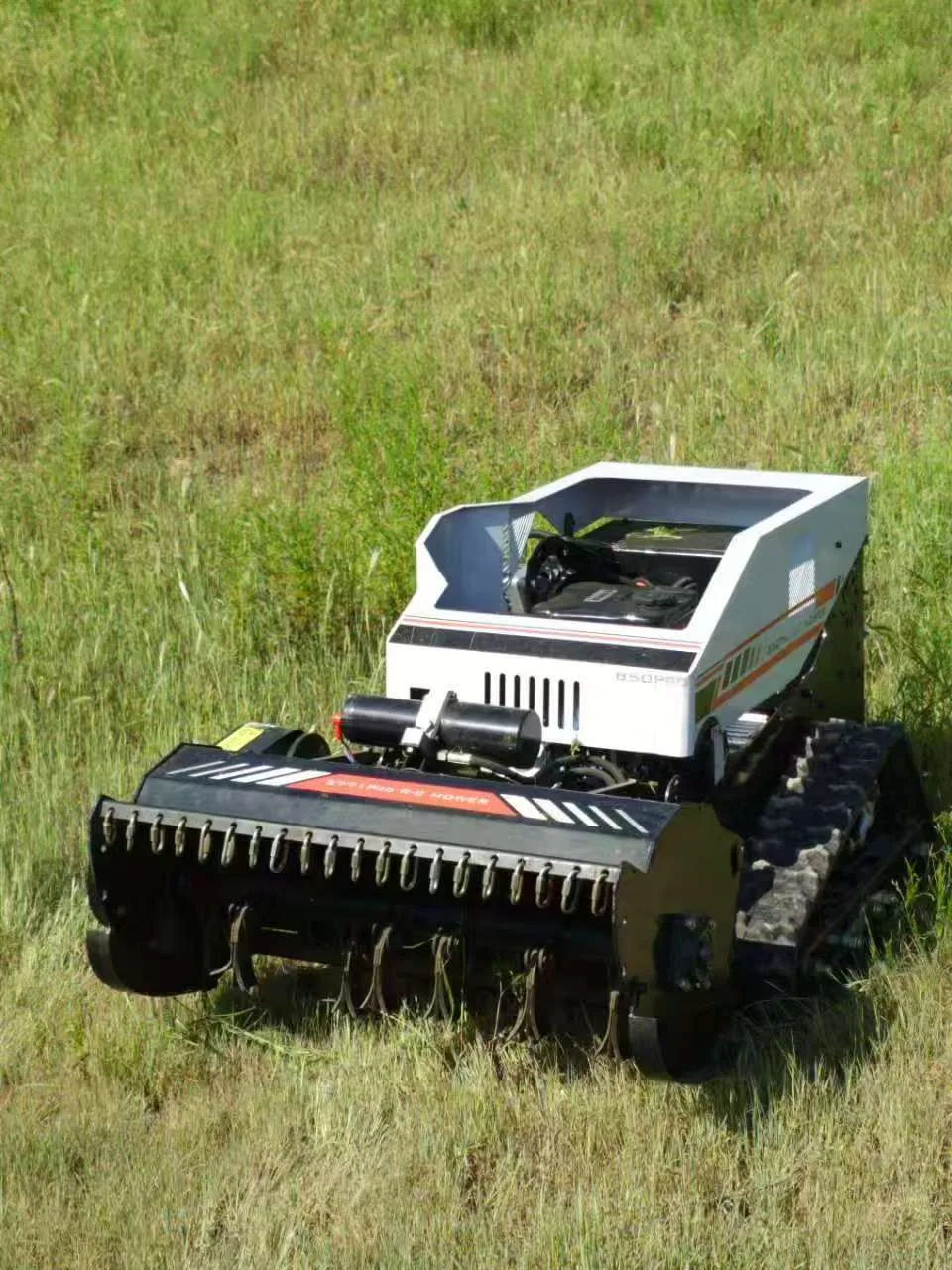
A remote-controlled mower keeps the operator away from the cutting deck, which is a genuine difference in exposure for that person. It does not remove the projectile. The stone still leaves the deck at speed; the difference is who is standing where. If a pedestrian is on the path beside the work area, moving the operator back does nothing for them.
This is the central planning point for remote mowing: the operator's distance from the blade is not the same as the bystander's distance from the hazard. Super Mowers' application material on remote-control mowers for roadside maintenance frames remote operation within commercial work contexts; it does not replace a site-specific assessment of who can reach the work area. The same applies to the broader commercial remote-control mower overview: control method is one factor, not a substitute for work-zone management.
Map people, vehicles and access

Before the first pass, build a simple picture of who can enter the area the mower will work and where material could travel. This is not a formal risk assessment unless your organization requires one; it is the working map a supervisor uses to place controls. Walk or review the site and record the routes people actually use, not the routes the site plan says they should use.
Start with the obvious: sidewalks, crossings, building entrances, bus stops, parking aisles, and any temporary pedestrian diversion. Then add the less obvious: delivery routes, cyclist lanes, maintenance access doors, and the paths people take when a sidewalk is blocked. A mower working near a public space can push foot traffic into unexpected lines, including behind the machine.
Identify sidewalks, entrances and obstructed sight lines
Sight lines matter as much as distance. Hedges, parked vehicles, signage, temporary fencing, and grade changes can hide a pedestrian from the operator's view until they are close to the work area. A remote operator may be positioned to see the machine but not the far side of a hedge, and a spotter may be watching one approach while another goes unobserved.
Use a short site walk to list each approach and what blocks the view of it. The table below is a planning aid, not a set of rules; fill it in for the actual site and confirm any model-specific points against the manual.
| Exposure point | Who can arrive | What blocks the view | Planned control | Who confirms |
|---|---|---|---|---|
| Sidewalk along the work edge | Pedestrians, joggers, dog walkers | Parked cars, hedge | Temporary closure or diversion; spotter | Site supervisor |
| Building entrance | Staff, visitors, deliveries | Recessed doorway | Notice to building manager; pause during peak use | Site supervisor and facility contact |
| Vehicle aisle or shoulder | Cars, vans, cyclists | Parked vehicles, curve | Traffic control per site plan; coordinate with traffic authority if public road | Supervisor and traffic coordinator |
| Maintenance gate | Contractors, site staff | Fencing, stored materials | Lock or staff the gate during work | Supervisor |
| Blind corner or grade change | Mixed | Terrain, vegetation | Spotter positioned with a clear view; stop if view is lost | Supervisor |
Set responsibilities from the site risk assessment and actual manual
Responsibility should be named, not assumed. In most commercial settings the supervisor owns the work-zone plan, the operator owns the machine and the stop decision within that plan, and a spotter or banksman owns watching a defined approach. Whoever controls the site — a facility manager, a highways authority, or an event organizer — owns closing or diverting public routes.
Write these roles down for the shift. A useful split is: who decides the work can start, who watches which approach, who can pause the job, and who is contacted if a member of the public refuses to leave. Confirm any machine-specific instructions — including where the operator should stand and how the machine is stopped — from the exact model manual, not from a generic article. If the manual and the site plan conflict, resolve the conflict before work begins.
Guards and work-area controls

Application review
Discuss your mowing application.
Share the working condition, target market, product family and project scope.
Guards, deflectors, and discharge shields are part of the machine's designed protection. Their purpose is to limit what leaves the deck and where it goes. They are not a guarantee that nothing will be thrown, and they are not interchangeable between models. The correct configuration is the one specified for that machine in its manual, with the parts actually fitted and undamaged.
Work-area controls sit alongside the guards. Temporary fencing, cones, tape, signage, spotters, and route diversion reduce the chance that a person is in the exposed area at the moment something is thrown. Neither layer is sufficient alone: guards without a controlled area still leave people exposed, and a controlled area with damaged or missing guards still allows material to leave the deck.
Explain why approved guards must remain in place
Removing or lifting a guard changes the machine from its designed configuration. It may widen the discharge path, expose the blade area, or direct material in a way the machine was not built for. It also removes the basis on which the site plan was made. For that reason, guards should stay in place during operation, and any missing, damaged, or modified guard should be treated as a reason not to start work until it is resolved.
This is a maintenance and pre-use check point as much as an operating one. Inspect guards at the start of the shift, record damage, and confirm replacement parts against the model's parts information. Do not improvise a repair or substitute a part from another machine. If the correct guard is not available, the safe decision is to stop that task, not to run without it.
Do not give a universal clearance distance
There is no single clearance distance that fits every mower, attachment, and site. Throw distance depends on the machine, the blade, the object struck, the deck configuration, the terrain, and the direction of travel. A figure quoted for one machine or one test condition should not be applied to another, and a consumer mower figure should not be applied to a commercial or remote-controlled unit.
What a supervisor can do instead is define the work area from the site and the manual: identify where material could travel given the machine's configuration, keep people out of that area, and confirm any manufacturer-stated limits for the exact model. Where the manual gives a specific instruction, follow it. Where it does not, treat the area as needing control rather than assuming a number.
| Control layer | What it does | What it does not do | Check before use |
|---|---|---|---|
| Approved guards and deflectors | Limit discharge from the deck | Guarantee nothing is thrown | Fitted, undamaged, correct for model |
| Work-area exclusion | Keeps people out of the exposed area | Protect someone who enters anyway | Barriers, signage, route diversion in place |
| Spotter or banksman | Watches a defined approach | Cover every approach at once | Clear view, defined zone, stop authority |
| Pre-work debris check | Removes objects the blade could strike | Find everything hidden in tall grass | Walk the area; note disturbed ground |
| Stop procedure | Ends the hazard when someone enters | Replace the need for planning | Known by operator; manual-specific |
If a person enters the work area

When a person enters the area the mower is working or the area material could reach, the priority is to stop the hazard, not to finish the pass. The operator should stop the machine using the method specified for that model, and the spotter or supervisor should direct the person away from the work area. Do not assume the person has seen the machine or understands the risk.
Follow the exact manufacturer and site procedures for stopping
The stopping method, the controls used, and any post-stop steps are model-specific. Follow the exact manual for the machine in use, and follow the site's own procedure for public interaction. If the site procedure and the manual differ on a safety point, treat that as a conflict to resolve before work continues. Do not restart until the area is clear and the supervisor confirms it.
Document incidents and escalate before reuse
Record what happened: the time, the location, who entered, how they were directed away, whether anything was thrown, and whether the machine or guards were involved. Report it through the organization's incident process and to the site controller where required. Before the machine returns to work, confirm that guards are intact, the work-zone plan still fits the site, and any damage has been assessed. If a guard or deck component was struck, do not resume until it has been checked against the model's requirements.
FAQ

Does a remote operator remove all bystander risk? No. Remote operation moves the operator away from the deck, but a thrown object can still reach a pedestrian, cyclist, or vehicle in the work area. The bystander risk is managed by the work-zone plan, guards, and stopping when someone enters.
Can a guard be lifted to improve discharge? No. Guards should remain in the configuration specified for the model. Lifting or removing a guard changes the discharge path and removes designed protection. If discharge performance is a concern, check the manual and the machine's condition rather than modifying guards.
Is there one safe distance for every mower? No. Throw distance varies with the machine, blade, object, deck configuration, terrain, and direction of travel. Use the exact model manual and a site-specific work-zone plan rather than a single universal figure.
Conclusion

Thrown-object safety comes down to controlling the cutting path, the discharge area, and who can reach it. Keep approved guards fitted, map people and vehicles against the real site, and stop when someone enters. Confirm every machine-specific detail in the exact model manual before the next shift.