

 By Anna
A replacement rubber track order often starts with three numbers copied from a worn track or an old invoice. If one number is misread or the unit is assumed, the track may arrive with the wrong width, the wrong link count, or a drive lug that will not seat. This guide explains how to measure rubber track size for a mower — width, pitch and number of links — and what to confirm before ordering.
Rubber track size is normally written as width × pitch × number of links. Width is the track belt's cross-section, pitch is the center-to-center distance between adjacent link holes or drive openings, and link count is the total number of links around the belt. Those three numbers identify a size, but they do not by themselves prove that a track fits a specific mower.
How to measure rubber track size width pitch number of links mower: Read the three dimensions used on a rubber track
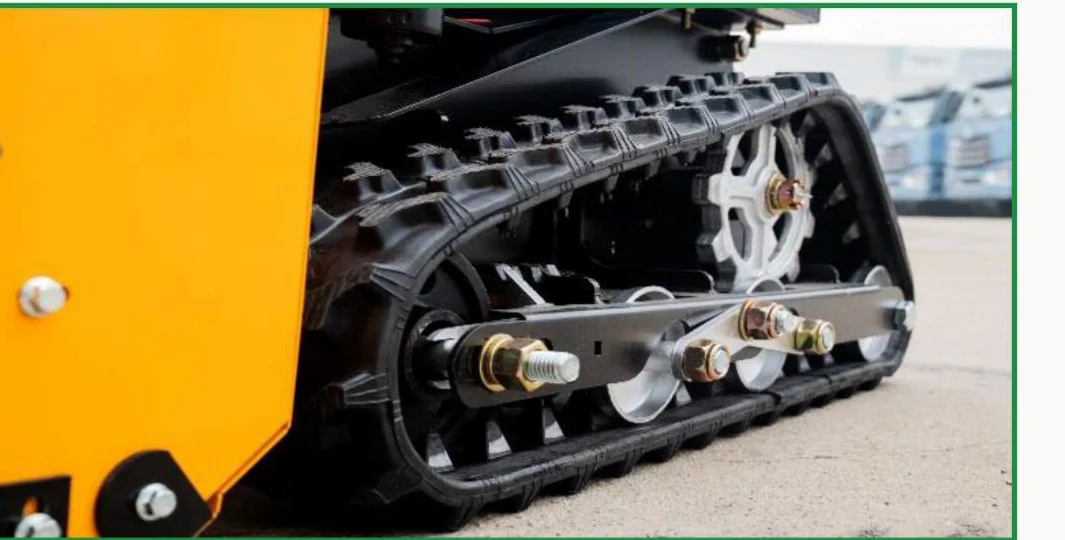
The three-number format is a shorthand, not a full specification. Two suppliers may describe the same convention while measuring from slightly different reference points, so the safest approach is to understand what each number represents, then confirm the measuring method with the supplier before ordering. Rubbertrax publishes a measurement guide, and Fortes tracks publishes a blog explanation of rubber track measurement; both are useful for understanding the convention, but neither should be treated as a universal rule for every mower undercarriage.
Width and its unit
Width is the nominal cross-section of the rubber belt, measured across the track rather than around it. In the trade, width is commonly stated in millimeters, and a figure such as 230 in a size string usually means 230 mm. That is a convention, not a guarantee: some catalogs and older records use inches, and a number without a unit is ambiguous. A 230 could be millimeters on one supplier's sheet and a different unit elsewhere.
For fleet records, always write the unit next to the number. "230 mm" is safer than "230." If a machine's manual or parts list states width in inches, convert carefully and keep the original figure in the record so the conversion can be checked later. Width affects how the belt sits on the track frame and how it interacts with the guide system, so a belt that is close but not correct is not a safe substitute.
Pitch between adjacent link centers and link count
Pitch is the distance between the centers of adjacent links, typically measured from one link opening or drive hole to the next around the belt. It is a repeating dimension, not the length of the whole track. Link count is the total number of links in the belt. The two work together: pitch multiplied by link count gives an approximate circumference, which is why a track with the same pitch but a different link count is a different size.
When measuring pitch, the reference points matter. Measuring from the outside edge of one opening to the outside edge of the next can produce a different figure than measuring center to center. Fortes' explanation of rubber track measurement describes pitch in terms of adjacent link centers, and that is the convention to use when recording a size. If a worn track is stretched or damaged, a direct measurement may not match the original specification, so cross-check against the machine's parts information where available.
| Dimension | What it describes | Common unit | What it does not tell you |
|---|---|---|---|
| Width | Cross-section of the rubber belt | Millimeters (confirm per supplier) | Whether the belt fits the frame or guide system |
| Pitch | Center-to-center distance between adjacent links | Millimeters (confirm per supplier) | Total track length or number of links |
| Link count | Total number of links around the belt | Count (no unit) | Whether the drive lug pattern matches the sprocket |
Work through the named 230 × 72 × 43 example

A worked example makes the format easier to read, provided the example stays attached to its source. Fortes tracks uses 230 × 72 × 43 as an illustration of the three-part size convention. In that string, 230 is the width, 72 is the pitch, and 43 is the number of links. The example is useful for learning how to parse a size, but it is not a Super Mowers specification and it does not identify a track for any particular mower.
Keep the example tied to its source
The value of the Fortes example is that it shows the order of the numbers and the units typically implied. It does not establish that every 230 × 72 × 43 track is interchangeable, and it does not tell you which machines use that size. Different manufacturers can produce tracks with the same three numbers but different drive lug geometry, guide profiles, or rubber compounds.
When you cite an example in a purchasing record, note where it came from and what it was meant to illustrate. A note such as "format example from Fortes tracks blog, not a machine specification" prevents a later reader from treating the example as an approved part number. This is especially important in dealer and fleet environments where records pass between purchasing staff, technicians, and outside suppliers.
Check units and count independently
Before accepting a size string, check the units and recount the links. A pitch figure in millimeters and a width figure in inches cannot be combined safely, and a link count copied from a damaged belt may be wrong if links were lost or the belt was replaced with a non-original part. Where the machine's manual or parts list gives a size, use that as the reference and treat field measurements as a cross-check.
The arithmetic is simple: pitch × link count gives an approximate circumference. For the Fortes example, 72 mm × 43 links gives about 3,096 mm, or roughly 3.1 meters. That figure is an approximation because pitch is a center-to-center repeating dimension and the actual belt path depends on the undercarriage. It is useful for sanity-checking a measurement, not for specifying a replacement on its own.
Application review
Discuss your mowing application.
Share the working condition, target market, product family and project scope.
| Check | Question to ask | Why it matters |
|---|---|---|
| Units | Are width and pitch both in millimeters, or both in inches? | Mixed units produce a wrong size |
| Link count | Was the count taken from the original belt or a replacement? | A non-original belt may have a different count |
| Arithmetic | Does pitch × link count roughly match the measured circumference? | A large mismatch suggests a recording error |
| Source | Is this a machine specification or a format example? | Examples do not identify a compatible part |
Verify track compatibility beyond the three numbers

Width, pitch, and link count describe the belt's size, but compatibility depends on the machine. The undercarriage, drive sprocket, guide system, and tensioning arrangement all affect whether a track will seat and run correctly. A supplier who quotes only the three numbers has not yet confirmed fit. The next step is to match the machine and undercarriage details, then ask about the drive lug geometry.
Match machine model and undercarriage details
Start with the machine's make, model, and serial number or production range, because manufacturers can change undercarriage components between batches. Record the number of track rollers, the sprocket tooth count, the guide type, and any tensioning specifications the manual provides. These details help a supplier identify the correct track family rather than matching on the three numbers alone.
Super Mowers' public product pages list tracked remote-control mower equipment, including the Remote 50 gasoline mower page, but those pages do not establish the pitch, link count, measuring method, or interchangeability of any Super Mowers track. Treat the catalog as a starting point for identifying the machine family, then confirm the track specification with the supplier or the machine's documentation. For related reading on machine types, see the comparison of tracked and wheeled remote-control mowers and the flail mower maintenance checklist for fleet records.
Ask the supplier about drive-lug geometry
Drive lugs are the raised features on the inside of the track that engage the sprocket. Their spacing, height, shape, and count must match the drive system. Two tracks with identical width, pitch, and link count can still differ in lug geometry, and a track that does not engage the sprocket correctly is not a safe replacement. Ask the supplier to confirm the lug pattern against the machine's undercarriage, ideally with a photo or drawing of the sprocket and the old track's inner surface.
Also ask about guide profiles and any reinforcement or compound differences that affect the intended application. These questions belong in the quotation stage, before a purchase order is placed. A written confirmation from the supplier, kept with the machine record, gives the fleet a reference if a future order is placed or a warranty question arises.
| Compatibility item | What to record | Who confirms it |
|---|---|---|
| Machine identity | Make, model, serial or production range | Fleet or dealer records |
| Undercarriage | Roller count, sprocket tooth count, guide type | Manual or supplier |
| Drive lugs | Spacing, height, shape, count | Supplier, with drawing or photo |
| Tensioning | Manual specification and adjustment method | Manual or qualified technician |
| Application | Terrain, load, and operating conditions | Fleet or dealer, matched to supplier guidance |
FAQ

Do equal width and pitch guarantee interchangeability? No. Width and pitch describe the belt's size, but interchangeability also depends on link count, drive lug geometry, guide profile, and the undercarriage. Two tracks with the same width and pitch can still be incompatible.
Is track pitch the same as total track length? No. Pitch is the center-to-center distance between adjacent links. Total length is closer to pitch multiplied by link count, and even that is an approximation because the belt path depends on the undercarriage.
Can another maker's example size specify an SM machine? No. The Fortes 230 × 72 × 43 example illustrates the size format; it is not a Super Mowers specification. Confirm the correct track for an SM machine through the machine's documentation and the supplier.
Conclusion

Read width, pitch, and link count as a size convention, then verify machine model, undercarriage, and drive lug geometry before ordering. Record the source of every figure so the next buyer can check it.