


 By Anna
A commercial mower comes into your shop with a hard-start or low-power complaint. The technician has a compression gauge in one hand and a leak-down tester in the other, and the service writer needs to know which result the work order should carry. The small engine compression test vs leak down test question matters because the two tests answer different questions, and on some engines one of them is harder to read than the other.
A compression test measures the pressure a starter can build in the cylinder; a leak-down test measures how well a cylinder holds pressure supplied from an external source. They are complementary, not interchangeable, and a single number from either test does not identify a failed part on its own.
This article is written for dealership service advisors and engine repair coordinators who receive mowers, take the customer complaint, and hand the unit to a technician. It uses the Kohler Command PRO EFI ECV940/ECV980 service manual (62 690 05 Rev H) as a named example of how a manufacturer qualifies compression readings, and it builds a handover checklist you can adapt to your own engine models. It does not give you a universal pass/fail number, because no responsible source can.
Small engine compression test vs leak down test: Distinguish what compression and leak-down tests report
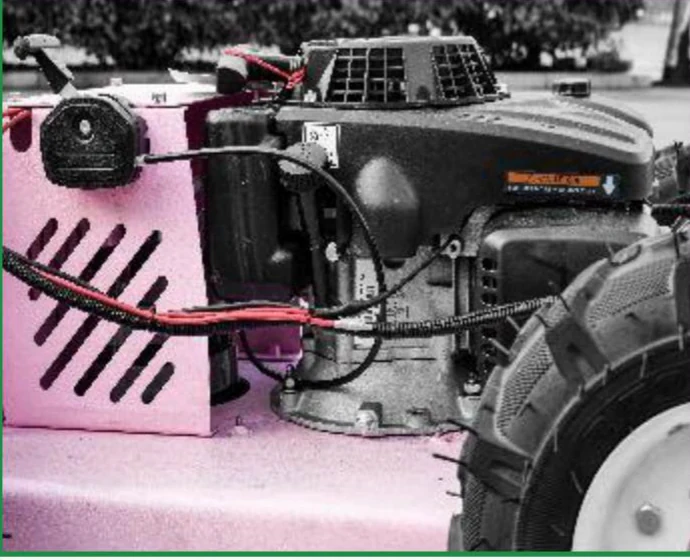
The fastest way to keep a work order accurate is to record which test was run and what it can and cannot tell you. A compression test is a cranking-pressure measurement: the engine is turned over, usually on the starter or recoil, and the gauge captures the peak pressure the cylinder develops. A leak-down test is a controlled-loss measurement: the piston is positioned at a defined point, typically top dead center on the compression stroke, and regulated air is fed into the cylinder while the tester shows the percentage of that air escaping.
That difference shapes what each result means in a service conversation.
| Question | Compression test | Leak-down test |
|---|---|---|
| What is measured | Peak pressure built by cranking | Rate of pressure loss from a supplied air source |
| What it can suggest | Whether the cylinder builds pressure at all, and how cylinders compare | Where pressure escapes and how badly |
| What it cannot do alone | Locate the leak path or name the failed component | Reproduce the engine's own cranking behavior |
| Main dependencies | Cranking speed, starter/recoil condition, throttle and valve state, release mechanisms | Piston position, regulator setting, tester calibration, listening points |
| Typical service use | First-pass screen and cylinder-to-cylinder comparison | Follow-up localization after a low or uneven compression result |
A compression test is quick and useful as a screen. If one cylinder is far below its neighbors on a multi-cylinder engine, that is a signal worth pursuing. But the gauge reports a single peak number, and that number is the product of several inputs: how fast the engine cranked, whether the throttle plate was open, whether the valves sealed, and whether any mechanism was holding a valve open during cranking.
A leak-down test gives a technician a different kind of information. Because air is supplied steadily and the loss is expressed as a percentage, the technician can listen at the intake, the exhaust, and the crankcase breather or oil fill to judge whether air is escaping past an intake valve, an exhaust valve, or the rings. That localization is the test's real value. What it does not do is tell you the engine's own cranking pressure, and it does not by itself declare a part failed.
For a service advisor, the practical translation is simple: a compression result belongs on the work order as a screening observation, and a leak-down result belongs as a localization observation. Neither should be written up as a diagnosis until the technician has tied it to the engine's configuration and symptoms.
Read the Kohler ECV940/ECV980 manual and its ACR qualification

The Kohler Command PRO EFI ECV940/ECV980 service manual, document 62 690 05 Rev H, is a useful example because it states a limitation that many generic test guides skip. According to that manual, some recoil-start models equipped with automatic compression release (ACR) are difficult to compression-test accurately, and a leak-down test can serve as an alternative approach.
That statement deserves careful reading. It is model- and configuration-specific. It applies to the engines and starting arrangements the manual covers, and it is tied to the presence of automatic compression release. It is not a claim that every small engine has ACR, that every Kohler ECV model behaves the same way, or that compression testing is useless on equipment in your shop.
What ACR does, in general terms, is hold a valve slightly open during cranking so the starter or recoil does not have to overcome full compression. That is a starting aid. The consequence for testing is that a gauge measuring cranking pressure may see a lower peak than the cylinder would produce without the release operating. The reading is not necessarily wrong; it may simply be measuring a different condition than the technician assumes.
| Manual detail (62 690 05 Rev H) | What it supports | What it does not support |
|---|---|---|
| Some recoil-start models with ACR are difficult to compression-test accurately | Treating a low cranking reading on those configurations with caution | A universal low-compression threshold for all engines |
| Leak-down testing is presented as an alternative | Using leak-down as a follow-up where ACR complicates the gauge reading | Replacing every compression test with a leak-down test |
| Electronic throttle diagnostics require the appropriate dealer system | Routing EFI throttle work to a properly equipped dealer | Any DIY electronic throttle procedure |
The same manual also limits electronic throttle diagnosis to the appropriate dealer system. For a service coordinator, that is a routing decision, not a repair instruction: EFI throttle faults on these engines go to a dealer with the specified system rather than to a general bench.
If your shop services mixed brands, keep the source attached to the claim. A note on the work order that reads "ACR-equipped recoil-start model; compression reading may not be representative per OEM manual" is defensible. A note that reads "all small engines with ACR read low" is not, and it will not survive a customer conversation or a warranty review.
Explain why a reading alone is not a universal diagnosis

Automotive test guides are widely available and often well written, but their numbers do not transfer to commercial mower engines. Compression ratios, cranking speeds, cam profiles, combustion chamber volumes, and starting aids all differ. A figure that indicates a healthy cylinder on a passenger car can be meaningless on an air-cooled twin, and the reverse is also true.
Three practical reasons explain why a single reading should not close a diagnosis.
Configuration changes the measurement. Automatic compression release is the clearest example from the Kohler manual, but it is not the only variable. Throttle position, choke state, battery condition, starter health, and valve clearance all influence what a compression gauge sees. A technician who does not record those conditions leaves the next person unable to interpret the number.
Application review
Discuss your mowing application.
Share the working condition, target market, product family and project scope.
A percentage is not a part number. A leak-down tester can show that a cylinder is losing air, and listening can suggest where. It cannot tell you whether the loss is a burned valve, a worn ring set, a scored bore, or a head gasket path without further inspection. Writing "leak-down 30%, bad rings" on a work order overstates what the test proved.
Symptoms carry context the gauge does not. A mower that surges under load, burns oil, or starts hard when hot tells a different story than one that simply reads low on a cold bench test. Our article on lawn mower engine surging symptoms covers how symptom patterns point toward fuel, ignition, or mechanical causes before a tester is connected. Pairing the symptom history with the test result is what makes the result useful.
A reasonable service sequence, stated in general terms rather than as a procedure, looks like this: capture the complaint and operating conditions, confirm the engine model and starting configuration, run the appropriate screen, follow up with a localization test where the screen is ambiguous, and route anything requiring manufacturer-specific equipment to the right party. The sequence matters more than any single number.
For shops that also handle remote-controlled equipment, the same discipline applies. Super Mowers' Remote 50 gasoline mower is listed with a gasoline engine, and engine service questions on that platform should be answered from its own documentation rather than from a Kohler manual or a car guide. The product listing does not establish which diagnostic configuration applies to a given unit in your shop.
Prepare engine model, configuration and symptoms for qualified service

The handover is where most diagnostic value is lost. A technician receives a unit with a one-line complaint, no model confirmation, and no note about how it starts. Building a short, repeatable intake record fixes that without requiring the service advisor to diagnose anything.
Use the following as a template. It is a question set, not a specification sheet; every field is something to confirm from the unit, its labels, or its documentation.
| Handover field | What to record | Why it matters |
|---|---|---|
| Engine make, model, spec number | From the engine label, not the mower model alone | Test interpretation is model-specific |
| Starting system | Recoil, electric start, or both | ACR-related reading limits are tied to configuration |
| Presence of automatic compression release | Confirmed from the engine documentation | Changes how a cranking reading should be treated |
| Fuel system type | Carbureted or EFI | EFI diagnostics may need dealer equipment |
| Customer complaint | Starting, power, smoke, noise, fuel use, hot vs cold | Directs which test is run first |
| Operating conditions | Load, terrain, temperature, hours since last service | Explains symptom patterns |
| Tests already performed | Which test, gauge or tester used, conditions | Prevents duplicate or misread results |
| Routing decision | Bench, dealer system, or specialist | Keeps work within the shop's capability |
Two habits make this table work in practice. First, record the conditions alongside the result: "compression checked, cold, throttle closed, recoil start" is far more useful than "compression low." Second, note when a test was not run because the configuration made it unreliable, and say why. That note protects the shop and gives the next technician a starting point.
For EFI units covered by a manual like 62 690 05 Rev H, the routing decision should be explicit. If electronic throttle diagnosis requires the appropriate dealer system, the service advisor should say so at intake rather than after a bench attempt. That is a scheduling and capability question, not a judgment about the technician's skill.
Finally, keep the source visible. When a work order cites a manufacturer statement, name the document and revision. Manuals are revised, and a claim that was accurate under Rev H should be checked against the current revision before it is repeated in a warranty file or a customer explanation.
FAQ

Can automatic compression release change a compression reading?
Yes, it can affect what a cranking compression gauge shows, because the release holds a valve open during starting and reduces the pressure the engine builds while cranking. The Kohler ECV940/ECV980 manual (62 690 05 Rev H) notes that some recoil-start models with ACR are difficult to compression-test accurately and presents leak-down testing as an alternative. That statement is specific to the models and configuration the manual covers; it should not be generalized to every small engine.
Does a leak-down result alone identify the failed part?
No. A leak-down test shows how much supplied air escapes and, with careful listening, where it is escaping. Turning that into a part-level diagnosis requires further inspection and the engine's own service information. Record the percentage and the listening observations, then let the qualified technician complete the diagnosis.
Conclusion

Compression and leak-down tests answer different questions, and ACR-equipped engines can make one reading misleading. Record the model, configuration, and symptoms, cite the manual revision, and route EFI work to properly equipped service.
Video: How To Do A Compression and Leak Down Test | What is the difference?
