By Anna
You are pricing a roadside or hillside vegetation job and deciding how to split it: machine work on the open ground, hand work at the edges, or both. The answer is rarely one tool for the whole site.
For a contractor, the remote control slope mower vs brush cutter question is not a straight substitution. The mower is a candidate for open, accessible ground within its documented limits; the brush cutter handles edges, obstacles, and small residuals. Compare them by zoning the site, checking each tool's conditions, and costing the full job, not by comparing machine price to tool price.
This article is a planning framework for US landscape and roadside vegetation contractors. It does not publish Super Mowers performance figures, and it does not treat any other company's marketing as a general result.
Remote control slope mower vs brush cutter contractor: Map the whole worksite before comparing tools

The first comparison is not between machines. It is between zones of your site. Walk the work area and divide it into ground a machine can reach and work within its manual, ground that needs hand work, and ground that should be excluded from both until a competent person decides otherwise. Only after that map exists does a mower-versus-brush-cutter question become answerable.
This matters because the two tools fail in different ways. A remote mower's constraint is usually access, slope, ground condition, obstacle clearance, and the operating limits in its manual. A brush cutter's constraint is the operator: reach, fatigue, exposure, and the time needed to work around fixed objects. A site that suits one may be entirely unsuitable for the other, and a mixed crew is often the realistic plan.
Record open ground, access, obstacles and work exclusions
Build a simple zone record before requesting equipment or pricing labor. The table below is a field template, not a set of rules; fill it from your own site walk and the applicable manual.
| Zone record item | What to capture | Why it changes the tool decision |
|---|---|---|
| Open ground | Continuous area, vegetation type and height, ground surface | Determines whether machine mowing is a candidate at all |
| Slope and cross-slope | Measured value with units and where it occurs | Must be compared with the exact model manual, not a general figure |
| Access route | Gate width, path surface, turning space, transport route | A mower that cannot reach the zone is not in the comparison |
| Obstacles | Posts, hydrants, trees, ditches, culverts, guardrail | Drives residual hand work and exclusion zones |
| Ground condition | Soft, rutted, rocky, wet, loose | Affects traction and stability questions for any machine |
| Work exclusions | Areas not to be worked, and who decided | Prevents the bid from assuming work that will not happen |
| Edge length | Linear feet of boundary, fence, curb and structure edge | The main driver of brush cutter labor |
| Debris and disposal | Volume estimate and destination | Often a larger cost line than cutting itself |
Record slope in the units your manual uses and note where on the site each measurement was taken. Do not convert degrees to percent grade casually, and do not treat a slope figure from a brochure, a video, or another model's manual as an operating limit for your machine.
Compare documented roles and restrictions

Once the zones exist, assign roles. In most contractor planning, the remote mower is evaluated for the open area and the brush cutter for edges, tight spots, and residuals. That division is a planning default, not a safety conclusion: each zone still has to be checked against the equipment's own documentation and your site assessment.
A 2019 California Department of Transportation research report on roadside vegetation control is sometimes cited in these discussions. Treat it as what it is: a study of specific equipment and specific test conditions. It does not establish Super Mowers efficiency, safety, or suitability, and it should not be generalized into a claim that remote mowers replace hand crews or that a particular slope is safe.
Separate machine and handheld tool conditions
The two tools carry different condition checks, and mixing them in one comparison hides the important differences.
| Decision area | Remote-controlled slope mower | Handheld brush cutter |
|---|---|---|
| Primary role in the plan | Open-area vegetation work within documented limits | Edges, obstacles, small residuals, tight access |
| Key limit source | The exact model manual and its operating instructions | Tool manual, cutting attachment specification, operator training |
| Access requirement | Transport route, gate width, unloading space, turning room | Foot access; can reach where a machine cannot |
| Ground sensitivity | Traction and stability questions on soft or loose ground | Operator footing and balance |
| Operator exposure | Operator positioned away from the cutting unit per the control arrangement | Operator close to the cutting unit and debris path |
| Residual work | Leaves edge and obstacle trimming | Can complete most edge work, slower on large areas |
| Verification needed | Documented demonstration within stated conditions | Confirmed attachment, guard and training status |
Remote control means the control arrangement described in the equipment documentation. It does not by itself establish autonomous navigation, obstacle detection, unattended operation, a safe working distance, braking performance, or the ability to handle a given slope or vegetation type. Those are separate questions answered by the manual and by your site assessment.
For related reading on how slope figures are expressed and what they mean, see remote control mower slope rating. For vegetation and cutting capacity questions, see flail mower brush cutting capacity.
Compare the complete job cost

The useful comparison is cost per completed job, not cost per machine. A remote mower can look expensive against a brush cutter until you count the hours of hand work it removes from the open area. A brush cutter can look cheap until you count the hours it adds back at the edges, plus fatigue, rework, and schedule risk. Build the estimate from the zone map and the crew plan.
Application review
Discuss your mowing application.
Share the working condition, target market, product family and project scope.
Include setup, mowing, edge work, transport and downtime
Use a line-item structure that lets a reviewer recompute the numbers. The template below is deliberately qualitative; fill it with your own rates, crew sizes, and measured areas.
| Cost line | What to estimate | Common omission |
|---|---|---|
| Mobilization and transport | Truck, trailer, loading, travel, unloading | Return trips for a second machine |
| Site setup | Access preparation, marking exclusions, briefing | Time lost to unclear access |
| Open-area work | Area divided by a realistic productivity rate | Using a brochure rate as a job rate |
| Edge and residual work | Linear feet times a hand-work rate | Underestimating fence, curb and guardrail edge |
| Supervision and spotting | Crew coordination, traffic control where required | Assuming remote control removes supervision |
| Debris handling | Collection, loading, disposal fees | Disposal cost per load |
| Downtime allowance | Weather, breakdown, rework, waiting | Zero allowance in the bid |
| Contingency | A stated percentage with a reason | Hidden padding instead of a stated line |
Two habits make this table honest. First, keep productivity assumptions separate from verified equipment specifications; a rate you assume is not a tested result. Second, show hand-work hours explicitly rather than burying them in a general labor line, because edge work is where the two tools differ most.
A mixed crew often wins on total cost: the mower covers the open ground, and one or two operators finish edges and obstacles while the machine is still productive. The tradeoff is coordination, transport of two equipment types, and the need for clear zone boundaries so hand crews are never working where the machine is operating.
Test the proposed combination

Before committing a bid to a particular combination, verify it. Ask for a demonstration in conditions that resemble your site, and ask for a quotation that states what is and is not included. A demonstration is evidence about that machine in those conditions, not a guarantee for your slope, vegetation, or ground.
Use a documented demonstration and a clear quotation
Write down what you saw and what you were told, and keep the two separate. The checklist below is a practical record, not a certification.
| Verification item | Record |
|---|---|
| Machine model and configuration | Exact model, attachments, control configuration |
| Demonstration conditions | Vegetation type and height, ground, slope with units, weather |
| Operating limits stated | Source document and revision, quoted not paraphrased |
| Control arrangement | How the operator controls the machine and from where |
| Edge performance | How close the machine works to fences, curbs and obstacles |
| Residual hand work | What still needs a brush cutter, and roughly how much |
| Transport and access | Trailer, gate width, unloading, turning |
| Quotation scope | Included items, exclusions, assumptions, validity period |
| Support and parts | What is confirmed in writing for your model |
If a supplier cannot state a limit with a source, treat it as unconfirmed for bidding purposes. Super Mowers product information and quotation requests are handled through the products page and the quote contact; handheld brush cutters are referenced here only as a comparison tool, not as a Super Mowers offering.
FAQ

Can a remote mower replace every brush cutter?
No. A remote mower is a candidate for open ground within its documented limits. Edges, tight access, obstacles, and small residuals usually still need hand work. The right question is which zones each tool covers, not whether one replaces the other entirely.
Is moving the operator away enough to prove the job is safe?
No. Distance from the cutting unit is one factor in the control arrangement, not a safety conclusion. Slope, ground condition, stability, thrown objects, access control, and the manual's operating limits all matter, and the site assessment must cover them.
How should manual finishing be included in a bid?
Estimate it as linear feet of edge and obstacle perimeter multiplied by a hand-work rate you can defend, then show it as its own line. Include debris handling and a stated downtime allowance so the client can see what the hand work actually costs.
Conclusion

Zone the site first, check each tool against its own documentation, and cost the whole job including edges and downtime. Then ask for a documented demonstration and a quotation with clear exclusions before you bid.
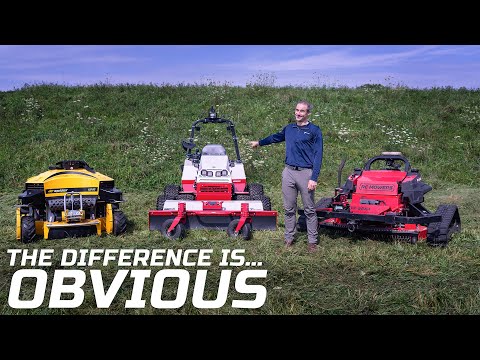
Video: Remote Control Mower Comparison | Which should I buy?