
 By Anna
A remote mower can be running 50 metres away while its operator stands beside a supervisor, a fuel can and a second machine. Deciding who needs lawn mower hearing protection, and what kind, is therefore a site question rather than a control-type question.
Remote control changes where people stand, not whether noise exists. Start by listing every worker and location near the machine, then gather measured noise data for those positions, read the protection label on each device, and check fit and communication needs before a supervisor signs the handoff.
This article is written for field supervisors and operator/maintenance staff on remote-mowing crews in the US. It sets out what to record, what to verify, and where to stop and ask a competent person. It does not supply sound levels for any Super Mowers model, and it does not certify any mower-and-protector combination. For background on how remote-controlled machines fit into site work, see the commercial remote control lawn mower overview.
Lawn mower hearing protection: Identify exposed workers and locations

The first step is a simple map of people, not a map of the machine. Walk the work area and note where each person will actually stand during a normal shift: the remote operator, anyone assisting with the mower, crew members working nearby, and staff who service or refuel the equipment. Each position can produce a different exposure picture, and each one needs its own entry in your records.
This is a planning exercise, not a measurement. The output is a list of roles and positions that a competent person can then assess. Keep the list specific: “operator at the rise on the north boundary” is more useful than “operator”.
Separate remote operator, nearby crew and service staff
Remote mowing often splits one job across several people. Treat these groups separately:
- The remote operator controls the machine from a chosen position. That position may be close to the cutting area, behind a vehicle, or on higher ground with a line of sight.
- Nearby crew may be string-trimming, blowing, moving obstacles or handling another machine within the same area.
- Service and maintenance staff may work near the mower when it is stopped, when blades are not running, or during checks and refuelling.
- Supervisors and visitors who spend only short periods in the area still need to be considered, even if their time is limited.
Each group has different tasks, durations and positions, so a single answer for the whole crew is rarely accurate. A protector that suits a trimmer operator may obstruct the radio headset a remote operator needs. Landscaping crew hearing protection therefore has to be matched to the role, not issued as one product for everyone.
Do not infer actual exposure from distance
It is tempting to assume that a remote operator standing well back from the machine is unexposed. Distance is one factor among many, and it is not a measurement. Ground shape, reflective surfaces such as buildings or vehicles, wind, other equipment running at the same time, and the actual engine and blade load all affect what reaches a person’s ears.
Remote control is a control arrangement. It does not by itself establish a sound level at the operator’s position, a safe working distance, or a protective requirement. The same applies to the machine’s own noise label: a figure measured at one location and condition does not automatically describe the operator’s ear position.
Use the position list to decide where assessment is needed. Do not use it to declare any position safe.
Gather the applicable noise information

Once the positions are listed, collect the noise information that actually applies to them. There are three possible sources, and they are not interchangeable: measurements taken in the real work area, figures published for the specific machine, and general occupational guidance. Each has a scope and a limit.
NIOSH’s occupational guidance on hearing protection addresses when protection is needed and how to select and use it in workplace settings, but it does not certify a particular mower-and-protector combination (CDC/NIOSH). General hearing-health information from the NIH is aimed at the public and is useful for explaining why protection matters, not for setting a site limit (NIH).
Record measurement location and conditions
If noise measurements exist or are commissioned, the record matters as much as the number. A figure without context cannot be applied to a different position or a different machine configuration. Capture at least the following for each reading:
| Record field | Why it matters |
|---|---|
| Date and time of measurement | Conditions and equipment change between shifts |
| Exact position relative to the mower | Operator ear position differs from a boundary reading |
| Machine model and configuration | Attachments, blades and settings affect the source |
| Engine and blade state | Idle, cutting and travel produce different results |
| Ground and surrounding surfaces | Hard or reflective surfaces change what reaches the ear |
| Other equipment running | Trimmers, blowers and vehicles add to the total |
| Measurement method and instrument | Results from different methods are not directly comparable |
| Who took the reading | The record needs an accountable name |
If any field is missing, mark it as unknown rather than filling it from memory or from another machine’s data. A partial record is more honest and more useful than a complete-looking one built on assumptions.
Leave unmeasured SANYANG values blank
This article has no measured sound levels for Super Mowers or SANYANG equipment, and no protective requirement can be inferred from the application-planning material on the Super Mowers site (application planning). That page describes intended use and reader context; it does not guarantee performance or state noise figures.
Likewise, the Burro Cortador manual-mowing page covers that machine only. Nothing in it should be transferred to a SANYANG model, and no sound level or protective requirement should be inferred from it (Burro Cortador manual).
In your own records, leave the sound-level column blank for any model or position that has not been measured. A blank cell is a prompt to assess; an invented number is a liability. When a figure is needed, obtain a real measurement under representative conditions or ask a qualified professional to assess the site.
Read protection labels and fit

Hearing protection is a labelled product category, and the label is the starting point for selection. The two common rating systems in the US are the Noise Reduction Rating (NRR) and, for some products, a dual rating that also gives an estimated A-weighted value. The rating describes the device under test conditions; it does not describe what a particular wearer receives in a particular workplace.
That gap is why fit matters as much as the number. A protector that is poorly seated, broken, or pushed aside to hear a radio provides far less benefit than its label suggests. Selection, fitting and training are part of the control, not an afterthought.
Application review
Discuss your mowing application.
Share the working condition, target market, product family and project scope.
Distinguish NRR labels from ordinary noise cancellation
Active noise cancellation (ANC) is a feature found in consumer headphones, earbuds and some communication headsets. It reduces certain sounds electronically, usually steady low-frequency noise. It is not the same as a hearing protector with a published attenuation rating, and a product marketed on its ANC performance alone should not be recorded as certified hearing protection.
When checking a device, look for:
- A stated attenuation rating and the standard it refers to
- Whether the product is described as hearing protection, not only as noise cancelling
- Instructions for correct insertion or placement
- Any stated limits on use, such as compatibility with other PPE
- Whether the manufacturer provides fitting or training information
If the label is missing or the product is described only in terms of ANC, record it as unverified and raise the question with the responsible person. Do not assume equivalence between a consumer headset and a rated protector.
Consider glasses, fit and communication
Real crews wear more than ear protection. Safety glasses, hard hats, face shields, radios and high-visibility clothing all interact with the head and ears. A few practical checks help:
- Glasses: temples can break the seal of earmuffs. Check whether the protector is designed to accommodate them, and confirm the wearer still gets a consistent fit.
- Headwear: hard hats and bump caps change how muffs sit. Use compatible combinations rather than forcing a fit.
- Communication: a remote operator may need to hear radio calls, alarms or colleagues. Some protectors include communication features; verify what the product actually provides rather than assuming.
- Duration and comfort: a protector that becomes uncomfortable will be removed. Comfort is part of whether protection is actually worn.
- Hygiene and condition: damaged cushions, cracked shells or stretched bands reduce performance and should be replaced.
A fit check is a conversation, not a formality. Ask the wearer to seat the device, then look at the seal, the position and whether anything is trapped underneath. Record who checked and when.
Record the fleet handoff
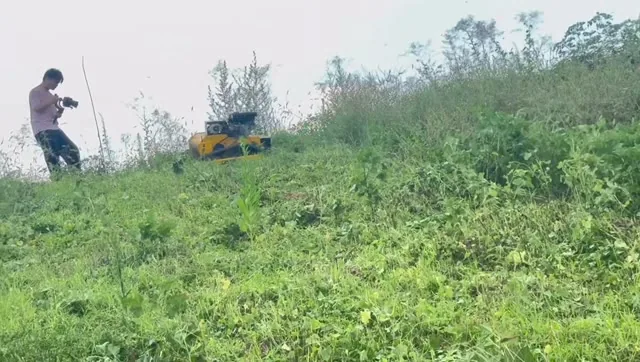
Remote mowing often involves shared equipment: machines move between sites, crews and rental arrangements. Every handoff is a chance for hearing-protection information to be lost. A short, consistent handoff record keeps the chain intact.
Use one record per machine per handoff, and include the following:
| Handoff item | What to record |
|---|---|
| Machine identity | Model, unit number and configuration |
| Positions assessed | Which roles and locations have been reviewed |
| Noise information held | Measured values, published figures, or “not measured” |
| Protectors issued | Type, rating label and size |
| Fit check | Who checked, when, and any issues found |
| Communication needs | Radio, alarms or other requirements noted |
| Open questions | Items referred to the responsible person |
| Sign-off | Name and role of the person accepting the handoff |
The record does not need to be long. It needs to be specific enough that the next supervisor can see what was and was not established.
Assign assessment to the competent responsible person
Deciding whether protection is required, and which protector is suitable, is an assessment task. It belongs to a competent responsible person within the organisation, working from real measurements and applicable requirements, not to whoever happens to be on site. The supervisor’s job is to make sure the assessment happens, that its conclusions reach the crew, and that the records travel with the machine.
Where personal selection concerns arise, such as an existing hearing condition or difficulty achieving a fit, the appropriate step is to consult a qualified professional. General guidance cannot resolve an individual medical or fitting question.
Recheck the applicable manual and local requirements
The machine manual and the local requirements that apply to your site are the controlling documents. Recheck them at each handoff, because models, configurations and rules change. Confirm:
- The exact model and revision of the manual in use
- Any stated noise information and the conditions it was measured under
- Any stated protective requirement, and whether it is model-specific
- Local workplace requirements that apply to your jurisdiction and site
- Any rental or client requirements attached to the machine
Do not carry a requirement from one model to another, and do not treat a general guidance document as a substitute for the manual or for local rules. Where the two appear to conflict, refer the question to the responsible person rather than resolving it informally.
Frequently asked questions

Does remote operation remove all hearing risk?
No. Remote control changes where the operator stands, but it does not establish the sound level at that position. Exposure depends on distance, surroundings, other equipment and the machine’s operating state. Treat the operator’s position as one to be assessed, not one to be assumed safe.
Is ANC alone certified hearing protection?
Not automatically. Active noise cancellation is a feature that reduces some sounds electronically. A hearing protector should carry a stated attenuation rating and be described as hearing protection. If a device is marketed only on ANC, record it as unverified and check with the responsible person before relying on it.
Does an NRR label equal actual protection for every wearer?
No. The NRR describes the device under test conditions. What a wearer receives depends on fit, condition, compatibility with glasses or headwear, and whether the device is worn correctly for the whole exposure period. Fit checks and training are part of the control.
Conclusion

List the positions, gather real noise data, read the labels, check the fit, and record the handoff. Where a value or requirement is unknown, leave it blank and refer it to the responsible person.
Video: You're using Hearing Protection WRONG!
