

 By Anna
Gasoline vs diesel remote control mowers: which is better for commercial grounds maintenance? Neither fuel automatically wins. The practical choice depends on the mower and deck configuration, the work performed per hour, fuel availability, maintenance support, and the full cost of completing the same mowing job.
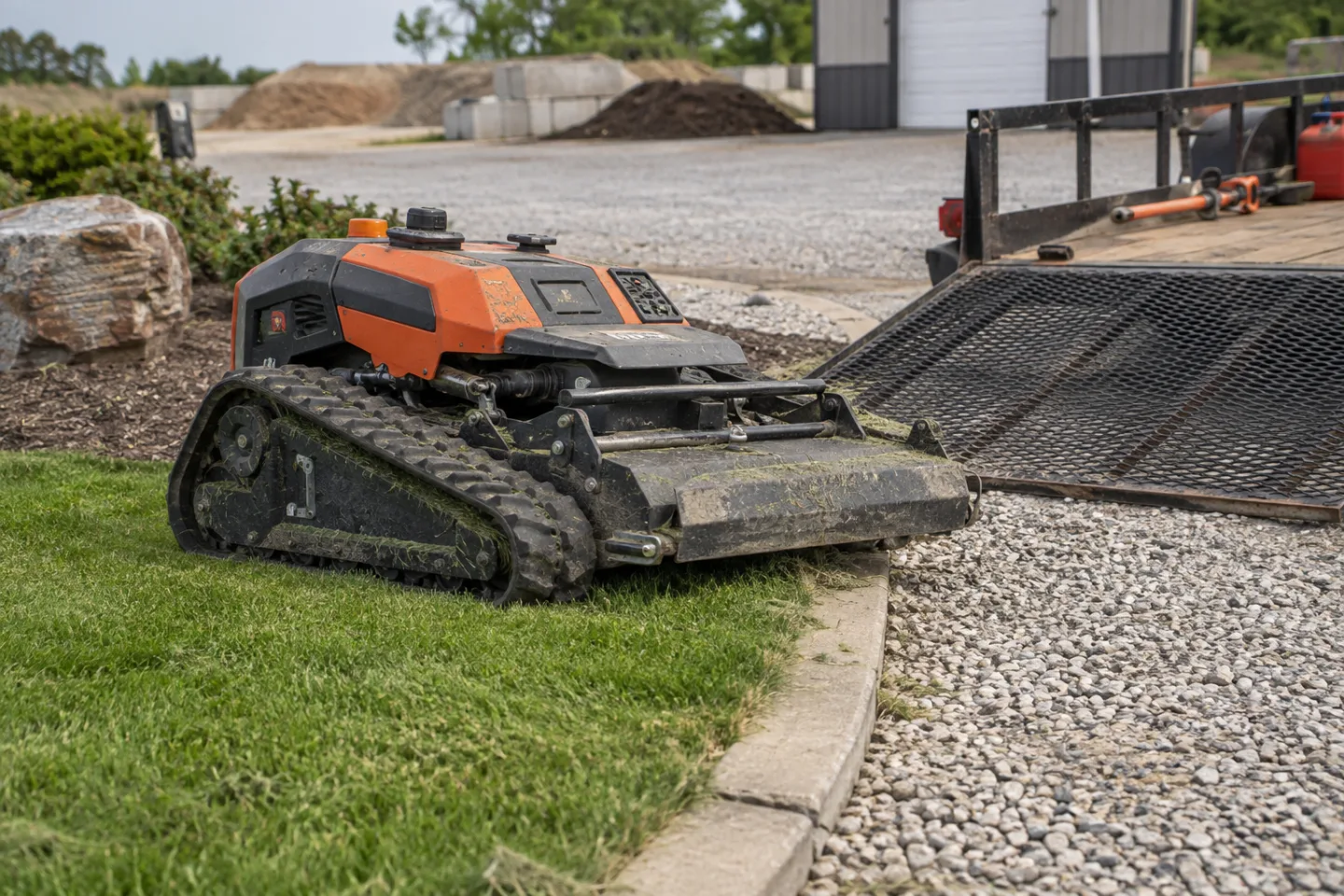
For the fairest comparison, ask suppliers for gasoline and diesel versions of the same remote-control mower platform if both are genuinely available. If no shared-platform options exist, compare machines in the same working class and document every difference instead of presenting fuel type as the only variable. This buyer’s guide includes an RFQ (request for quotation) checklist, a fuel-cost calculation, and questions for distributors and fleet managers.
This article compares internal-combustion remote-control mowers. Battery-electric equipment, snow-removal machines, and tracked carriers require separate evaluations because their work cycles and governing specifications are different.
Start with a matched mower and a defined job

An engine comparison is useful only when buyers know what the machines are being asked to do. Establish one representative work profile before comparing brochures:
- Site type: municipal park, roadside vegetation, orchard, solar site, or contracted commercial grounds.
- Vegetation and required finish: grass density, typical height, brush presence, cutting-height target, and clipping expectations.
- Workload: annual mowing hours, expected acres or hectares, daily deployment schedule, and travel between properties.
- Machine configuration: cutting width, deck type, tracks or wheels, transmitter functions, manufacturer-documented safety-stop controls, and attachment options.
- Constraints: access openings, transport requirements, local fuel access, service response times, and applicable site rules.
Best-case comparison: two engine options installed on the same chassis with the same mowing head, drive system, and remote-control functions. Request the exact model and option codes in writing; do not assume an advertised product family has interchangeable gasoline and diesel engines.
If no matched pair exists: use two machines with a comparable cutting function and working width, then show weight, drive-system, deck, speed, and control differences as separate variables. Check the documented emergency-stop and signal-loss functions for each machine rather than assuming they match. Mark the result as an equivalent-duty comparison, not a fuel-only test.
Gasoline vs diesel remote mower comparison table

Use the table to request evidence for the exact engine and mower configuration. It identifies items to check; it does not assume that a gasoline or diesel version will perform better.
| Decision factor | Gasoline remote mower: verify | Diesel remote mower: verify |
|---|---|---|
| Engine and rated output | Engine model, rated power and speed, torque data if available, and installed deck drive | Engine model, rated power and speed, torque data if available, and installed deck drive |
| Fuel used per job | Gallons per hour under a stated mowing duty cycle, plus measured area completed | Gallons per hour under the same stated mowing duty cycle, plus measured area completed |
| Fuel supply and storage | Approved gasoline grade and blend, turnover rate, storage and seasonal fuel requirements | Approved diesel grade or blend, storage condition, filtration, and water-management requirements |
| Starting and seasonal conditions | Documented temperature and altitude limits, battery and starting provisions where applicable | Documented temperature and altitude limits, cold-weather fuel guidance, and starting provisions where applicable |
| Maintenance | Oil and filter schedules, ignition and fuel-system service, consumable parts and labor time | Oil and filter schedules, fuel filtration, water-separator service if equipped, and other engine-specific tasks |
| Installed mower weight | Operating weight with the quoted deck, accessories, and a defined fuel level | Operating weight on the same measurement basis, including any engine-related changes |
| Emissions documentation | Applicable market and engine-family certification, plus site or contract requirements | Applicable market and engine-family certification, plus site or contract requirements |
| Ownership and support | Quoted price, warranty exclusions, local service coverage, and parts lead times | Quoted price, warranty exclusions, local service coverage, and parts lead times |
Both columns require documentation. Do not assume every diesel mower has a water separator, every gasoline mower has a carburetor, or either engine has a specific emissions-control component without checking its actual specification.
Why fuel economy is more than gallons per hour

Diesel fuel typically contains more energy per gallon than gasoline. The U.S. Energy Information Administration’s illustrative conversion factors list approximately 137,381 Btu per gallon for diesel and 120,214 Btu per gallon for motor gasoline. But energy per gallon is not the same as mowing productivity or cost per acre: engine design, transmission losses, deck power demand, cutting width, and site conditions all affect the result.
Ask for consumption measured during comparable work rather than comparing tank capacity or an engine’s advertised economy in isolation. When data is available, calculate:
- Fuel cost per operating hour = gallons used per hour × delivered fuel price per gallon.
- Fuel used per acre = gallons consumed during the job ÷ acres actually mowed.
- Fuel cost per acre = fuel used per acre × delivered fuel price per gallon.
For example, if one machine burns fewer gallons per hour but cuts substantially less area in that hour, it may still have a higher fuel cost per completed acre. Record travel, turning, refueling, and job interruptions consistently, or label the figures as engine-only measurements rather than whole-job results.
Application review
Discuss your mowing application.
Share the working condition, target market, product family and project scope.
Compare total operating cost, not just fuel spend
A commercial purchasing decision also needs maintenance labor, scheduled service parts, expected repair and downtime costs, local technician coverage, transport, and the purchase or financing difference. Use the same expected annual hours and service horizon for both quotes. If a supplier cannot substantiate a cost or service interval, leave it unverified rather than inventing a payback period.
Check seasonal fuel, maintenance, and compliance requirements
Fuel availability is a fleet constraint, not simply a pump-price comparison. A contractor whose other machines already use one approved fuel may reduce operational complexity, but the benefit must be weighed against the actual remote mower specification.
Engine manufacturers provide fuel-specific guidance that buyers should request for the exact engine:
- Gasoline storage: Briggs & Stratton’s equipment storage guidance warns that gasoline can deteriorate during extended storage. The applicable fuel grade, blend limits, and storage instructions should come from the supplied engine manual.
- Diesel fuel quality: Kubota Engine America’s service resources address diesel fuel specifications, approved blends, filtration, and engine-specific aftertreatment requirements. Do not transfer those provisions automatically to a different diesel engine.
- Emissions compliance: For U.S. purchases, the EPA provides separate information for nonroad spark-ignition engines and nonroad compression-ignition engines. Request evidence appropriate to the engine family, model year, and market of sale; do not assume the same certification applies to both fuels.
Site fuel handling, environmental conditions, and any special work restrictions must be checked against the current local requirements and the manufacturer’s instructions. This article does not prescribe fuel storage quantities, refueling methods, cold-start procedures, or operator safety limits.
Build a fair RFQ for gasoline and diesel configurations
Issue one technical questionnaire to every shortlisted supplier and make the comparison basis explicit:
- Define the job: intended mowing zones, vegetation, required finish, working hours, and total area.
- Identify the machine class: remote-control mower with the required deck type and approximate cutting width, not a snow or transport machine.
- Ask whether a matched platform exists: request gasoline and diesel option codes on the same chassis if offered.
- Record differences when platforms vary: deck, drive, weight, cutting speed, remote controls, and manufacturer operating limits.
- Request measurable performance: operating fuel use and acres per hour under a common, stated duty cycle.
- Request maintenance documents: service intervals, estimated service time, consumables, parts availability, and local support.
- Verify market fit: approved fuel and blend, documentation for the relevant engine and market, lead time, and warranty.
- Compare the completed job: calculate fuel cost per acre and review total annual ownership and operating costs.
Supplier response worksheet
| RFQ field | Gasoline quote | Diesel quote |
|---|---|---|
| Mower / engine model and version | Record exact ID | Record exact ID |
| Same chassis and deck? | Yes / No; document differences | Yes / No; document differences |
| Cutting width and height range | Attach current specification | Attach current specification |
| Fuel used during matched mowing test | Gallons and test conditions | Gallons and test conditions |
| Measured area completed | Acres or hectares and time | Acres or hectares and time |
| Annual service schedule and cost | Parts, labor and intervals | Parts, labor and intervals |
| Operating weight and dimensions | State measurement configuration | State measurement configuration |
| Certification, warranty, and support | Provide documents and contact | Provide documents and contact |
Where direct field-test data is unavailable, request the manufacturer’s published test conditions and treat estimated performance as provisional. A missing comparable figure is a reason to ask a question, not proof that one fuel is inferior.
Which fuel should a commercial buyer shortlist?

Consider a gasoline configuration when its documented mower capability meets the job and the fleet already has compatible fuel supply, reliable service support, and acceptable storage arrangements. Consider a diesel configuration when the quoted machine meets the same job requirements and its measured workload economics, service network, and site fueling arrangement make it a stronger fit. These are evaluation conditions, not universal engine-performance claims.
Before you choose, ask three final questions:
- Can both machines deliver the required mowing finish and coverage under a genuinely comparable work cycle?
- Are fuel, maintenance, downtime, and acquisition costs based on documented inputs rather than general assumptions about gasoline or diesel?
- Can the supplier support the exact engine, remote-control system, and deck configuration in the region where the mower will operate?
For a scoped commercial equipment inquiry, send the intended cutting width, vegetation and site profile, estimated annual mowing hours, local fuel arrangements, and required service location. Ask the supplier to identify whether both fuels are available on a matched remote mower platform—or to list the differences in a comparable-duty alternative.
The decision is not simply gasoline versus diesel. It is which fully specified remote-control mower can deliver your contracted mowing work at a verified operating cost, with reliable support and documentation.