By Anna
A flail mower in your fleet is vibrating, and someone has suggested sending the rotor for dynamic balancing. Before you book that service, you need to know what part is actually being balanced, what the workshop will need, and what your own records must show.
Flail mower rotor dynamic balancing treats a complete rotating assembly — typically the rotor shaft with its flail knives and mounting hardware fitted — as one unit, and it is a specialist workshop task, not a field adjustment. Balancing a single knife is a different job. Your part is to identify the machine, the assembly state, and the service scope before handoff.
This article is written for maintenance supervisors running commercial flail mower fleets and for dealer service staff who arrange repairs. It separates the parts of the balancing question, shows how one named manufacturer describes its factory-balanced rotor, and sets out the records to prepare before a specialist service takes the machine.
Flail mower rotor dynamic balancing: Define the rotor assembly and dynamic balancing

Dynamic balancing is the process of correcting the mass distribution of a rotating assembly so that it runs without excessive vibration at operating speed. It is performed on the assembly as it will rotate in service, using balancing equipment in a workshop. The correction itself — where material is removed or added, and how much — belongs to the specialist doing the work, working to the manufacturer's specification for that rotor.
For a flail mower, the rotating assembly is more than a bare shaft. It includes the rotor tube or shaft, the flail mounting points, the knives or hammers, and the pins, shackles, or bolts that hold them. Each of those parts contributes mass, and each can sit slightly differently on the rotor. That is why the assembly state matters so much when a balance service is quoted: a rotor balanced without its knives is not the same object as a rotor balanced with them.
Dynamic balancing is also distinct from static balancing. Static balancing corrects mass distribution in one plane, which is adequate for a single flat component such as one rotary blade. A long flail rotor can carry imbalance in more than one plane along its length, which is why the dynamic method — measuring while the assembly rotates — is the relevant service for this component. The distinction matters to a fleet supervisor because it explains why a workshop cannot simply treat the rotor like an oversized blade.
Individual blade or assembled rotor?
Three different things are often called "balancing" in fleet conversations, and mixing them up leads to the wrong service request:
- A part: one knife, hammer, or blade checked on its own. This is a component-level check, and it says nothing about how the rotor behaves as a whole.
- A set of knives: matching or checking the knives as a group, for example after sharpening or replacement, so that they are consistent with each other.
- The rotor assembly: the shaft, mountings, and fitted knives balanced together as the rotating unit.
Only the third is rotor assembly balancing in the sense a repair workshop means. A fleet that has just replaced knives and still has vibration has not necessarily proved a rotor problem — but it has changed the assembly, which is exactly the kind of information the balancing workshop needs. Conversely, a rotor that was balanced with one set of knives and then fitted with a different set is no longer the assembly that was balanced.
If your question is about a single rotating blade rather than a flail rotor, the site's article on lawn mower blade balance after sharpening covers that separate task. Do not use single-blade practice as a substitute for rotor assembly balancing.
Read a named manufacturer example

The GreenTec FR 92–162 instruction manual (UK, 1st edition 2021) is a useful published example because it describes the rotor in its delivered state. According to that manual, the rotor is balanced at the factory with the flail knives fitted. That single statement carries several practical implications for a fleet:
- The reference state includes the knives. The balanced condition the manufacturer established is a rotor-with-knives condition, not a bare shaft.
- Changing the knives changes the assembly. If the fitted knives, their arrangement, or their mounting hardware differ from the delivered state, the assembly is no longer identical to what was balanced.
- The manual is model-specific. This is a statement about the GreenTec FR 92–162 series as documented in that edition. It is not a universal rule for every flail mower, and it should not be pasted onto another brand's rotor without checking that brand's own manual.
That last point is the one fleets most often get wrong. A workshop that balances rotors every week may have a standard approach, but the machine owner still needs to confirm what the manufacturer of that specific model says about the rotor, the knives, and any limits on replacement parts. Where the manual is silent or unclear, the question goes to the manufacturer or its dealer — not to a general assumption.
Record knives and assembly state
Before any balancing work is discussed, build a record of the rotor as it currently stands. The GreenTec example shows why the knife state belongs in that record: the factory balance refers to a rotor with knives fitted, so the service history needs to say which knives were on the rotor and whether anything about the assembly had changed.
A workable record for each machine includes the model and serial number, the rotor part number if the manual gives one, the knife part number and quantity currently fitted, whether the knives are the original type or a replacement, and any recent work on the rotor — knife replacement, straightening, bearing work, or repair after impact. Photographs of the rotor with the knives fitted, taken before removal, help the workshop match what it receives to what was recorded.
| Record item | Why the balancing workshop needs it | Where to find it |
|---|---|---|
| Machine model and serial number | Confirms which rotor and which manual apply | Machine plate, fleet asset register |
| Rotor part number or identifier | Confirms the assembly being balanced | Parts manual for that model |
| Knife part number and quantity fitted | Shows whether the assembly matches the balanced state | Parts records, workshop job sheets |
| Knife type: original or replacement | Flags a possible change from the delivered assembly | Purchase records |
| Recent rotor work: straightening, repair, bearing change | Explains why the rotor may differ from its balanced condition | Service history |
| Vibration symptoms and when they occur | Gives the workshop context, not a diagnosis | Operator reports, see below |
| Manual statement on rotor balance | Sets the reference condition for that model | The model's own instruction manual |
Where any line is unknown, write "to confirm" rather than guessing. An incomplete record that is honest is more useful to a specialist than a complete-looking one built on assumptions.
Compare symptom records with a balance service

Vibration is the usual reason a rotor gets sent for balancing, but vibration is a symptom, not a finding. A workshop that repairs and balances flail mower rotors — WDB Group, for example, describes rotor damage, repair, and professional dynamic balancing as part of its service — is set up to assess the rotor itself. Your job before that point is to record what the machine did, when, and under what conditions, so the workshop is not starting from a single sentence.
A symptom record should capture the model, the operating conditions when vibration appeared (for example, which vegetation or ground conditions, and whether the vibration changed with rotor speed), whether the vibration began suddenly after an impact or developed gradually, what checks have already been done, and what has been changed on the machine since the last period of smooth running. That last item is often decisive: a knife change, a repair, or a bearing replacement between smooth running and vibration is a fact the workshop can use.
Application review
Discuss your mowing application.
Share the working condition, target market, product family and project scope.
Published case material shows the kind of work that can sit behind a balancing job. All Terrain Engineering's dynamic balancing case studies include an agricultural flail rotor that was straightened and then dynamically balanced. That is a service-provider case, not a Super Mowers case, and it does not tell you what any particular rotor needs — but it illustrates that balancing often follows repair, and that the repair and the balance are separate steps in one job.
Separate evidence of vibration from diagnosis
It is tempting to write "rotor out of balance" on a job sheet as soon as vibration appears. Resist that. Vibration can come from several sources, and only a workshop assessment of the rotor can establish whether imbalance is among them. The site's article on flail mower vibration causes and fleet records deals with capturing symptoms and preparing a report; this article deals with what happens once a rotor assembly is going to a balancing service. Keep the two documents separate so that neither pretends to be the other.
A practical split looks like this:
| Document | Owner | Content | What it must not claim |
|---|---|---|---|
| Vibration symptom record | Fleet maintenance team | What was observed, when, under what conditions, what changed | That the rotor is out of balance |
| Service handoff sheet | Fleet maintenance team with dealer | Model, rotor identity, assembly state, work requested | A repair method or a balancing specification |
| Workshop assessment and balance report | Repair and balancing specialist | Findings on the rotor, work done, condition on return | That the machine is approved for any use beyond the manual |
That division keeps each party's statements within what they can actually support. The fleet records observations; the specialist records the rotor work; the manufacturer's manual remains the reference for the machine's condition and use.
Prepare a model-specific service handoff

A handoff to a balancing service goes smoothly when the workshop receives a machine it can identify, a rotor whose history is clear, and a written scope of what is being asked. It goes badly when the workshop receives a rotor with an uncertain knife set and a verbal description of "vibration." The preparation work is mostly clerical, and it is the fleet's responsibility, not the workshop's.
Start with the machine identity. Record the model, serial number, and the manual edition you are working from, because the balance reference condition is tied to a specific model and manual. Then describe the rotor's current state: which knives are fitted, whether they match the original specification, whether the rotor has been repaired or straightened, and whether any mounting hardware has been replaced. Note the machine's operating hours and the date the vibration was first reported.
Then write the scope. "Dynamic balancing of the rotor assembly" is a start, but the workshop needs to know whether the knives are to be included, whether the rotor is being sent as a complete assembly or as a bare shaft, and whether any repair is expected before balancing. If the manufacturer's manual states a balanced condition with knives fitted, say so and cite the manual; if it does not, say that the reference condition is to be confirmed with the manufacturer. Do not instruct the workshop on how to balance — that is its competence — but do make clear what assembly you are asking to have returned in a balanced condition.
Identify the machine and the service scope
A short handoff checklist keeps the request consistent across a fleet:
- Model, serial number, and manual edition recorded.
- Rotor part number and current knife set recorded, with photographs.
- Recent rotor work listed, including repair, straightening, and bearing changes.
- Vibration symptom record attached, clearly labelled as observation.
- Scope stated: which assembly is to be balanced, with knives fitted or not, and any repair to be done first.
- Return condition agreed in writing, including what documentation the workshop will provide.
- Transport and lifting arrangements confirmed with the workshop before the rotor leaves your site.
That last point deserves attention. A flail rotor is a heavy, awkward component, and how it is removed, packed, and transported is a practical question for the workshop and the fleet together. Do not assume a method; ask the service what it expects to receive and how.
Super Mowers supplies remote-controlled flail mowers, and this article does not describe the rotor construction or balancing process of any specific Super Mowers model. For any machine in your fleet, the model's own manual and the manufacturer's service information are the reference for the rotor, the knives, and the work permitted on them.
Frequently asked questions

Does vibration prove a rotor needs balancing? No. Vibration is a symptom that can have several causes, and a symptom record does not establish imbalance. A workshop assessment of the rotor is what determines whether balancing is needed. Your record should describe the vibration accurately and leave the diagnosis to the specialist.
Is balancing one blade the same as balancing a rotor? No. Balancing a single knife or blade is a component-level check. Flail mower rotor dynamic balancing treats the complete rotating assembly — shaft, mountings, and fitted knives — as one unit. The two tasks use different methods and answer different questions.
Must knives be fitted during balancing? It depends on the manufacturer's specification for that model. The GreenTec FR 92–162 manual describes a rotor balanced at the factory with the flail knives fitted, which makes the knife-fitted assembly the reference condition for that series. Do not assume the same applies to another model; check that model's manual or ask the manufacturer, and tell the balancing workshop which condition applies.
Conclusion

Rotor dynamic balancing is a specialist service on a complete assembly, and the fleet's job is to identify the machine, record the knife and repair history, and state the scope clearly. Confirm the reference condition in the model's own manual before the rotor leaves your yard.
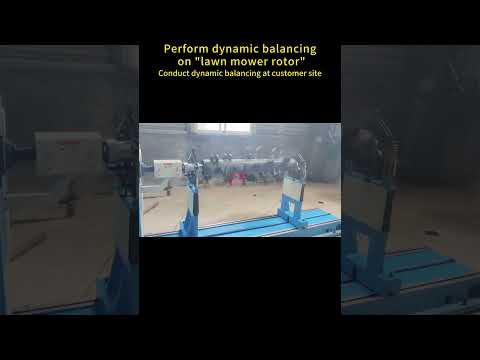
Video: Dynamic Balancing of Flail Mower and Forestry Mulcher Rotors PHW-500H