

 By Anna
A chute that will not rotate during a commercial snow-clearing shift forces an immediate decision: keep working, stop and clear, or hand the unit to service. The wrong call wastes crew time or sends a machine in for the wrong repair. When a snow blower chute not rotating shows up mid-shift, the fix starts with disciplined records, not guesses.
Treat "chute not rotating" as a symptom to document, not a diagnosis. Confirm whether the delivered machine has adjustable chute direction and what controls it, record whether movement is absent, limited or misaligned, separate that from discharge blockage, and follow the exact model's stop and service instructions before anyone reaches into the chute area.
Snow blower chute not rotating: Identify the actual chute and controls

Before anyone labels the fault, establish what the machine actually has. Snow throwers and snow blowers differ in how the discharge chute is aimed: some use a manual crank or lever, some use a cable or rod linkage, some use a powered or remote control, and some may have no adjustable direction at all. The phrase "snow blower chute not rotating" can therefore describe several different systems, and the service route depends on which one is on the unit in front of you.
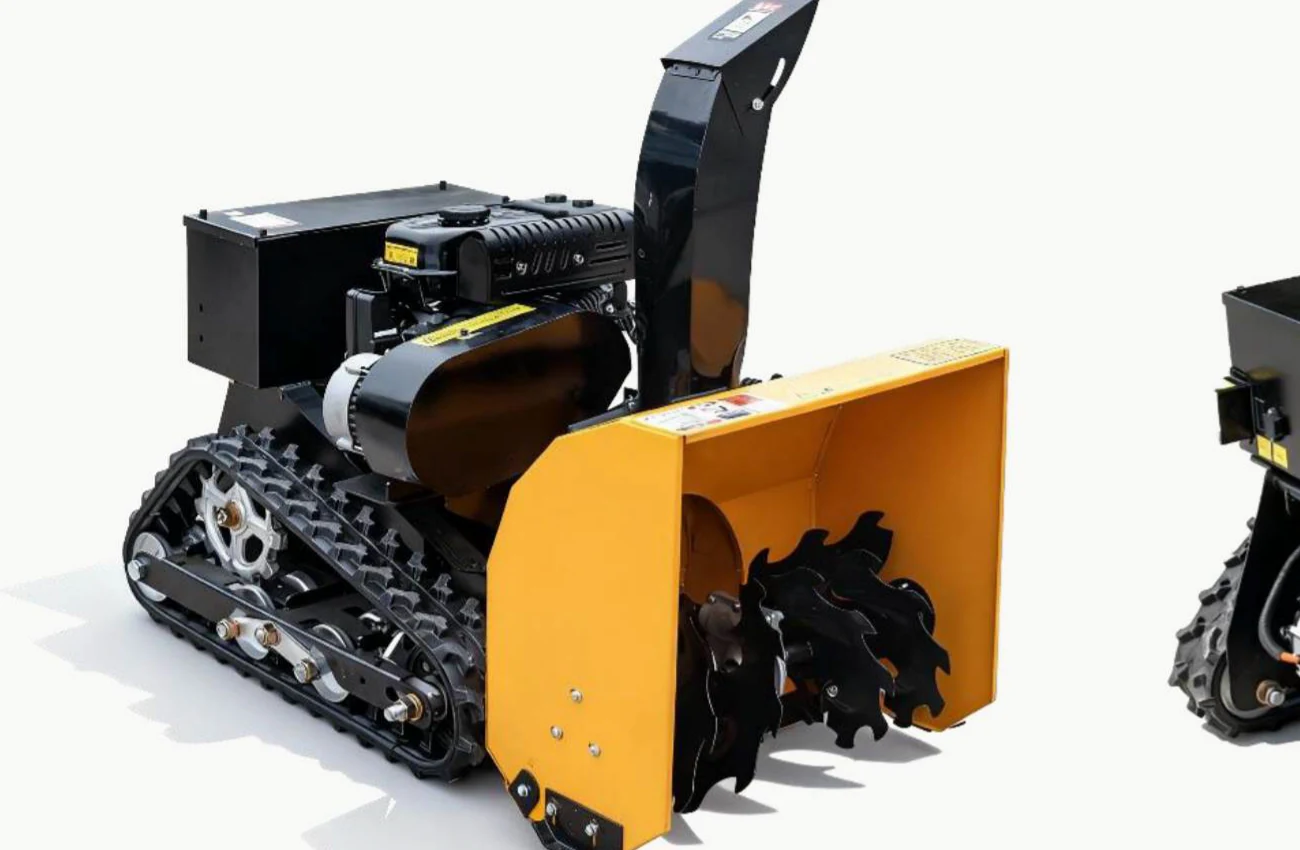
Start with the delivered configuration, not the brochure. Super Mowers publicly describes the DY-620 and DY-1000 as remote-controlled auger snow-clearing equipment, but the specific chute rotation structure and remote functions for those models still need confirmation from model materials. Do not assume that a remote-controlled machine automatically has powered chute rotation, or that the rotation is controlled from the same transmitter as travel. Those are questions for the supplier, backed by the correct manual or parts diagram.
Confirm whether the delivered machine has adjustable chute direction
Check the unit identification plate, the manual that came with the delivery, and the handover record. Then look at the chute itself and trace the control back to the operator position. The goal is a plain description: what the operator moves, what it connects to, and what is supposed to move as a result. If the documentation does not show a chute-direction control, stop and ask the supplier before recording a "rotation fault" — the machine may simply not have that feature.
Record whether movement is absent, limited or misaligned
"Not rotating" hides three different behaviors, and service teams need them separated:
- Absent: the control moves but the chute does not move at all.
- Limited: the chute moves in one direction only, or stops partway through its normal travel.
- Misaligned: the chute rotates but does not line up with the intended discharge direction, or the control and chute positions disagree.
Husqvarna's support page on chute alignment is a useful reminder that alignment is its own category of problem, distinct from a control that does nothing. Record which of the three behaviors you observed, in which direction, and whether it changed with engine speed, load, or snow conditions.
Separate direction control from a clogged chute

A blocked chute and a failed direction control can look similar from the operator seat: snow goes the wrong way, or nowhere useful. They are not the same fault, and mixing them in a work order sends the machine down the wrong service path. A clog is a discharge problem; a rotation fault is a control or mechanism problem. Some units can have both at once, which is exactly why the record must describe each symptom on its own.
Describe discharge and control symptoms independently
Write two separate notes. First, the discharge note: where snow actually went, whether the stream was steady or intermittent, whether the chute or auger housing visibly filled, and what the snow conditions were — wet, heavy, icy, or dry and blowing. Second, the control note: what the operator did, what moved, what did not, and any sound or resistance noticed. Keep the two notes apart even if they occurred on the same pass.
This separation matters because the safe response differs. Clearing a discharge blockage involves specific stop and clearing steps in the model manual; diagnosing a control linkage does not. Neither should be improvised from a generic online checklist. The existing Super Mowers article on remote-control snow blowers versus robotic snow blowers is a useful reference for keeping control-arrangement language accurate when describing the unit.
Avoid assuming a cable or gearbox exists on every model
Consumer troubleshooting articles often describe a cable, a gearbox, or a hand crank. Those parts exist on many walk-behind machines, but they are not universal. A remote-controlled or hydrostatic-drive commercial unit may use a different arrangement entirely, and an electric model may use yet another. Do not write "check the cable" or "inspect the gearbox" on a work order unless the model documentation shows that part. Instead, write what you observed and let the supplier identify the mechanism.
| Symptom recorded | What it points toward | What to confirm before service |
|---|---|---|
| Control moves, chute does not move at all | Direction-control mechanism or linkage | Whether the model has powered or manual rotation, and the correct schematic |
| Chute moves one way only | Partial travel limit or linkage obstruction | Full intended travel range from the manual |
| Chute rotates but discharge aims wrong | Alignment or reference-position issue | Alignment procedure for this exact model |
| Chute does not move and snow will not discharge | Possible blockage plus control question | Manual stop and clearing steps; keep the two faults separate |
| No chute-direction control found on unit | Feature may not be fitted | Supplier confirmation of delivered configuration |
Follow the safe stop and service boundary

A chute problem is not a reason to reach into the machine. The auger and impeller can remain dangerous, and the correct shutdown sequence is model-specific. The safe contribution from the operator or fleet supervisor is to stop the unit as the manual requires, secure it, record what happened, and route the repair to qualified personnel. That boundary protects the crew and keeps the service record credible.
Application review
Discuss your mowing application.
Share the working condition, target market, product family and project scope.
Use the exact model instructions and keep clear of moving parts
The manual for the exact model and revision is the authority on shutdown, lockout, and clearing. Follow it rather than a general habit carried over from another machine. Keep hands, tools, and clothing clear of the auger housing, impeller, and chute while any possibility of stored energy or unexpected start exists. Do not attempt to free a chute by running the machine in a way the manual does not describe, and do not modify or bypass guards, interlocks, or safety switches to keep a crew moving.
Refer repairs to qualified personnel
Disassembly of a chute control, linkage, or drive component belongs with qualified service personnel using the correct parts information. The operator's job is to deliver an accurate description and the unit's configuration details, not to diagnose the internal cause. Where the machine is under warranty, dealer service arrangement, or a fleet maintenance contract, follow that route and record who authorised the handoff and when.
Give service the right information
A service team that receives "chute won't turn" will spend the first hour asking questions. A well-prepared handoff answers them in advance. The aim is a record that lets the technician or supplier identify the model, understand the observed behavior, and order the right parts or schedule the right visit without a second site trip.
Record unit configuration, control behavior and conditions
Capture the following in the work order or fleet log:
- Unit identity: make, model, serial number, and any revision or build detail on the plate.
- Control arrangement: what the operator uses to aim the chute, and where it is located.
- Observed behavior: absent, limited, or misaligned; which directions; whether it changed over the shift.
- Discharge behavior: kept separate from the control note, with snow conditions described.
- Conditions: temperature, snow type, site surface, and whether the fault appeared cold-start or after hours of work.
- Actions taken: shutdown performed, unit secured, and any manual-referenced clearing steps completed.
- People and timing: who observed it, when, and who authorised the service referral.
Ask the supplier for the correct schematic and service route
Send the supplier a short, specific request: the model and serial number, the recorded symptoms, and a direct question about whether the delivered unit has adjustable chute direction and how it is controlled. Ask for the correct parts diagram or schematic for that configuration, the recommended service route, and any model-specific safety or warranty conditions that apply. For Super Mowers remote-controlled units such as the DY-620 and DY-1000, this is also the point to confirm which functions the remote control actually covers. The snow blower versus snow plow comparison for commercial sidewalks can help frame equipment-role questions, but it does not replace model documentation.
| Handoff item | Why service needs it | Source to attach |
|---|---|---|
| Model, serial, revision | Identifies the correct manual and parts list | Unit plate and delivery record |
| Control type observed | Distinguishes manual, cable, or powered arrangement | Operator note and photos of the control |
| Absent / limited / misaligned | Narrows the service path | Symptom log |
| Discharge note kept separate | Rules blockage in or out | Shift record |
| Shutdown and securing steps | Shows the unit is safe to receive | Manual reference and time log |
| Supplier questions | Confirms features and route | Written enquiry with unit details |
FAQ
Is a chute that will not rotate the same as a clogged chute? No. A clog is a discharge blockage; a rotation fault is a control or mechanism problem. They can occur together, so record discharge behavior and control behavior as separate notes and follow the model manual for any clearing step.
Do all remote snow blowers have powered chute rotation? No assumption is safe. Remote control describes the travel-control arrangement, not the chute system. Confirm from the model materials whether the delivered unit has adjustable chute direction and how it is operated.
What should the operator tell the service team? The model and serial number, the control type, whether movement was absent, limited, or misaligned, the separate discharge note, the conditions, the shutdown steps taken, and who authorised the referral.
Conclusion

Record the symptom, separate it from blockage, stop per the exact manual, and hand off with full unit details. Ask the supplier to confirm the chute system before any repair is planned.
Video: Snowblower Chute Won't Turn: Chute Control and Gearbox Issues
