

 By Anna
A dealer service desk receives a remote mower for a plug change and needs one number for the lawn mower spark plug gap. The engine code plate is dusty, the old plug is unmarked, and a web search returns several different values. The safe answer starts with identity, not with a gap figure.
Record the unit, the engine code, and the approved plug first. Take the gap only from the engine manufacturer’s documentation for that exact engine, and adjust the electrode only if that documentation allows it. If any of those records is missing, hold the job and ask the supplier rather than copying a value from a general webpage.
This article is written for dealer service staff and fleet technicians who maintain remote-controlled mowers, including mixed fleets where gasoline, diesel, and battery-electric units sit side by side. It covers the paperwork and identification chain around a gasoline spark plug. It does not supply a gap value, because no serial-specific engine manual was supplied with this brief.
Lawn mower spark plug gap: Confirm the machine power system

Before anyone reaches for a plug socket, confirm what actually powers the machine in front of you. A spark plug belongs to a spark-ignition gasoline engine. A diesel engine uses compression ignition and has no spark plug to gap, and a battery-electric unit has no engine at all. Treating the three as one service category is the most common way a wrong part or a wrong procedure enters a fleet record.
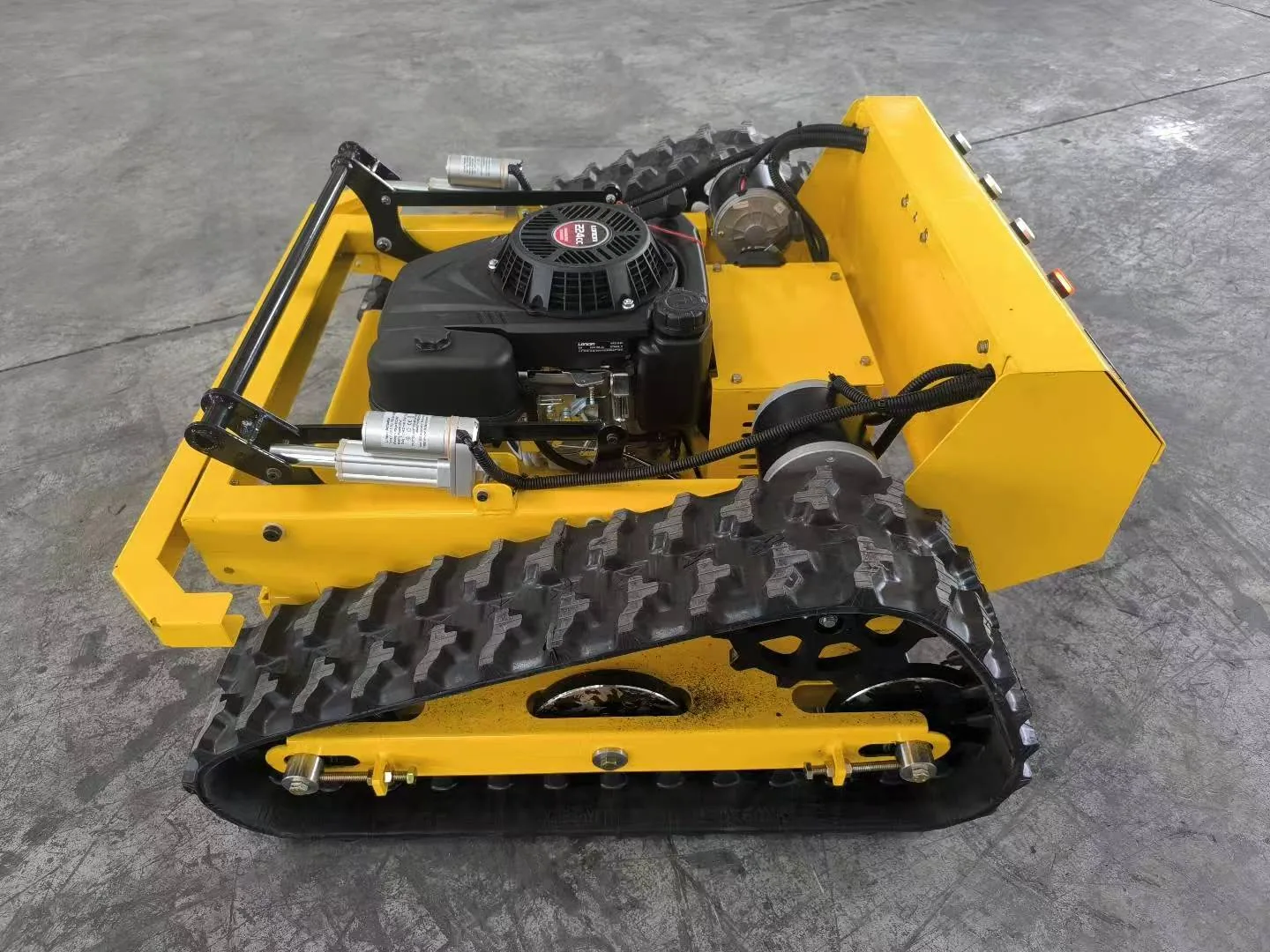
Remote-controlled mowers are sold in more than one power configuration, so the model name alone is not enough. The public Super Mowers catalogue lists a gasoline tracked configuration, the Remote 50 gasoline mower, and the wider product catalogue shows the model families on offer. A catalogue listing tells you a configuration exists; it does not prove that the unit on your bench is that configuration. For background on how the power systems differ in service terms, see the site’s comparison of gasoline vs diesel remote control mowers.
Gasoline engine only where applicable
Apply this workflow only when the unit carries a gasoline engine and the job is a spark plug check or replacement. If the unit is diesel, the correct action is to close the spark plug task and route the work to the diesel service schedule. If the unit is electric, close it and route to the battery and drive system schedule. Neither case should inherit a gasoline gap value, a gasoline plug part number, or a gasoline torque figure.
Mixed fleets make this harder than it sounds. A dealer may hold gasoline and diesel units of similar appearance, and a technician may move between them in one afternoon. The defence is a power-system field on the job card that must be filled before parts are picked. If the field is blank, the parts counter should not release a plug.
Record full engine and unit identity
The engine code is the anchor for everything that follows. Record it exactly as stamped or labelled, including any prefix, suffix, and specification variant, because small differences in that string can change the approved plug. Alongside the engine code, record the unit serial number, the model designation, the hour meter reading, and the date.
A useful identity block for a service record looks like this:
| Field | What to record | Why it matters |
|---|---|---|
| Unit model and configuration | Model name plus power system as labelled on the unit | Prevents a gasoline procedure being applied to a diesel or electric unit |
| Unit serial number | Full serial as stamped | Ties the job to one machine, not a model family |
| Engine make and code | Full engine code string, including variant characters | The engine code, not the mower model, selects the approved plug |
| Engine serial or build data | If present on the engine label | Resolves build-period differences within one engine family |
| Hour meter | Reading at time of service | Supports later interval and history checks |
| Installed plug | Any markings visible on the removed plug | A cross-check, not a substitute for the manual |
| Documentation used | Manual title, revision, and date | Shows where the gap figure came from |
If the engine label cannot be read, clean it and try again before assuming. If it is genuinely missing or illegible, the record should say so explicitly. A blank field is honest; a guessed engine code is not.
Find the approved plug
The approved plug comes from the engine manufacturer’s documentation for that engine code, not from the mower’s model page and not from a parts site’s generic fitment filter. Engine makers publish plug recommendations by engine family and code range, and those recommendations are the reference point a dealer should be able to show on request.
Briggs & Stratton, for example, publishes guidance on identifying the correct spark plug and gap for its listed engine families and code dates. That page is useful as a model of how the lookup should work: engine identity first, then the approved plug, then the gap guidance. Its scope is Briggs & Stratton engines only. It cannot be used to assign a plug or a gap to an engine from another maker, and this brief does not establish which engine is fitted to any particular Remote 50 unit.
Match the engine code and approved part
Work the lookup in a fixed order so the result is reproducible by the next technician:
- Read the engine code from the engine label, not from memory or from the sales invoice alone.
- Open the engine manufacturer’s documentation that covers that code and build period.
- Note the approved plug designation exactly, including any suffix that indicates electrode type or heat range.
- Note whether the documentation gives a gap value, a pre-gapped plug instruction, or no gap instruction at all.
- Note whether the documentation permits adjustment of the electrode.
- Write all four items into the job record before fitting anything.
Step 3 deserves emphasis. Plug designations that look similar can differ in electrode construction, and electrode construction is exactly what determines whether a gap may be set by the technician. A part number that is close is not the approved part.
Resolve missing information with the supplier
When the engine documentation is not on hand, the correct move is to obtain it, not to substitute a plausible figure. For remote mower units, the route runs through the machine supplier’s service support. MERI, for example, operates a remote mower parts and support channel for its own products; that channel is MERI-specific and does not establish SANYANG availability or compatibility, and it should not be treated as a universal parts desk for every remote mower brand.
A supplier enquiry is more likely to succeed when it carries the full identity block rather than a model name alone. Ask for the engine manual section covering spark plug specification, the approved plug designation, the permitted gap or the statement that the plug is pre-gapped, and any restriction on electrode adjustment. Keep the reply with the job record.
| Situation | Correct action | Action to avoid |
|---|---|---|
| Engine code readable, manual available | Follow the manual for that code | Using a value from a different engine family |
| Engine code readable, manual missing | Request the manual or the specification from the supplier | Copying a figure from a general web page |
| Engine code illegible | Record the condition and escalate | Guessing the code from the mower model |
| Unit is diesel | Close the spark plug task, route to diesel schedule | Applying a gasoline plug or gap |
| Unit is battery-electric | Close the task, route to electrical schedule | Treating it as a gasoline engine |
Find and interpret the gap instruction

The gap instruction is a property of the engine and plug combination, and it lives in the engine documentation. Two questions must be answered separately: what gap does the documentation specify, and does the documentation allow the technician to change the gap on the plug that is fitted? Many plugs arrive pre-gapped for their intended application, and the instruction may be to verify rather than to adjust.
Application review
Discuss your mowing application.
Share the working condition, target market, product family and project scope.
This is where a general web search does the most damage. Search results mix values from different engine families, different plug designs, and different model years, and they rarely carry the engine code that would make them applicable. A number that appears frequently is not thereby correct for the engine on your bench.
Use the exact engine manual and part guidance
Read the gap instruction in the context it was written for. Check the engine code range the manual covers, the plug designation it names, and any note about pre-gapped plugs. If the manual gives a gap, record the value with its unit and the manual reference. If the manual says the plug is supplied pre-gapped and should not be adjusted, record that instruction instead of a number.
Where the manual and the plug packaging appear to disagree, do not resolve the conflict by choosing the more convenient figure. Record both, and escalate to the engine maker’s or supplier’s technical support with the engine code and plug designation. The resolution belongs in the record so the next technician does not repeat the enquiry.
Treat fine-electrode restrictions as model-specific
Fine-electrode plugs are a specific case, not a general rule. Some plug designs with fine electrodes are supplied pre-gapped and are not intended to be re-gapped by the technician, because the electrode geometry is easily damaged by a feeler gauge or gap tool. Other designs in the same engine family may be adjustable. The distinction follows the plug designation and the engine maker’s instruction, not the appearance of the plug.
For a dealer, this means the parts counter and the workshop must agree on which plug designation is approved before the job starts. If a substitute plug is proposed because the approved one is out of stock, the substitution needs its own documentation check. A cross-reference that is acceptable for one engine code may not be acceptable for another, and the gap instruction may differ.
| Check | Question to answer from documentation | Where the answer belongs |
|---|---|---|
| Engine coverage | Does this manual cover the exact engine code and build period? | Job record, documentation field |
| Plug designation | Is this the approved plug, including suffix? | Job record, parts field |
| Gap instruction | Is a gap value given, or is the plug pre-gapped? | Job record, specification field |
| Adjustment permission | Does the documentation permit electrode adjustment? | Job record, procedure field |
| Substitution | If a substitute is proposed, is it documented for this code? | Escalation note |
Hand off the job

A spark plug job is short, which is exactly why its records are often thin. The handoff is where the next technician, the next shift, or the next dealer inherits either a traceable decision or an unexplained number. Build the record so that a colleague can reconstruct where the gap figure came from without contacting you.
Record document version and responsibility
Every gap figure in a service record should carry four things: the value with its unit, the document it came from, the revision or date of that document, and the name or role of the person who applied it. Where the instruction was “pre-gapped, do not adjust”, that instruction should be recorded in the same fields, because it is the specification for that job.
Responsibility should be explicit at three points. The person who identifies the engine code owns the accuracy of that identification. The person who releases the part owns the match between engine code and plug designation. The person who completes the work owns the record of the instruction followed. In a small dealership one person may hold all three roles, but the record should still show that each check happened.
Do not guess a universal value
There is no single gap value that applies across mower engines, and no responsible way to derive one from a model name. Engine families differ, plug designs differ, and manufacturers publish their own specifications for their own products. A universal figure circulated online is not evidence for the engine in front of you.
This matters more in remote mower fleets than in a single domestic machine, because a dealer may service units from several brands and several engine suppliers. The discipline that scales is the identity-first workflow: power system, engine code, approved plug, documented instruction, recorded responsibility. A technician who follows that sequence on every unit does not need to remember values, only where the values live.
When the documentation chain cannot be completed, the honest record says so and the job waits. That is a better outcome than a mower returned to a customer with a plug set to a figure nobody can source.
FAQ

Does one gap fit all mower engines?
No. Gap specifications are published by engine manufacturers for their own engine families and codes, and they can differ between engines and between plug designs. A figure taken from a general webpage has no engine code attached to it and should not be entered into a service record.
Should every spark plug be adjusted?
No. Some plugs are supplied pre-gapped for their application, and some fine-electrode designs are not intended to be re-gapped by the technician. Whether adjustment is permitted is stated in the engine documentation for the approved plug, and that instruction should be recorded instead of a value when adjustment is not allowed.
Can a diesel or electric mower use this workflow?
No. A diesel engine uses compression ignition and has no spark plug, and a battery-electric unit has no engine. Both should be routed to their own service schedules. This workflow applies only to gasoline engines, and only after the power system has been confirmed on the unit itself.
Conclusion

Identify the power system, record the full engine code, match the approved plug, and take the gap only from that engine’s documentation. If the record is incomplete, hold the job and ask the supplier.
Next step: add the identity and documentation fields above to your dealer job card before the next plug service.
Video: Spark Plug Numbers & Letters - NGK Spark Plugs -Tech Video
