

 By Anna

Retention pond mowing requires a site-specific maintenance plan before a remote-control mower can be selected. A stormwater pond is not one continuous lawn: its embankment, side slopes, wet margins, inlet and outlet structures, and access routes may have different vegetation objectives and operating restrictions. Commercial grounds contractors, stormwater facility managers, and equipment buyers can use this brief to document those differences and request a model-specific review.
The goal is to answer three procurement questions: Which zones are actually designated for mowing? Who has authority to approve work in each zone? What evidence must a remote mower supplier provide before a quote is accepted? This is a buyer’s planning worksheet, not a permission to operate machinery on a pond bank or in saturated ground.
Why retention pond mowing starts with the stormwater maintenance plan

A constructed stormwater pond is designed to manage runoff, sediment, and water discharge. Mowing may support inspection access and vegetation management, but it does not replace checks of outlets, erosion, sediment accumulation, or embankment condition. The Minnesota Stormwater Manual’s pond maintenance guidance distinguishes routine activities such as mowing from structural inspections and repairs that require appropriately qualified professionals.
Before requesting a mower quote, obtain the facility’s current operation and maintenance plan, approved drawings, vegetation management requirements, inspection records, and any applicable permit or contract conditions. These documents establish the work scope; a product brochure does not.
Verify which type of stormwater facility you have
Property teams sometimes use retention pond, detention basin, and stormwater pond interchangeably. They may have different water conditions and maintenance zones. Confirm the asset’s actual design classification rather than assuming every basin has a permanent water pool or a mowable bottom. The Minnesota Stormwater Manual’s wet pond fact sheet explains how water level, outlet structures, and vegetation areas affect maintenance.
Do not impose a universal mowing frequency. An embankment maintained for inspection visibility may have a different schedule from a planted shoreline buffer or meadow. The owner-approved plan should resolve that difference before a contractor prices the work.
Divide the pond into mowing and no-mow decision zones

Use the approved pond drawing or site map to assign each area a zone ID. Record current conditions separately: a mower suitable for one accessible, established turf area has not thereby been approved for an adjacent slope or water-edge strip.
| Pond zone | Buyer or site-owner inputs | Decision to resolve before quoting |
|---|---|---|
| Water edge and saturated margin | Seasonal water levels, observed soil conditions, planting or buffer requirements, owner-defined exclusion boundary | Is mowing specified here at all? If so, who verifies the ground and access conditions? |
| Vegetated side slopes | Surveyed slope profile, surface stability, erosion evidence, vegetation specification, obstacles | Which segments are within the approved maintenance scope, and which require separate engineering or equipment review? |
| Berm, crest, and embankment | Access width, surface condition, inspection needs, burrows, cracks or wet spots identified by the owner | What vegetation height is required for inspections, and are there restrictions on machinery or loading? |
| Inlets, outlets, spillways, and drainage structures | Headwalls, risers, pipes, screens, riprap, concrete edges, utility assets, inspection access | Where must mowing stop and structure inspection or maintenance become a separate work item? |
| Access roads, gates, and turnaround areas | Measured gate and path widths, surface condition, staging, loading/unloading areas, public access | Can the exact machine reach the permitted work zone and leave it under an approved transport plan? |
Practical rule: Mark each zone as mowing included, separate review required, or excluded. If the owner has not defined a zone, leave its status unresolved. A nearby dry-looking patch or a supplier’s general slope claim is not evidence that the zone is approved.
Keep maintenance findings separate from mowing instructions
Observed erosion, a blocked outlet, damaged erosion-control materials, unstable soil, or exposed structures should be recorded and routed to the responsible pond authority. Do not treat the mower inquiry as authorization to repair a bank, clear a hydraulic structure, enter water, or change the approved vegetation.
Keep remote mowers and other equipment categories separate
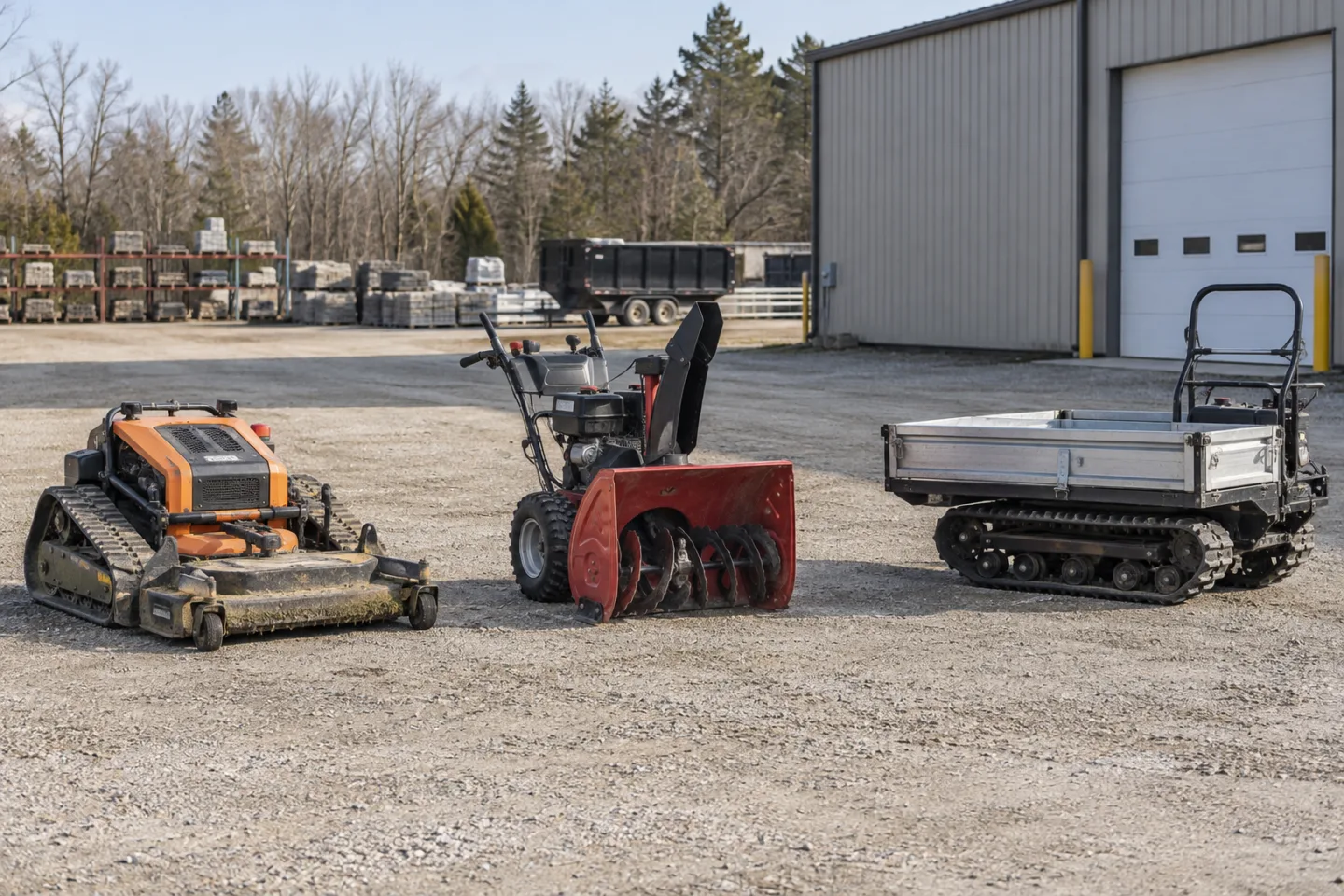
The equipment class matters because a machine’s appearance or remote-control function does not establish its permitted application.
- Dedicated remote-control mower: Evaluate the documented cutting configuration against the approved vegetation zones, ground conditions, access and supervision requirements.
- Tracked carrier with mowing attachment: Request the exact approved carrier-and-attachment combination, guarding, stability information and maintenance documentation. Do not transfer claims from a bare carrier to an attached mower.
- Snow-removal equipment: Treat winter clearing as a separate task, specification and contract scope.
For a starting point, see the Super Mowers remote lawn mower category. A category listing can identify available product families, but it cannot certify a particular model for a specific stormwater pond.
Assign responsibility before approving a mower shortlist
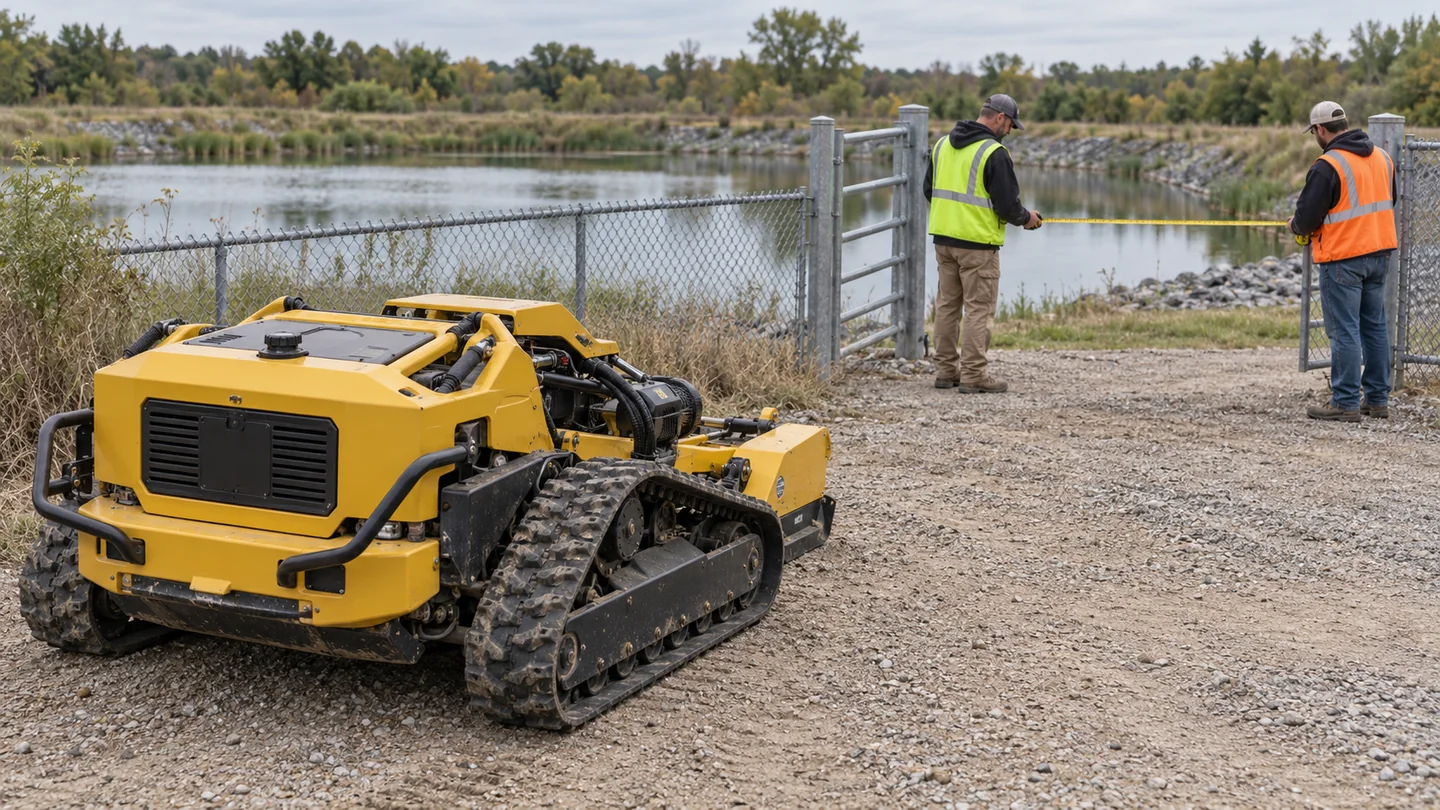
Stormwater maintenance decisions and equipment decisions overlap, but they are not owned by the same party. Use the following allocation as a starting point and replace the example role names with the actual people or departments under your contract.
Application review
Discuss your mowing application.
Share the working condition, target market, product family and project scope.
| Responsible party | Evidence or decision they supply | What the mower quote cannot decide |
|---|---|---|
| Pond owner / stormwater operator | Current facility plan, permitted maintenance work, vegetation objective, access and exclusion areas | Whether the owner has approved mowing in an undefined zone |
| Engineer or designated stormwater authority | Interpretation of design constraints, structural concerns, embankment or drainage restrictions | Structural suitability or the response to erosion and damage |
| Maintenance contractor / grounds supervisor | Site measurements, crew schedule, observed conditions, training records, escalation process | Authority to override the maintenance plan or machine manual |
| Equipment manufacturer / distributor | Exact model documentation, configuration, rated limitations, parts and training support, written suitability review | Site-owner permission or an engineering approval for a pond bank |
Make one person responsible for resolving missing information before the request goes to tender. If the pond operator or engineer has identified an exclusion area, preserve it in the supplier brief and in the final work order.
Retention pond mowing site-input worksheet

Complete one worksheet for each pond or clearly defined maintenance package. Use measured values and owner-approved documents, and identify the source of every important input. Write not verified when a value is missing instead of guessing.
| Information to capture | Site entry / document reference | Why the buyer needs it |
|---|---|---|
| Pond ID, address, and facility type | Record asset ID, drawing revision and facility classification | Prevents the quote from being transferred to a different basin |
| Approved mowing zones and excluded areas | Attach marked site plan or zone map | Defines what the proposed equipment must actually service |
| Vegetation and cut-quality requirement | Record turf, brush, planted buffer, specified height or required finish where applicable | Connects deck selection to the maintenance contract |
| Measured slope and surface conditions | Survey or competent-site-review reference for each proposed zone | Allows a model-specific limitation check without assuming a safe angle |
| Water level, moisture, and seasonal access | Record observed conditions and owner restrictions by season | Flags changing access rather than treating one visit as permanent evidence |
| Structures and protected features | Inlets, outlets, spillways, riprap, utilities, erosion-control treatments | Identifies areas requiring owner review or a separate task |
| Machine access and transport | Measured gates, paths, turns, trailer route, staging and storage location | Tests the full machine dimensions, not just cutting width |
| Public exposure and incident handoff | Existing site rules, access control responsibility and recovery contact | Clarifies which team owns worksite management |
| Service frequency and reporting | Contract cycle, weather-related exceptions, photos, work-order format | Supports a comparable commercial quote and closeout record |
Do not derive a universal setback from the waterline, acceptable soil firmness, or permitted slope from this table. Those limits require the pond authority’s requirements, a competent site assessment, and the current manual for the exact machine.
What to ask remote mower suppliers before requesting prices

Send the same site-input worksheet to every bidder. Require written answers tied to a current model and configuration, not a generic statement that a tracked mower is suitable for slopes.
- Exact configuration: What model, cutting deck, drive type, tracks or wheels, guards and optional equipment are included?
- Documented limitations: Which manufacturer instructions address the recorded slope, ground conditions, vegetation and exclusions? Which inputs still require a site review?
- Physical fit: What are the full machine width, height, transport dimensions, weight and turning requirements in the supplied configuration?
- Operator controls: What are the documented supervision, visibility, emergency-stop and communication-loss requirements for the specific control system?
- Cutting result: What cutting-width, cutting-height, discharge or collection options are supported for the owner’s vegetation specification?
- Maintenance and support: What inspection schedule, wear parts, local service coverage, operator training and warranty apply in the buyer’s market?
- Unresolved conditions: Which pond zones will the supplier decline to recommend until additional owner, engineering or site evidence is supplied?
Compare complete deployed proposals, not only mower prices
Ask each bidder to identify the included machine configuration, delivery, transport accessories, training, spare parts, maintenance support and quote exclusions. For an owner maintaining several ponds, record whether the same unit could serve the approved zones at multiple sites after each site receives its own review. Do not assume a successful demonstration at one pond carries over to another.
Close the loop before issuing the purchase order

Use four simple review outcomes for each pond zone: included for equipment review, pending owner or engineer clarification, pending manufacturer documentation, or excluded from the mowing package. Keep the decision, responsible person, document version and date in the purchasing file.
- Confirm that the latest maintenance plan defines which vegetation will be cut and which areas are protected or excluded.
- Attach the zone map, measured access data and applicable owner restrictions to every supplier request.
- Check the exact model manual and obtain written clarification for conditions the published data does not cover.
- Assign structural inspections, sediment work, outlet maintenance and erosion repairs separately from ordinary mowing.
- Retain quote assumptions and exceptions so the receiving team knows which areas were not approved by the equipment review.
Bottom line: A remote-control mower may be worth evaluating for selected, approved retention pond mowing zones, but the machine type alone does not establish pond-bank suitability. The strongest buying brief connects the stormwater facility’s maintenance rules to measured site conditions, assigns clear decision owners, and asks the supplier for model-specific evidence.
If you are sourcing a remote mower for a stormwater maintenance contract, review the Super Mowers application overview and contact the equipment team with your pond-zone map, vegetation specification, access measurements and current maintenance requirements. Ask for a documented, site-specific model review rather than a general pond-mowing claim.
Scope note: This guide supports procurement and work-scope documentation only. It does not prescribe operating distances, slope limits, ground-bearing thresholds, water-entry methods or emergency procedures. Final site permissions and working methods belong to the responsible pond owner, qualified site personnel, applicable authority and the exact machine instructions.
Video: RC Mowers TK-52XP Tracked Slope Mower on Retention Ponds & Waterways
