

 By Anna
An orchard remote control mower must fit more than the space between tree rows. Commercial buyers need to check the narrowest usable travel width, the lowest overhead obstruction, the available turning area at row ends, and the route from storage to the orchard block. A mower that appears compact in a product photograph may still be too wide for an irrigation layout or require more room to turn than the headland provides.
This guide helps orchard operators, grounds contractors, and equipment distributors collect those measurements and compare them with manufacturer specifications before purchasing or requesting a demonstration. It includes an orchard site-fit worksheet, a supplier document checklist, and a practical review process.
The worksheet does not establish a universal clearance margin, safe slope, turning method, or equipment suitability rating. Those decisions depend on the specific mower configuration, its current operating manual, and a responsible review of the worksite.
Why orchard mower fit starts with clearance and turning space
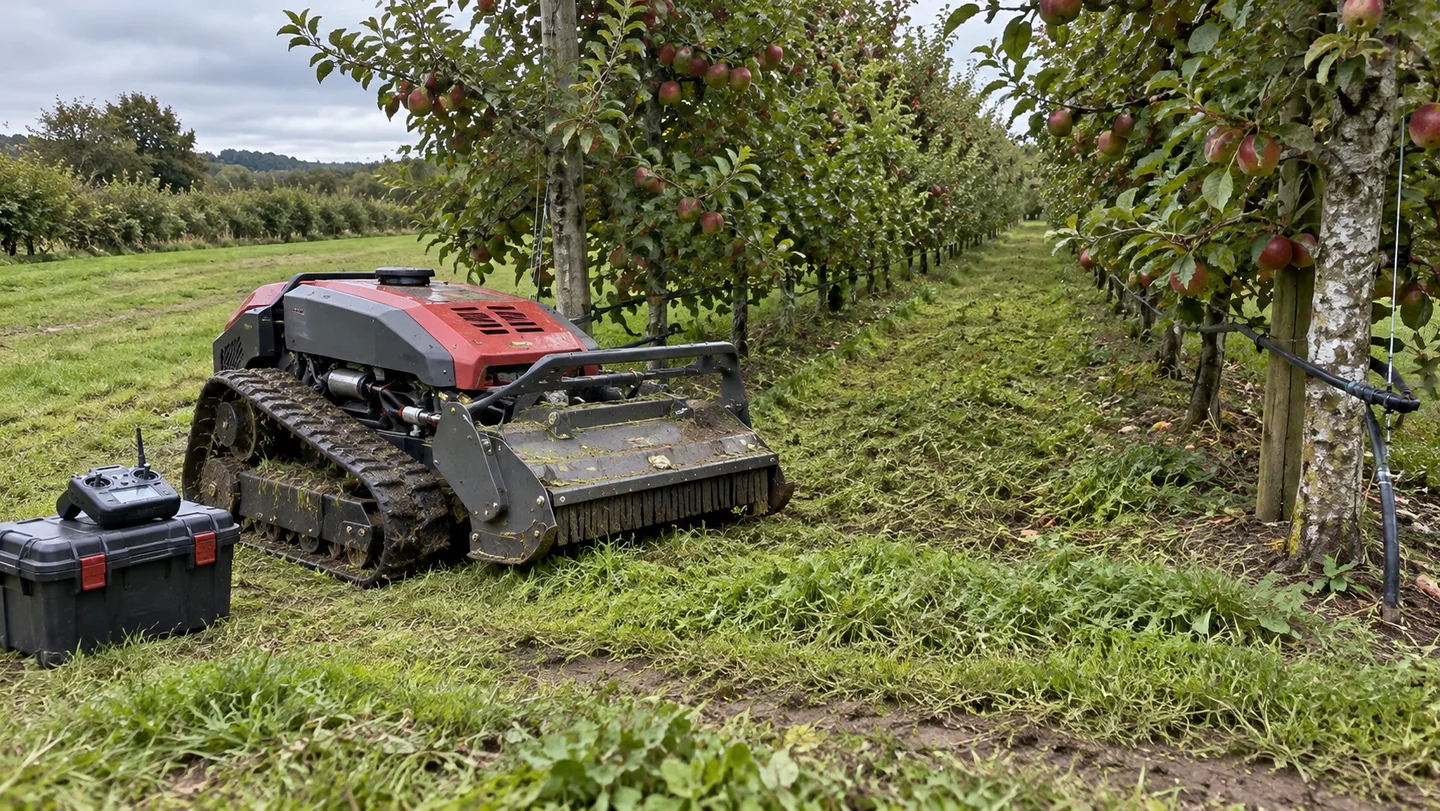
Orchards differ in tree spacing, canopy structure, trellis systems, irrigation layouts, soil conditions, and headland dimensions. Even within one orchard, the usable passage width may change between rows or at different points along the same row.
For example, the distance between two tree-row centerlines is not necessarily the width available to a mower. Trunks, branches, support posts, irrigation risers, and other permanent fixtures can reduce the actual passage.
Similarly, the published height of a mower does not establish that it can pass beneath a fruit canopy. The buyer needs to account for the complete operating configuration and the lowest obstruction along the proposed route.
Key purchasing rule: Compare the mower’s complete operating dimensions with the orchard’s narrowest usable passage, lowest overhead obstruction, and available turning area. Do not substitute nominal row spacing or cutting width for these measurements.
Four dimensions that should not be confused
- Row spacing: The distance between planted rows or their reference centerlines.
- Usable row clearance: The space actually available for the mower to travel without contacting orchard structures.
- Overall machine width: The widest relevant dimension of the mower with its required components installed.
- Cutting width: The width of vegetation the mowing deck is designed to cut in one pass.
These measurements answer different questions. Cutting width helps estimate coverage. Overall machine width helps determine whether the machine can enter the passage. Neither number establishes the turning space or overhead clearance required.
Step 1: Complete the orchard-block measurement worksheet

Complete a separate worksheet for each orchard block that has materially different dimensions or obstacles. Record the measurement location, date, and units. Where several points differ, identify the narrowest or most restrictive condition rather than recording only an average.
Use suitable measuring equipment and the orchard’s approved site-access procedure. Do not assume the measurements authorize mower operation.
Row width and canopy clearance
| Measurement | What to record | Field entry |
|---|---|---|
| Orchard block ID | Block name, row numbers, and measurement date | |
| Nominal row spacing | Planted row spacing, with the measurement reference identified | |
| Narrowest usable row width | Smallest unobstructed width along the intended mower travel path | |
| Width restriction location | Row number and location of the narrowest passage | |
| Lowest canopy clearance | Lowest branch, fruit, netting, or other overhead obstruction along the intended route | |
| Canopy measurement condition | Season, growth condition, fruit load, or other relevant observation | |
| Continuous mowing length | Length of the intended travel section between turning areas |
Measurement note: A low branch at one location can be more restrictive than the average canopy height across the block. Record the actual location of the limiting obstruction so the supplier can review it.
Headland width and turning space
Headland dimensions matter because a mower must be able to change direction without contacting trunks, trellis structures, irrigation hardware, or other restricted areas.
Do not assume that a mower described as having zero-turn capability can complete every orchard-row turn. The full machine, including its cutting attachment, must remain within the available space during the maneuver.
| Measurement | What to record | Field entry |
|---|---|---|
| Available headland depth | Usable distance beyond the row end before reaching a boundary or obstacle | |
| Available turning width | Unobstructed lateral space available for the complete turning movement | |
| Turning-area surface | Grass, compacted soil, gravel, pavement, or other surface | |
| Headland restrictions | Posts, fences, trunks, irrigation lines, drains, or stored materials | |
| Reversing permitted? | Whether the site’s approved route allows reversing or a multi-point turn | |
| Smallest turning area | Location and dimensions of the most restrictive row end |
The supplier should explain the space required for the proposed machine and turning method. A published turning radius may not describe the complete space occupied by the chassis and deck during a maneuver.
Tree, irrigation, and trellis obstacles
Orchard equipment fit is not limited to measurements between solid objects. Some infrastructure may be difficult to see, move seasonally, or extend into the travel path at different heights.
| Obstacle | What to document | Field entry |
|---|---|---|
| Tree trunks | Trunks or trunk guards that restrict the proposed travel corridor | |
| Exposed roots | Root locations and surface changes requiring site review | |
| Irrigation equipment | Drip lines, emitters, risers, valves, tubing, and supports | |
| Trellis hardware | Posts, anchors, wires, and other structural components | |
| Overhead restrictions | Branches, netting, fruit, supports, or crossing infrastructure | |
| Ground conditions | Ruts, drainage features, soft soil, rocks, and surface transitions |
Photographs and an orchard block map can help clarify these entries. Label each image with its location and date rather than relying on a photograph alone to establish a measurement.
Access, transport, and storage measurements
A machine that fits between orchard rows may still be unable to reach the block from its storage area or fit the contractor’s existing trailer.
| Measurement | What to record | Field entry |
|---|---|---|
| Narrowest access gate | Clear opening width with the gate in its intended position | |
| Access-route restrictions | Paths, bridges, bends, overhead obstacles, and surface changes | |
| Trailer dimensions | Relevant opening, deck, and transport dimensions | |
| Loading arrangement | Available trailer and loading equipment for manufacturer review | |
| Storage space | Usable width, height, length, and access opening | |
| Service access | Available space and facilities for approved inspection and maintenance |
Use the mower manufacturer’s transport instructions and the transport equipment’s own requirements when reviewing these entries. Site measurements alone do not establish that a particular loading arrangement is suitable.
Step 2: Compare orchard measurements with mower specifications

Once the orchard worksheet is complete, ask each supplier for a current technical specification sheet and the applicable operating manual. The documents must correspond to the exact model and configuration being quoted.
Do not compare an orchard measurement with a different equipment dimension merely because both are expressed in inches or millimeters.
Application review
Discuss your mowing application.
Share the working condition, target market, product family and project scope.
| Orchard measurement | Matching mower specification | What the supplier must confirm |
|---|---|---|
| Narrowest usable row width | Overall operating machine width | Whether all required tracks, wheels, guards, and attachments are included |
| Lowest overhead obstruction | Complete operating machine height | Whether antennas, protective structures, and other installed components affect height |
| Smallest headland turning area | Required turning space and complete swept path | Whether the documented turning method fits the measured area |
| Ground obstacles | Ground clearance and underbody configuration | Whether the recorded conditions fall within the manufacturer’s permitted use |
| Access gate and storage opening | Working and transport dimensions | Which configuration applies at each stage of access and transport |
| Soil and slope conditions | Model-specific operating restrictions | Applicable limitations, surface assumptions, and required equipment |
| Orchard vegetation | Cutting deck and vegetation limitations | Whether the mower is intended for the grass and vegetation present |
Machine height must include the actual configuration
Some remote-controlled mowers use compact, low-profile designs. For example, RAYMO’s manufacturer application information describes a low-profile mower platform intended for access beneath certain overhead obstacles.
That is an example of a design approach, not evidence that a particular mower will fit your orchard. Different decks, components, and configurations may change the relevant dimensions.
Ask for a dimension drawing showing the highest point of the complete operating machine. Do not assume every remote-control mower has a rollover protective structure, and do not use a deck-height measurement as the overall machine height.
Cutting width and overall width are separate specifications
A larger cutting width may help reduce the number of mowing passes, but it does not guarantee better access between orchard rows.
Request both specifications:
- Rated cutting width: The mowing swath covered by the cutting system.
- Overall operating width: The widest relevant dimension of the configured machine.
Also confirm whether a discharge guard, deck side plate, track assembly, or other installed component changes the outside width.
Never use cutting width as a substitute for the machine’s full width when checking gates or orchard passages.
Turning capability requires more than a radius figure
A supplier may describe a machine as highly maneuverable, zero-turn, or capable of reversing its mowing direction. These features are relevant, but none automatically establishes the space required to complete a particular orchard turn.
For example, Agria’s manufacturer information for the 9500-90 discusses forward and reverse mowing capability. Such a feature may affect how a contractor plans row-end movements, but it should not be treated as a universal turning-space specification.
Ask the supplier to confirm the complete turning envelope of the proposed mower. Include the full chassis and cutting attachment, not only the nominal pivot point.
Step 3: Review the most restrictive orchard locations

An orchard fit review should prioritize the locations most likely to prevent access or require a different mowing approach.
- Identify the narrowest passage. Compare the measured usable width with the complete machine width and obtain the manufacturer’s required clearance information.
- Identify the lowest overhead point. Compare the recorded obstruction with the full operating machine height, including installed components.
- Check the smallest headland. Ask the supplier to document the turning method and the space it occupies.
- Review fixed obstacles. Have the orchard manager identify irrigation, trellis, tree-protection, and other restrictions that cannot be treated as ordinary mowing obstacles.
- Confirm transport access. Check the route from storage or the trailer to the orchard block using the machine’s relevant transport dimensions.
- Record unresolved conditions. Mark any missing data as requiring supplier or site-owner confirmation before procurement approval.
What about slopes and uneven orchard ground?
Ground clearance and overall size alone do not determine whether an orchard mower is suitable for uneven ground.
Where the proposed route includes slopes, soft soil, ruts, or abrupt surface transitions, request the manufacturer’s operating limitations for the exact mower and attachment. Do not apply a universal slope angle or ground-clearance allowance to all remote-controlled machines.
The orchard manager and responsible equipment personnel should determine whether additional site or equipment review is required.
What about remote-control signal and operator visibility?
Dense tree rows, buildings, terrain, and the planned operator location may affect how a remote-controlled mower can be supervised and controlled.
Ask the supplier for the exact manual requirements covering operator visibility, transmitter use, communication-loss behavior, stop controls, and permitted working conditions.
The fact that a transmitter has a published maximum communication range does not mean that the same range is appropriate or available throughout an orchard.
Orchard remote control mower procurement checklist

Before requesting a final quote or approving a model for an orchard-maintenance contract, confirm the following:
- The orchard block and intended mowing areas are clearly identified.
- The narrowest usable row width has been measured rather than estimated from nominal tree spacing.
- The lowest canopy or overhead obstruction has been recorded for the intended route.
- The most restrictive headland and turning area have been documented.
- Trunks, exposed roots, irrigation hardware, and trellis components are included in the site record.
- The complete mower width and operating height are supported by current manufacturer documentation.
- The cutting width has been recorded separately from overall machine width.
- The proposed turning method has been checked against the available headland space.
- Access gates, transport arrangements, and storage dimensions have been reviewed.
- Relevant surface, slope, and vegetation conditions have been referred to the manufacturer documentation.
- Operator supervision, remote-control behavior, and stop requirements are documented for the exact model.
- Any unresolved fit issue has been assigned to the supplier or responsible site team before purchase approval.
What should an orchard buyer send to a supplier?
A useful orchard mower inquiry should include enough information for the supplier to respond with model-specific dimensions instead of a generic product brochure.
Prepare the following information:
- Orchard type, block identifier, and intended mowing application.
- Narrowest usable row width and its location.
- Lowest canopy clearance over the intended travel path.
- Minimum available headland dimensions and turning restrictions.
- Fixed obstacles, including irrigation and trellis components.
- Gate, trailer, and storage dimensions.
- Surface conditions and any slopes requiring separate review.
- Preferred power source, cutting deck, and local maintenance requirements, if already established.
Ask the supplier to respond with the exact mower configuration, current specification sheet, relevant manual sections, and written clarification of any measurements that cannot be confirmed.
Bottom line: An orchard remote control mower should be selected using measured row clearance, overhead clearance, turning space, and access constraints—not simply a compact appearance or advertised cutting width. Completing the worksheet first allows commercial buyers to compare machines against the same orchard requirements and identify unresolved fit issues before ordering.
Scope note: This article is a procurement and site-measurement guide. It does not establish safe operating clearances, authorize mowing around orchard infrastructure, or confirm that any specific mower is suitable for a particular orchard block. Use the current manufacturer documentation and the orchard’s responsible site review process.
Video: VTLM800 Remote Control Mower Conquers Orchards and Steep Slopes in Italy 02 (Vigorun, third-party)
