

 By Anna
A fleet manager or dealer parts desk is replacing a worn tire on a wheeled mower and needs to order the right part the first time. The sidewall carries a short string of numbers, but those numbers alone rarely answer the whole question. With lawn mower tire size numbers explained clearly, the marking becomes one input in a documented check rather than a guess.
This guide shows how to read the marking, record the machine and wheel position, and build a parts request that gets a confirmed answer. The numbers describe nominal tire dimensions, not a complete fitment approval. Before ordering, confirm the machine model and serial number, the wheel position, the rim, the load condition, and the manufacturer-approved replacement specification. Treat a matching size as a starting point for verification, not as proof of compatibility.
Lawn mower tire size numbers explained: Identify the actual wheel and tire configuration
A tire order fails most often because the request describes a size but not a machine. Two mowers in the same fleet can use different wheels at different positions, and a tire that fits one position may not be approved for another. The first step is therefore to identify the exact wheel and tire configuration on the unit in front of you, not the configuration you remember from a similar model.
Start with the machine itself. Record the make, model, and serial number from the plate or label on the machine. Then record which wheel position the tire serves: front or rear, left or right, drive or non-drive, caster or load-bearing. Wheel position matters because load, steering duty, and drive duty differ by position, and a supplier cannot judge fitment without knowing where the tire will work.
Record machine, serial, wheel position and tire construction
Tire construction is the part fleets most often skip. A pneumatic tire, a tubeless tire, a foam-filled tire, and a solid or semi-solid tire are different products even when their nominal dimensions look alike. Record what is currently fitted, including whether a tube is present, whether the tire is foam-filled, and whether the wheel is a one-piece rim or a multi-piece assembly. If you cannot confirm construction from the sidewall and the machine documentation, write “to confirm” rather than guessing.
A practical fleet record for each wheel position should capture:
- machine make, model, and serial number;
- wheel position and whether the wheel drives, steers, or carries load;
- the full sidewall marking, copied exactly, including any load or speed suffix;
- tire construction and whether a tube or foam fill is used;
- rim marking or rim part number, if visible;
- current tire condition and reason for replacement;
- the manual or parts reference that lists the approved replacement.
This record does two jobs. It supports the immediate order, and it becomes the fleet’s baseline for the next replacement cycle, so a later buyer does not have to re-derive the same information from a worn sidewall.
Ask for approved replacement parts before ordering
Once the configuration is recorded, ask the machine manufacturer or an authorized parts channel for the approved replacement specification for that model, serial range, and wheel position. The question should be specific: “What tire and rim specification is approved for this position on this serial number?” A general answer about a model family is weaker evidence than a parts listing tied to the unit.
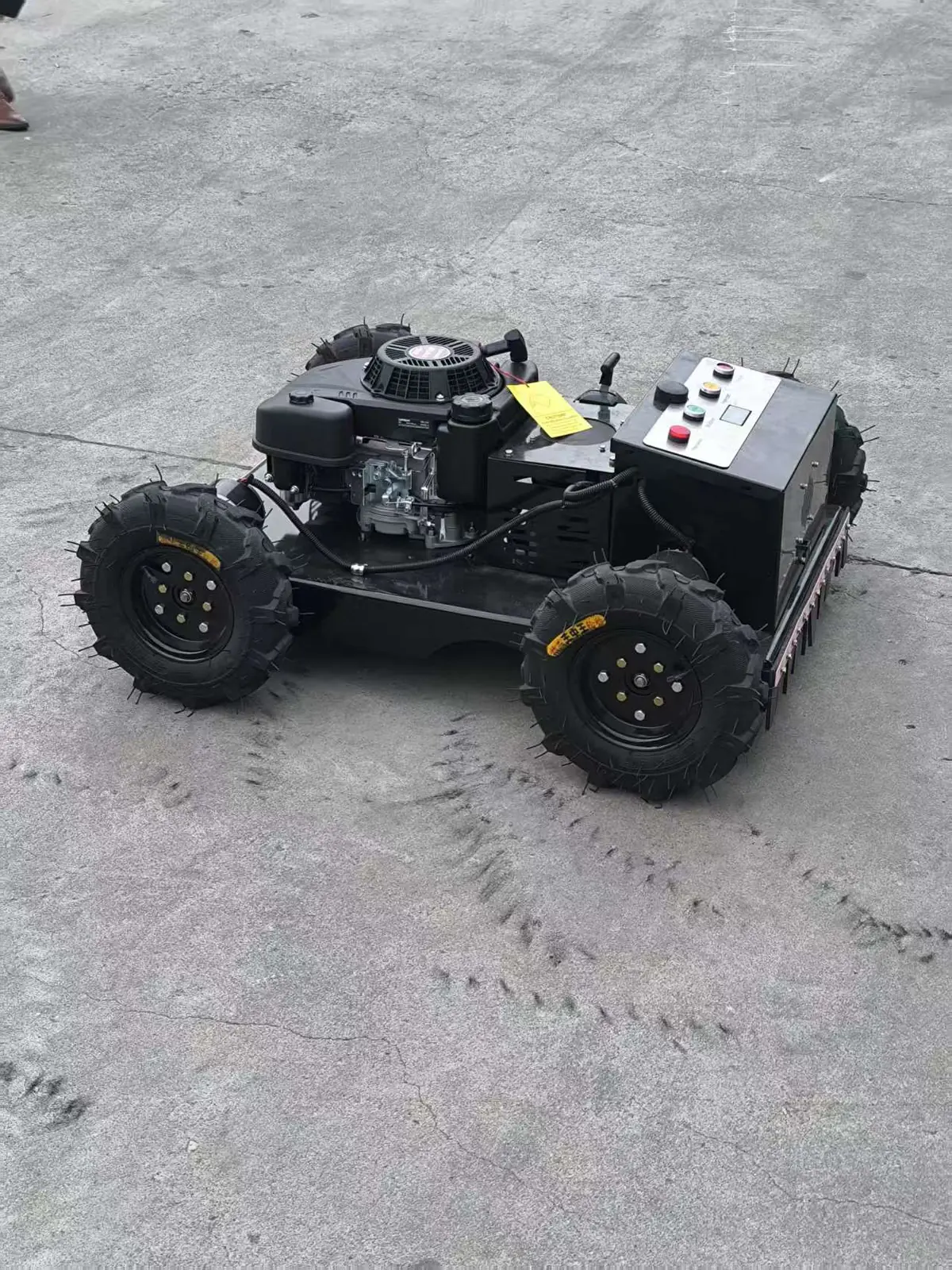
This matters for remote-controlled and specialty equipment as well. Super Mowers lists the DY-550L as wheeled remote-controlled mowing equipment, but the supplied material does not confirm its tire construction, tire specification, or approved replacement range. Do not assume that a size read from a DY-550L wheel is an approved replacement specification; confirm it with the manufacturer or dealer parts documentation for the exact unit. The same caution applies to any fleet unit whose manual or parts list is not at hand.
Read the size markings
The sidewall marking is the second input, not the first. Read it carefully and copy it exactly, including punctuation and any suffix. Lawn and garden tire markings commonly follow a format with three main numbers, but the meaning of each position depends on the format used, and formats differ between tire families. The supplied tire-retailer references describe common lawn tractor formats, but they are not a substitute for the tire manufacturer’s or machine manufacturer’s own explanation of the marking on your tire.
Identify the dimensions described by the marking format
In the common lawn and garden format, the marking typically communicates a width, a profile or sidewall height, and a rim diameter, or in other formats a width, an overall diameter, and a rim diameter. The order and meaning depend on the format, so the first task is to identify which format the tire uses. A marking that reads as width/profile–rim is not read the same way as one that reads as width–overall diameter–rim.
A useful discipline is to write the marking out in words next to the numbers, then mark each word as “confirmed by tire maker” or “to confirm.” The supplied references are not fully consistent on every digit. One retailer page reportedly describes the final number in one place as rim diameter and elsewhere as rim width, and another describes it as diameter. That inconsistency is a reason to verify against the tire manufacturer’s data and the machine’s parts documentation, not a reason to pick the interpretation that seems most convenient.
| Marking element | What it usually describes | What to verify before ordering |
|---|---|---|
| First number | Nominal section width | Whether the format is width/profile–rim or width–diameter–rim |
| Middle number | Profile/sidewall height or overall diameter, depending on format | The tire maker’s explanation for this exact marking |
| Final number | Rim diameter in common formats, but confirm | Rim size marking on the wheel itself |
| Letter or suffix | Load/speed or construction information where present | Machine manual and tire data book |
| “Tubeless” or “Tube type” | Inflation/construction arrangement | Whether the wheel and valve arrangement match |
Distinguish tire size from wheel rim diameter
The rim diameter is a wheel dimension, not a tire dimension, even though it appears in the tire marking. A tire marked for a given rim diameter must be matched to a wheel whose rim actually measures that diameter and whose width and profile suit the tire. The safest check is to read the rim marking stamped on the wheel, or the rim part number in the parts list, and compare it with the tire specification.
Do not measure a mounted tire’s outside diameter and use that as the rim size. Overall diameter, section width, and rim diameter are different measurements, and confusing them is a common cause of wrong orders. If the rim marking is not visible, record the wheel part number and ask the supplier to confirm the rim specification against the machine’s parts list.

Check compatibility beyond matching numbers
Matching numbers are necessary but not sufficient. Compatibility also depends on load capacity, rim fit, tire construction, clearance, and the machine manufacturer’s approval for that position. A tire that is nominally the same size can differ in load rating, ply rating, tread, and construction, and those differences affect whether it is appropriate for a given mower and duty cycle.
Review load, fit and approved construction with the supplier
Load is a central question for commercial fleets because mowers carry equipment, operate on varying ground, and may be fitted with attachments that change weight distribution. Ask the supplier to confirm the load capacity of the proposed tire against the load the machine places on that wheel position, using the machine manufacturer’s information where available. Do not infer load capacity from the tire’s physical size alone.
Fit questions to confirm include rim width and profile, overall diameter and clearance to the machine body, fender, or steering components, valve arrangement, and whether the wheel is designed for a tube, tubeless mounting, or foam filling. Construction questions include the tire’s intended application and whether the machine manufacturer approves that construction for the position. For remote-controlled equipment, also confirm that the replacement does not interfere with the drive or steering arrangement described in the machine documentation.
Application review
Discuss your mowing application.
Share the working condition, target market, product family and project scope.
| Compatibility question | Why it matters | Who should confirm |
|---|---|---|
| Load capacity at this wheel position | Prevents overloading a tire beyond its rated duty | Tire supplier and machine manufacturer |
| Rim diameter and width | A nominally matching tire can still be wrong for the rim | Wheel/rim marking or parts list |
| Overall diameter and clearance | Affects fit near fenders, frames, and steering parts | Machine documentation and physical check |
| Construction (pneumatic, tube, foam, solid) | Changes ride, load behavior, and service approach | Machine manufacturer’s approved specification |
| Tread and intended use | Affects traction and ground interaction for the duty | Supplier, with machine duty in mind |
| Approval for this model and position | A size match is not a fitment approval | Manufacturer or authorized dealer |
Do not assume all tires of the same nominal size interchange
Fleets sometimes standardize on a nominal size to simplify purchasing. That can be reasonable as a starting filter, but it should not become an assumption that every tire with the same marking is interchangeable across machines or positions. Different constructions, load ratings, and rim requirements can make two same-size tires unsuitable substitutes for each other.
The practical rule is: use the size to narrow the search, then use the machine record, the rim data, the load condition, and the manufacturer’s approval to decide. If any of those is missing, the order is not yet confirmed. This is especially important when a fleet mixes brands or model years, because a parts list from one unit does not automatically apply to another.
Prepare a parts request
A clear parts request reduces back-and-forth and protects the fleet from ordering a tire that arrives but does not fit. The request should let a supplier answer without guessing: it identifies the machine, the position, the current tire, the rim, and the duty, and it states which values are confirmed and which are not.
Include a clear sidewall photo and model identity
A sidewall photo is useful when it is legible and complete. Photograph the full marking in good light, straight on, with the entire string visible, and include a second photo of the machine identification plate and a third of the rim marking if it can be seen. Avoid photos that crop the marking, catch glare, or show only part of the tire. Label each photo with the machine serial number and wheel position so the supplier can match it to the request.
A written transcription should accompany the photo, because photos can be misread. Copy the marking exactly, including spaces, slashes, hyphens, and suffixes. If the sidewall also shows a maximum inflation pressure, record it as a sidewall marking, not as the machine’s operating pressure. The related article on remote mower tire pressure specifications addresses that distinction; this guide does not set an operating pressure for any machine.
Leave unknown values blank and obtain written confirmation
Do not fill gaps with plausible guesses. If the rim marking is unreadable, the load rating is not visible, or the manual is missing, write “not confirmed” and ask the supplier to help identify it. A blank field invites a question; a guessed value invites a wrong order.
Ask for written confirmation of the proposed part number, the specification it meets, and the basis for saying it is approved for the machine and position. Keep that confirmation with the fleet record. For dealer and parts-channel readers, the related page on remote-control mower spare parts dealer lists may help identify the right channel for a model, but the approval question still belongs with the manufacturer or authorized parts source.
| Parts request field | Example entry approach | Status to mark |
|---|---|---|
| Machine make/model/serial | Copy from the machine plate | Confirmed |
| Wheel position | Front left, rear right, etc. | Confirmed |
| Sidewall marking | Exact transcription plus photo | Confirmed |
| Rim marking or part number | From wheel stamping or parts list | Confirmed or to confirm |
| Tire construction | Pneumatic, tube, foam, solid | Confirmed or to confirm |
| Load condition | Machine duty and any attachments | To confirm with manufacturer |
| Approved replacement spec | Manufacturer or dealer part reference | To confirm in writing |

Frequently asked questions
What do the numbers on a mower tire describe?
They describe nominal tire dimensions in a format set by the tire maker. Common lawn and garden formats use numbers for section width, profile or overall diameter, and rim diameter, but the order and meaning depend on the format. Copy the full marking and confirm its meaning against the tire manufacturer’s data and the machine’s parts documentation rather than assuming one reading.
Does the same size guarantee the tire fits the wheel?
No. A matching nominal size does not confirm rim width and profile, load capacity, construction, clearance, or manufacturer approval for the position. Use the size to narrow the search, then confirm the rim, load, construction, and approved specification with the supplier and the machine documentation.
Is the sidewall pressure the machine operating setting?
The maximum pressure marked on a sidewall is a tire marking, not automatically the machine’s operating setting. Operating pressure should come from the machine manufacturer’s instructions for that model and configuration. Record the sidewall figure as information, and confirm the operating setting separately.
Conclusion

Read the marking, record the machine and wheel position, and confirm rim, load, construction, and approval before ordering. A size match starts the check; a written approved specification finishes it.
Video: Lawnmower tires - How to read the numbers on the sidewall of a lawn mower tires
