
 By Anna
You have found a patch of closely cropped or exposed soil after a remote mower pass, and the crew wants to know whether the site or the machine is responsible. This mower scalping uneven ground check helps you record the location, surface transitions, and job conditions so an authorized service contact can assess the equipment with real evidence.
Scalping is a result to document, not a diagnosis to guess. Record where it happens, whether it repeats in the same spot or follows the machine, and what the mower was set to cut. Then hand those observations to authorized service staff rather than adjusting the deck yourself.
The sections below build a simple site file: what counts as accidental scalping, how to map repeat damage, what machine and job evidence to collect, and how to pass the file on without making unsafe changes. The approach suits orchard floors, commercial grounds, and other uneven sites where a remote-controlled mower is one part of the maintenance plan. It does not confirm that any specific model is suitable for a given slope, surface, or vegetation condition.
Mower scalping uneven ground: Identify accidental scalping

Start by describing what you see in neutral terms: grass cut shorter than the surrounding pass, exposed soil, torn stems, or a visible line where the deck met a rise. The UC Guide to Healthy Lawns describes scalping as cutting turf too short, and notes that recovery differs by grass growth habit. That is useful context for the finish you expected, but it does not tell you why this particular patch occurred.
For a site record, the practical definition is narrower: an area cut shorter than the intended finish, or cut into soil, that was not part of the planned work. Write the date, time, weather, and the pass direction. Note whether the area was visible before the mower started or found afterward. If the crew deliberately cuts a strip shorter for an edge, a path, or a seasonal renovation, label it as deliberate so it is not confused with accidental damage later.
Separate accidental damage from deliberate seasonal scalping
Deliberate short cutting is usually planned, bounded, and recorded: a known strip along a fence, a renovation pass, or a specific finish requested by the site owner. Accidental scalping is unplanned and often appears at a transition the crew did not anticipate. The distinction matters because the two produce different follow-up. Planned short cutting is a finish decision; accidental damage is a site-and-equipment question that needs evidence.
Ask the crew three questions before writing anything down. Was this area supposed to be cut shorter? Did anyone change a setting, attachment, or route before the pass? Was the area inspected after the previous cut? The answers separate a planned finish from an unexpected result and prevent a deliberate strip from being reported as a fault.
Document the site and finish requirement
Record the finish the site actually needs, not a single number applied everywhere. Orchard floors, headlands, and access lanes may have different expectations. Write down the intended cut for each zone, who set that expectation, and whether the client or site manager has confirmed it. If the requirement is unclear, mark it as an open question rather than assuming a value.
A short site note is enough at this stage:
| Record item | What to write | Why it matters |
|---|---|---|
| Zone name | Orchard row, headland, lane, boundary strip | Lets others find the exact area |
| Intended finish | Description plus any confirmed figure from the site plan | Separates expectation from result |
| Observed result | Shorter than surrounding pass, exposed soil, torn stems | Gives service staff a concrete symptom |
| Date and weather | Date, recent rain, soil moisture if known | Ground conditions affect the surface |
| Who observed it | Name and role | Makes follow-up questions possible |
Keep descriptions factual. “Cut short along the east headland beside the drainage channel” is more useful than “mower damaged the lawn.” The first can be checked; the second invites disagreement.
Map where the damage repeats

The most useful question is whether the damage stays in one place or travels with the machine. A fixed location points toward a surface feature the deck meets repeatedly. A pattern that follows the mower across different areas points toward the machine’s condition or configuration. Many real cases combine both, which is why the map should record location and machine identity together.
Walk the area with the crew and mark each affected patch on a simple plan or phone map. Note the size, the direction of the mower pass, and what the ground does just before the patch: a rise, a dip, a rut, a root, a drain cover, or a change from turf to bare soil. Photograph the patch with something for scale and a second photo showing the surrounding surface.
Record locations and surface transitions
Surface transitions deserve their own column. A mower deck reacts to a change in ground level, and a shallow depression or a raised edge can produce a short cut even where the surrounding grass is uniform. Record the transition type rather than only the damaged spot.
| Location ID | Surface before the patch | Transition observed | Pass direction | Repeat visits |
|---|---|---|---|---|
| A1 | Level turf | Shallow dip beside drain | Along the row | Seen twice |
| A2 | Turf over compacted track | Raised edge at track | Across the row | Seen once |
| A3 | Bare soil strip | Soil to turf step | Along boundary | To confirm |
Use “to confirm” where the crew has not yet re-checked. Do not fill the table with guessed measurements; a described transition is more reliable than an invented depth.
Separate site patterns from machine-side patterns
A site pattern repeats at the same coordinates regardless of which machine or operator runs the pass. A machine-side pattern appears wherever that machine works, including areas with no obvious surface feature. To test the difference, compare passes: same machine on a different zone, and a different machine or configuration on the same zone if one is available and approved for that area.
Do not run a comparison pass on ground the site has not cleared for mowing, and do not ask operators to test beyond the manual’s limits. The comparison is an observation exercise, not a trial. If only one machine is available, note that limitation in the file so service staff know the evidence is one-sided.
A simple split helps the handoff:
| Observation | Points toward site | Points toward machine |
|---|---|---|
| Same patch every visit | Likely | Possible |
| Patch follows the machine to new zones | Unlikely alone | Likely |
| Patch only after a setting change | Possible | Possible |
| Patch at a visible dip or edge | Likely | Possible |
| Patch on uniform ground with no transition | Less likely | More likely |
Application review
Discuss your mowing application.
Share the working condition, target market, product family and project scope.
These are clues, not conclusions. The service contact decides what to inspect.
Collect machine and job evidence
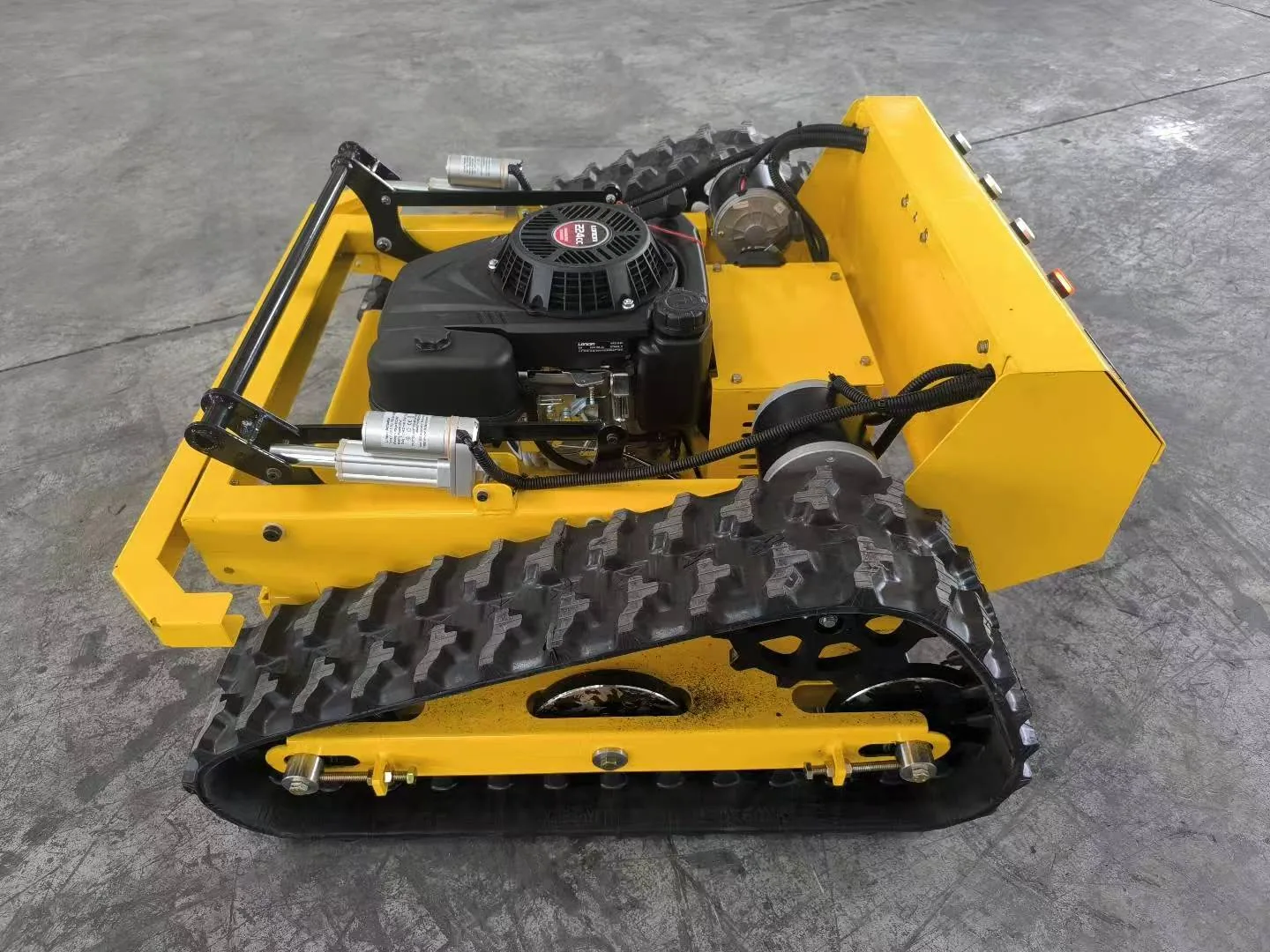
A service conversation goes faster when the machine is identified precisely. Record the model, serial or fleet number, the manual revision in use, the installed attachments, and the control configuration. Note the cutting-height setting as displayed or marked, but do not change it to see what happens. The goal is a faithful record of the configuration at the time of the observation.
The job evidence matters as much as the machine data. Record the vegetation type and height, the ground moisture, the pass speed if the machine reports it, and whether the area had been cut recently. A patch that appears after rain on soft ground is a different observation from one that appears on dry, firm turf.
Record configuration and manual version
Manual versions change, and a setting described in one revision may not match another. Write down the revision printed on the manual or label the machine carries, and keep the relevant page reference with the site file. If the manual is not on hand, record that gap rather than reconstructing instructions from memory or from another model’s documentation.
| Evidence item | Source | Status |
|---|---|---|
| Model and fleet number | Machine label | Confirm on site |
| Manual revision | Supplied manual or label | Confirm version |
| Cutting-height setting | Operator record | Record as found |
| Attachments fitted | Operator record | Record as found |
| Control configuration | Operator record | Record as found |
| Recent maintenance | Service log | Attach if available |
Where a cell cannot be completed, write “not available” and say why. An honest gap is more useful than a plausible guess.
Ask authorized service staff to assess the equipment
Deck height, roller condition, blade condition, and mounting hardware are equipment-side questions for authorized service staff working from the correct model documentation. The crew’s job is to describe the symptom and the conditions, not to diagnose or correct them. This boundary protects the warranty conversation and keeps untrained hands away from moving or guarded components.
When you contact support, lead with the file: location map, repeat pattern, configuration record, and photographs. Ask what additional information they need and whether a site visit is required. Avoid asking for a universal fix; ask what applies to this model and this configuration.
Decide the next handoff
Before the next scheduled cut, decide who receives the file and what happens to the affected zones in the meantime. Options include rerouting the pass, marking the area for a visual check, or pausing that zone until service staff respond. The right choice depends on the site’s access rules, the client’s expectations, and the manual’s guidance for the model.
Record the decision and the date. If the zone continues to be cut, note who authorized it and what was observed on the next pass. A short follow-up entry turns a one-off report into a usable record.
Communicate observations without unsafe adjustment
Write the handoff in plain language and keep recommendations inside your authority. Say what was seen, where, when, and under what conditions. Do not instruct the crew to raise or lower the deck, alter rollers, change blades, or bypass a guard to test a theory. Those are service decisions tied to the model’s documentation.
A useful handoff note has four parts: the symptom, the repeat pattern, the configuration at the time, and the open questions. Keep it to one page if possible, with the map and photos attached. Service staff can then ask targeted questions instead of starting from scratch.
Compare with the existing cutting-height specification guide
If the site’s intended finish was set from the cutting-height specification guide, check that the zone’s requirement matches what was recorded. The guide is background for the finish decision; it is not a diagnosis of this patch and does not authorize a change. Where the site requirement and the recorded setting differ, note the difference as a question for the site manager and service contact.
For orchard layouts, the fit guidance helps frame access and row questions. General application planning is described on the Super Mowers site, and the public model listing shows categories only; neither confirms that a specific configuration suits a particular slope or surface. Super Mowers publishes these pages as planning context, not as a performance guarantee.
FAQ

Why does scalping appear in the same place?
A fixed location usually means the deck meets the same surface feature on every pass: a dip, a raised edge, a rut, or a transition between turf and bare soil. Record the transition and the pass direction. Repeat damage at one spot is a site clue, but service staff still decide whether the machine also needs attention.
Can a single deck setting solve every site?
No. A single setting cannot account for dips, edges, and varying ground across a commercial site, and changing settings without model-specific guidance is not a crew task. Record the intended finish per zone and let authorized staff advise on what the model’s manual allows.
When should the crew contact equipment support?
Contact support when damage repeats in the same place after the surface has been checked, when it follows the machine to new zones, or when the cause is unclear. Bring the location map, configuration record, manual revision, and photos. Do not adjust the deck or guards while waiting for a response.
Conclusion

Record the patch, the surface transition, the repeat pattern, and the machine configuration. Then hand the file to authorized service staff and keep the crew away from unapproved adjustments.