By Anna
You are pricing a mixed contract: flat aprons, a few long grades, and a bank the current zero-turn cannot touch. The tempting shortcut is to compare maximum slope numbers and pick a winner. That shortcut usually produces a bad purchase. The real decision in remote control mower vs zero turn slope mowing is which machine does which part of the job, under whose documented limits, at what total cost.
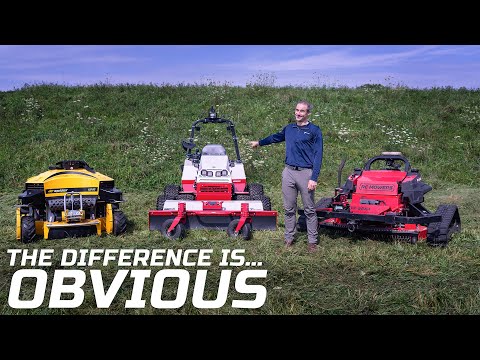
A zero-turn and a remote control mower are not substitutes for one another. A zero-turn is typically a ride-on machine for accessible, relatively even ground; a remote control mower is a walk-behind or tracked unit operated from outside the cutting path. Compare them by work zone, by the exact model's documentation, and by the full cost of covering the whole site.
This article sets out a comparison method you can apply to a real bid. It uses a named Toro manual and a California Department of Transportation (Caltrans) research report as bounded examples, not as a verdict on any machine. Super Mowers supplies remote control mowing equipment and configuration quotes; it does not claim to supply zero-turn mowers, so the zero-turn side of this comparison has to come from the manufacturer whose machine you actually intend to use.
Remote control mower vs zero turn slope mowing: Define the slope job and the equipment being compared
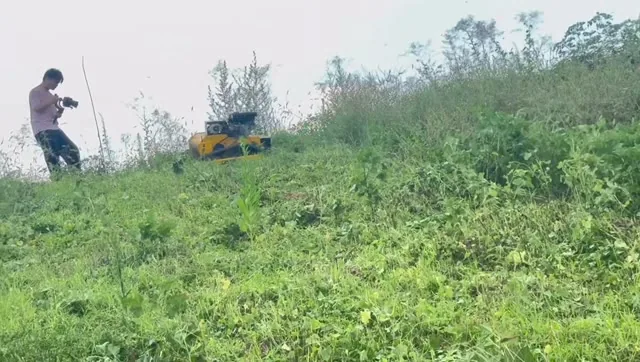
Start by describing the contract as a set of zones rather than as one average slope. A site that is "mostly flat with a bank" is not one condition; it is at least two, and often three: ground a ride-on machine can work normally, ground where any machine needs a considered approach, and ground that should be excluded from mowing or handled another way. Until those zones are drawn, any equipment comparison is guesswork.
Write the site profile down before you talk to a supplier. The purpose is to make the supplier answer a specific question instead of quoting a general capability. It also protects you later: if a machine underperforms, you can show what conditions you described.
Record site profile, finish, access and machine configuration
A useful site record covers five things: the terrain itself, the vegetation and desired finish, how equipment and operators get in, the machine configuration being considered, and the surrounding constraints. Each one changes the answer.
- Terrain: record gradient in the unit the source uses, and record it per zone, not as a site average. Note direction of slope, cross-slope, surface (turf, gravel, compacted soil, rock), and whether the ground is uniform or broken by ditches, curbs, tree wells, or drainage channels. A single steep pitch on an otherwise gentle bank is a different problem from a continuous grade.
- Finish and vegetation: mowing height, acceptable cut quality, grass type, density, and how often the area is cut. A rough maintenance pass on a roadside bank and a fine finish on a corporate lawn are different tasks even at the same gradient.
- Access: gate widths, paths, kerbs, overhead branches, and whether a trailer can reach the work area. Access often decides the machine class before slope does.
- Configuration: cutting width, deck type, track or wheel format, control arrangement, and any attachments. Two machines from the same family can have different configurations and different documented limits.
- Constraints: public access, traffic control, working hours, noise, and whether people or vehicles pass below the slope. These affect method as much as machine choice.
A practical way to hold this together is a zone sheet you fill in once and reuse for every supplier conversation.
| Zone record field | What to write | Why it changes the comparison |
|---|---|---|
| Zone ID and area | e.g. Z1 north apron, Z2 mid-bank, Z3 upper bank | Lets you price and schedule each zone separately |
| Gradient and direction | Value plus unit, plus up/down vs across | A figure without direction and unit cannot be checked against a manual |
| Surface and condition | Turf, gravel, soil, rock; dry, damp, rutted | Traction and stability questions depend on surface, not gradient alone |
| Vegetation and target finish | Species, density, cut height, finish standard | Determines deck type and pass count, which drive cost |
| Access | Gate width, path, trailer reach, overhead clearance | Can rule out a machine class entirely |
| Machine configuration under review | Model, deck, track/wheel, controls | Limits are configuration-specific |
| Exclusions | Areas not to be mown, buffers, protected features | Prevents a quote that assumes full coverage |
| People and traffic | Public access, roads below, working hours | Affects method, supervision and scheduling |
Fill the sheet before requesting a demonstration. Suppliers can only confirm or challenge the conditions you actually describe.
Compare named machine documentation without treating ratings as permission
A published slope figure is a statement about a machine under stated conditions. It is not a permission slip for your site. The comparison only becomes useful when you read each machine's own documentation and keep the two sets of statements separate.
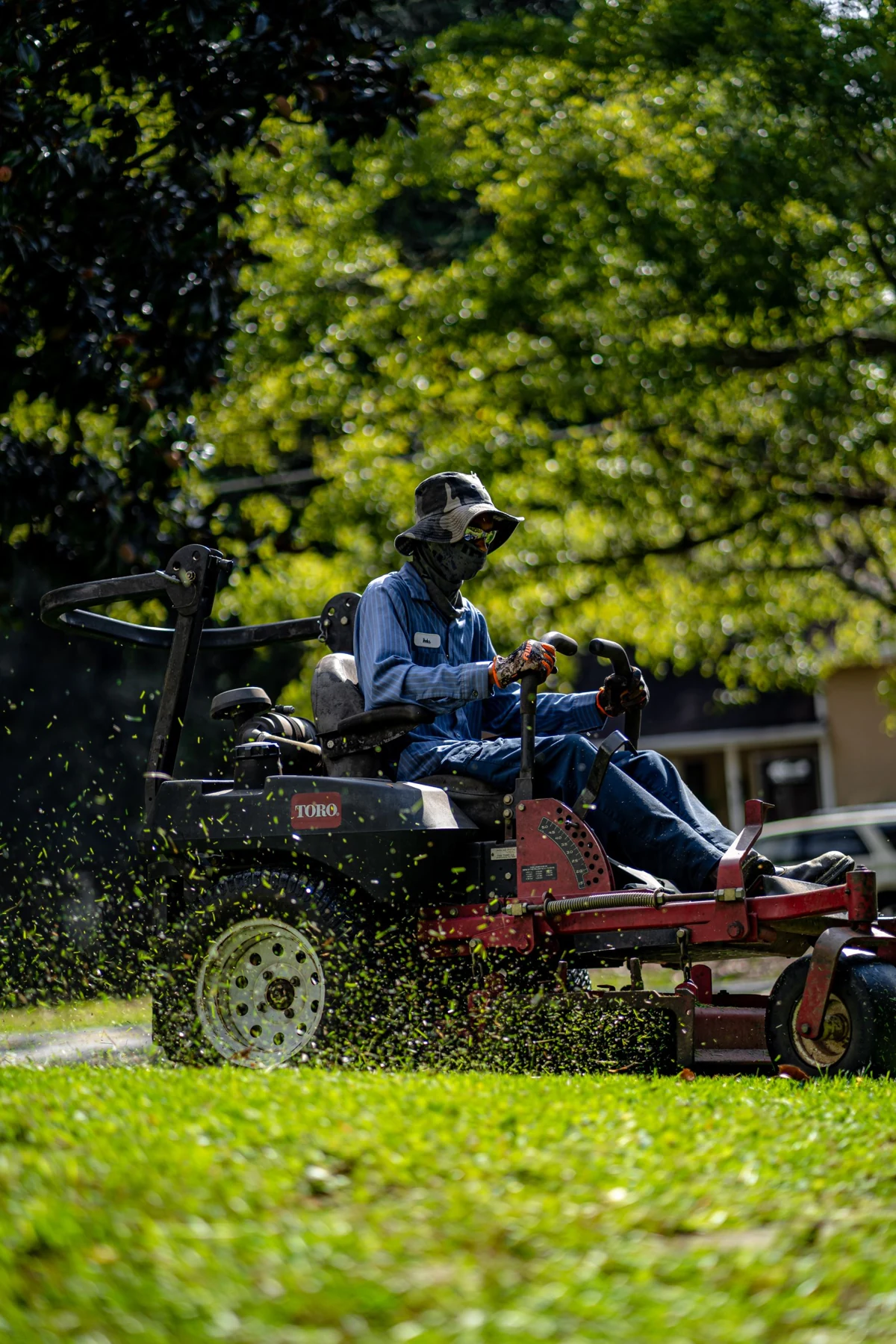
For the zero-turn side, use the manual for the exact model you intend to run. Toro publishes operator manuals online, and the manual for a given model states that model's operating limits and instructions. Those statements apply to that model and configuration; they do not transfer to another zero-turn, and they certainly do not transfer to a remote control machine. The same logic runs in reverse: a remote mower's documentation describes that machine, not the zero-turn beside it.
Read the Toro manual and remote model documentation separately
Build two columns and never merge them. In the zero-turn column, record what the Toro manual for the intended model says about slope operation, load, attachments, and any stated restrictions, quoting the manual's own wording and units. In the remote column, record what the specific remote model's documentation says about gradient, surface, control range, and operating conditions. Where a document is silent, write "not stated in supplied document" rather than filling the gap with an assumption.
| Documentation item | Zero-turn (named Toro model manual) | Remote control (named model documentation) |
|---|---|---|
| Exact model and revision | Record from the manual cover | Record from the supplied document |
| Slope statement and unit | Quote verbatim, with unit | Quote verbatim, with unit |
| Conditions attached to the statement | Note surface, load, attachment caveats | Note surface, configuration, control caveats |
| Operating instructions relevant to grades | Summarise only what the manual states | Summarise only what the document states |
| Attachments and their effect | Record any stated limits | Record any stated limits |
| Items not addressed | Mark as not stated | Mark as not stated |
Two habits keep this honest. First, keep units intact: do not convert a figure from one unit to another and then compare it as if the source had said so. Second, distinguish a test or demonstration result from an operating limit. A machine that climbed a bank in a video has demonstrated something on that day, in those conditions; it has not published a limit for your site.
This is also where the Super Mowers article on remote control mower slope ratings is useful: it deals with unit conversion and with checking what conditions a rating was issued under. Use it to interrogate a figure, not to adopt one.
Assign work zones and compare the complete job

The comparison that matters is not machine versus machine. It is total job versus total job. Assign each zone to a method, then cost the combination. In many mixed contracts the answer is not "remote instead of zero-turn" but "zero-turn on Z1, remote on Z2, and Z3 excluded or handled by another method."
Work through the zones in order of difficulty. Flat, open, accessible ground is normally the zero-turn's territory, and it is usually the fastest way to cover large areas. The middle zone is where the decision is genuinely open: it may be workable by a ride-on machine at reduced speed with a considered approach, or it may be better handled remotely so that no operator is on the machine. The steep or broken zone is where a remote machine's separation between operator and cutting deck becomes the reason to use it, provided the specific model's documentation supports the conditions.
Application review
Discuss your mowing application.
Share the working condition, target market, product family and project scope.
Then add the costs that a slope-number comparison hides:
- Setup and transport for each machine, including trailer capacity and access.
- Labour for each method, including the second person needed for some remote operations and any traffic or spotter requirements.
- Pass count and speed on each zone, based on the finish standard, not on a brochure figure.
- Changeover time between zones and between machines.
- Excluded areas and how they will be maintained, or the client's acceptance that they will not be.
- Risk and supervision costs that follow from working near public access or below a slope.
Use the Caltrans study as a bounded example and record site-specific costs
Caltrans published a research report on roadside slope mowing (Task 2730, report dated 2019). It is useful because it describes slope mowing as a real operational problem with equipment, safety, and cost dimensions, in a defined setting: roadside vegetation management under a state transportation agency's conditions. It is not a test of your site, your vegetation, or a specific machine you are considering, and it does not establish that any machine is safe on any gradient.
Use it the way you would use any bounded case study: to generate the questions and cost lines you might otherwise miss, then answer them with your own site data. The table below is a template, not a set of findings.
| Cost line | Zero-turn on Z1 | Remote on Z2 | Zone Z3 (method TBC) |
|---|---|---|---|
| Machine capital or hire rate | From your own quote | From supplier quote | To be decided |
| Transport and setup per visit | Estimate from access record | Estimate from access record | — |
| Crew size and hours per cut | From your productivity record | From demonstration, not brochure | — |
| Passes needed for finish standard | From site trial | From site trial | — |
| Changeover and supervision | Include | Include | — |
| Excluded-area handling | n/a | n/a | Client decision required |
| Annual cut frequency | Contract term | Contract term | Contract term |
The numbers must come from your own records and written supplier quotes. Do not import figures from a research report, a competitor page, or a demonstration into a bid as if they were your productivity.
Prepare a demonstration and supplier questions

A demonstration is only informative if it is run on your conditions. Arrange it on the actual zone, at the actual vegetation height and moisture level you expect, with the actual configuration you would buy. Ask for the same operator who would train your crew, and ask them to show the machine stopping, turning, and being recovered on the bank, not just cutting a clean pass.
Before the demonstration, send the supplier your zone sheet. After it, record what you saw: gradient and direction, surface, vegetation, configuration, control arrangement, and who was present. Note anything the machine did not do, and anything the supplier declined to demonstrate. That record is more valuable than a video, because it is tied to your site.
Ask for model-specific limits, support and written quote
Put the questions in writing and ask for written answers. A supplier who will not put a limit in writing is telling you something useful.
- Which exact model and configuration are you quoting, and what documentation covers it?
- What does that documentation state about gradient, surface, and operating conditions, in what units, and under what stated conditions?
- What is the control arrangement, and what does the documentation say about keeping the operator separated from the cutting path?
- What training, handover, and operator familiarisation are included?
- What spare parts and service support are available in our region, and on what lead time basis?
- What does the written quote include and exclude: deck, tracks or wheels, delivery, commissioning, training, warranty terms?
- What happens if the machine cannot work a zone we described? What is the remedy?
For Super Mowers remote control equipment, configuration enquiries go through the product pages and the quote request form. Ask for the model-specific documentation and a written quote covering the items above; do not accept a general capability statement as a substitute.
FAQ

Can a remote mower automatically work any slope a zero-turn cannot? No. A remote mower's suitability depends on its own documented limits and on the site conditions: gradient, direction, surface, vegetation, and access. A slope that is beyond a zero-turn's documented limits is not automatically within a remote machine's. Each zone has to be checked against the specific model's documentation, and some zones may be excluded from mowing altogether.
Does a published slope figure establish safe operation? No. A published figure describes a machine under stated conditions. It does not account for your surface, moisture, vegetation, load, direction of travel, or the people and traffic around the work. Treat it as one input to a site-specific assessment, and keep the source's units and conditions attached to it.
How should a contractor compare costs on mixed terrain? Divide the site into zones, assign a method to each, and cost the combination: capital or hire, transport, crew hours, passes, changeover, supervision, and excluded-area handling. Compare total job cost and total risk, not maximum slope figures. Use your own productivity records and written supplier quotes rather than figures from brochures or case studies.
Conclusion

Compare the job, not the brochure. Zone the site, read each named model's documentation separately, and cost the whole contract. Then ask suppliers for written, model-specific limits and a demonstration on your ground.
Video: Remote Control Mower Comparison | Which should I buy?