 Par Anna
A hydraulic fault report lands on your desk with a vague note: "filter changed, problem back." Before you order parts or book labour, you need to know which filter the technician meant — the one on the pump inlet or the one on the return line. The hydraulic suction filter vs return filter question is not academic; it decides which part number you order and which line you open.
A suction filter (often a strainer) sits between the reservoir and the pump inlet and protects the pump from coarse debris while keeping inlet restriction low. A return filter sits on the line back to the tank and captures wear particles after they pass through the circuit. Position, pressure, and flow requirements differ, so the correct part comes from the machine's own documentation.
Filtre d'aspiration hydraulique par rapport au filtre de retour : localiser les filtres d'aspiration et de retour dans un circuit simple

In a basic hydraulic circuit, the two filter locations sit at opposite ends of the oil's journey. The suction side is upstream of the pump; the return side is downstream of the working components. That single difference in position explains most of the difference in how each filter is built, rated, and serviced.
Suivre le fluide du réservoir à la pompe et retour
Commencez au réservoir. Le fluide quitte le réservoir par une ligne d'aspiration et entre dans l'entrée de la pompe. Si un filtre d'aspiration ou une crépine est installé, il se trouve dans cette ligne — ou à la sortie du réservoir — de sorte que tout ce qui entre dans la pompe le traverse d'abord. Depuis la pompe, l'huile sous pression se dirige vers les vannes, les vérins et les moteurs, effectue son travail, puis revient par une ligne de retour vers le réservoir. Un filtre de retour, lorsqu'il est installé, se trouve sur ce trajet de retour.
Power & Motion's hydraulic filtration overview describes filtration as a circuit-level concern, with filters placed at points where they protect sensitive components and where the system can tolerate the pressure drop they introduce. That framing is useful for maintenance staff: the question is not only "what does this filter catch?" but "what is this filter allowed to cost the circuit in pressure and flow?"
Le guide de Flowfit's pour choisir un filtre d'aspiration hydraulique se concentre spécifiquement sur le cas de l'entrée de pompe. Il traite la filtration d'aspiration comme un équilibre entre la protection de la pompe et l'évitement d'une restriction excessive à l'entrée, ce qui explique pourquoi les éléments côté aspiration sont communément décrits comme des crépines à média relativement ouvert plutôt que comme des filtres fins. La construction exacte, la classification en microns et la configuration de dérivation restent spécifiques au produit et à la machine.
Indiquer que les circuits réels diffèrent
Une boucle simple est un schéma pédagogique, pas un dessin de machine. Les équipements mobiles réels peuvent placer la filtration dans la ligne de pression, dans une boucle hors ligne dédiée, dans l'évent du réservoir, ou en combinaisons. Certains circuits utilisent une crépine d'aspiration plus un filtre de retour ; d'autres n'utilisent qu'un seul de ces éléments ; d'autres n'utilisent ni l'un ni l'autre sous la forme que vous attendez.
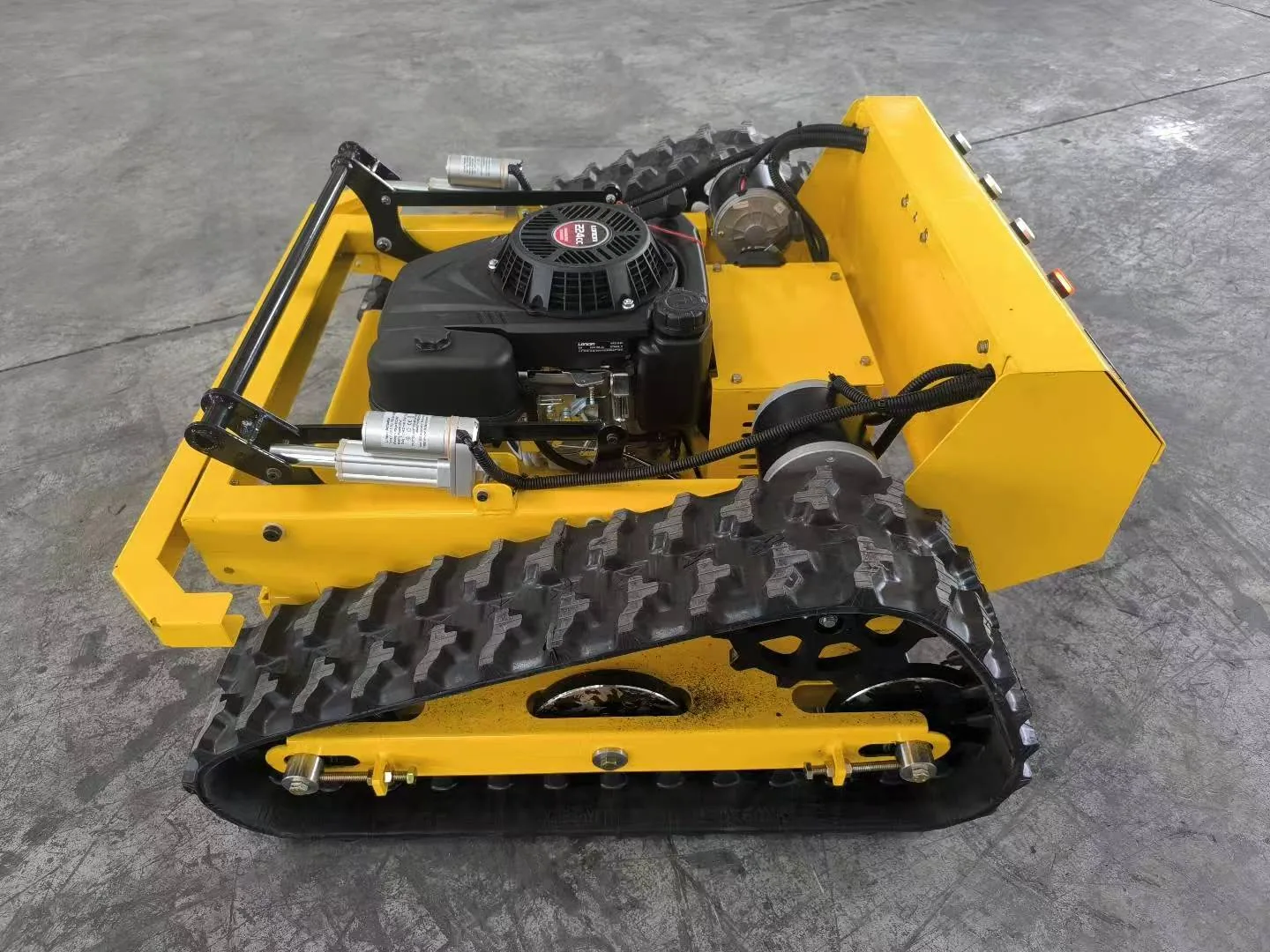
This matters for parts identification. If a technician reports "the hydraulic filter is clogged," the maintenance coordinator should establish which filter, on which line, on which machine and serial number. Without that, a replacement order is a guess. The same caution applies to any Super Mowers machine: the public product page for the remote-controlled gasoline mower lists an optional hydraulic lift, but the filtration layout of that machine is not established by the page and should be confirmed against the actual unit's documentation before any part is ordered.
Compare each location's filtration task and pressure conditions

The two locations face different operating conditions, and that is the practical heart of the comparison. A suction element lives under negative pressure created by the pump's draw; a return element lives under whatever back-pressure the return path and housing impose. Elements are selected for those conditions, not swapped between them.
Utilisez les descriptions de Flowfit et de Power & Motion
Flowfit's suction-filter guidance centres on pump protection and inlet restriction. The pump is the most expensive and least tolerant component in many circuits, and debris entering the inlet can damage it directly. At the same time, too much restriction at the inlet can cause cavitation and poor pump filling. Suction strainers therefore tend to be coarse, generously sized, and sometimes fitted with a bypass or a vacuum indicator, depending on the design.
Power & Motion's overview places return filtration in the context of the whole circuit: return filters capture wear debris generated by components after it has passed through them, and they are positioned where pressure drop is usually more tolerable than at the pump inlet. Return-line filtration is often described as a convenient service point because the housing is accessible and the element can be changed without opening the pressure side.
Donaldson's hydraulic filtration overview is a further reference for how filter media, ratings, and housing design are presented in manufacturer literature. It is a general technical document; it does not establish the filtration specification of any particular mower, and its examples should not be transferred to a machine without the machine's own manual.
Conservez les exigences de pression et de débit associées au filtre
Un numéro de référence de filtre n'est valable que dans les conditions de pression, de débit et de fluide pour lesquelles il a été conçu. Deux éléments peuvent sembler similaires et différer néanmoins par la pression d'écrasement, le réglage du bypass, la classe du média filtrant et la capacité de débit. La planification de la maintenance doit donc associer les éléments suivants à chaque fiche de filtre :
| Question | Élément côté aspiration | Élément côté retour |
|---|---|---|
| Où se trouve-t-il dans le circuit ? | Entre le réservoir et l'entrée de la pompe | Sur la ligne renvoyant l'huile au réservoir |
| Que protège-t-il principalement ? | La pompe, contre les débris pénétrant par l'entrée | Les composants du circuit et la propreté du fluide, en capturant les débris d'usure |
| À quelle condition de pression est-il soumis ? | Pression à l'entrée de la pompe (négative/limitée) | Pression de la ligne de retour et contre-pression du boîtier |
| Qu'est-ce qui limite généralement le choix de l'élément ? | Restriction à l'aspiration et remplissage de la pompe | Caractéristiques du boîtier, capacité de débit et configuration de dérivation |
| Que doit contenir la fiche de pièces ? | Modèle de machine, numéro de série, position sur la ligne, référence de l'élément | Modèle de machine, numéro de série, position du boîtier, référence de l'élément |
| Que faut-il confirmer dans le manuel ? | Si une crépine est installée et sa méthode d'entretien | Si un filtre de retour est installé, ses caractéristiques et son intervalle d'entretien |
None of the cells above should be filled from a generic article. They are prompts for the machine's own documentation. Where the manual is silent or unavailable, the correct status is "confirm with the manufacturer or dealer," not "assume standard."
Examen de l'application
Discutez de votre application de tonte.
Partagez les conditions de travail, le marché cible, la famille de produits et la portée du projet.
Utilisez la documentation du fabricant pour planifier l'entretien

Maintenance planning for hydraulic filters depends less on general theory than on accurate machine records. The coordinator's job is to ensure the right element is identified, the right interval is followed, and the right person performs the work. General references help you ask better questions; they do not replace the manual.
Évitez de supposer que les deux filtres existent sur chaque tondeuse
It is tempting to build a service checklist that lists "suction filter" and "return filter" for every hydraulic machine in a fleet. That checklist will be wrong for some units. Mobile equipment designs vary widely, and a machine with a small hydraulic function — such as a lift circuit — may have a simpler filtration arrangement than a machine with a full hydrostatic drive and multiple work functions.
A safer approach is to build the checklist from the machine's parts list and manual, then use the general suction/return distinction to interpret what you find. For each unit, record:
- Modèle de machine, numéro de série et configuration de construction.
- Les points de filtration que le manuel indique réellement.
- La référence de la pièce filtrante et toute supersession notée par le fabricant.
- L'intervalle d'entretien et les indicateurs conditionnels spécifiés par le manuel.
- Qui est autorisé à ouvrir des composants hydrauliques sous pression ou confinés.
This record also helps when a technician's report is ambiguous. "Filter changed" becomes a specific line item with a part number and a location, which is what a parts counter needs to supply the correct item.
Confier l'entretien sous pression à du personnel qualifié
Hydraulic systems store energy. Lines may remain pressurised after the machine is shut down, and fluid can be hot. Filter housings on the return or pressure side may be under pressure during operation and may require specific depressurisation steps before opening. The machine's manual defines those steps for that machine; a general article should not.
Maintenance coordinators should route filter replacement, housing opening, and any work on pressurised lines to personnel trained and authorised for that equipment, following the manufacturer's procedure. The coordinator's contribution is scheduling, parts accuracy, and record keeping — not improvising a procedure when the manual is missing. If the manual cannot be obtained, that is a documentation gap to escalate, not a reason to proceed from memory.
Questions fréquentes

Les filtres d'aspiration et de retour sont-ils le même composant ?
No. They sit at different points in the circuit and are selected for different conditions. A suction element is chosen with pump-inlet restriction in mind; a return element is chosen for the return line's flow and pressure conditions. They should not be treated as interchangeable even when they look similar.
Toutes les machines hydrauliques ont-elles les deux emplacements ?
No. Some machines have a suction strainer and a return filter, some have only one, and some use other filtration arrangements. The machine's own manual and parts list are the authority on what is fitted.
Une référence de filtre à air ou à carburant peut-elle identifier un filtre hydraulique ?
No. Air and fuel filtration are separate systems with their own part numbers and specifications. A number from an engine air or fuel filter does not identify a hydraulic element. Use the hydraulic section of the machine's parts list, and confirm the line position as well as the part number.
Pour les sujets connexes de filtration côté moteur sur ce site, voir les articles sur l'entretien du filtre à air pour les flottes télécommandées et les symptômes du filtre à carburant; ils couvrent des systèmes différents et ne remplacent pas la documentation hydraulique.
Conclusion

Suction and return filters protect different parts of the circuit under different conditions. Identify the location and part number from the machine's own manual before ordering or servicing.
Video: 032 Suction Filter vs Hydraulic Return Filter Element: Explanation of Differences and Selection
