 By Anna
Direct answer: Start with the owner-approved maintenance plan, not a model search. Bring the written work zones, vegetation objectives, exclusions, access constraints and documentation requirements into the supplier conversation. The supplier’s first job is not to declare a machine suitable for a landfill; it is to return current model documentation and non-applicability statements against the owner’s scope.
The current Super Mowers catalog does not establish landfill suitability for any specific mower model. Super Mowers has a current remote-control mower product family, but that listing is a catalog, not a slope, ground-pressure or landfill approval. The Applications page gives general mowing contexts and has no landfill-specific equipment conclusion. The owner, the permit/closure plan and qualified professionals define the approved work scope. Ask for current manuals and a project risk assessment rather than model-specific operating or safety advice.
Inputs from the owner-approved maintenance plan
Pull the following inputs from the already approved plan before contacting any supplier.
- Approved work zones and boundaries: State each zone name, the written boundary, and the maintenance task the owner approved. Do not ask the supplier to interpret a permit or map.
- Vegetation management objective: State whether the target is height control, woody stem reduction, fuel load reduction, visual screening or another owner-defined outcome. Do not turn a general mowing objective into a model capability claim.
- Exclusions and no-go areas: Carry over the owner’s exclusion list—gas wells, leachate features, monitoring points, settlement areas, geomembrane/cover boundaries, drainage features, access roads and any non-mechanical area. The supplier brief should use the owner’s exclusions, not a vendor’s assumptions.
- Access, staging and transport: Define gate width, temporary access, loading and offloading points, whether tracked or wheeled movement is allowed on the surface, and how the machine will reach each work zone without crossing an excluded feature. These are transport and logistics questions, not slope-approval questions.
- Inspection and control distance: State whether the operator can maintain visual line of sight from a fixed point, whether remote operation is from the top of slope or an adjacent area, and whether the site plan permits operator positions outside the work zone. Remote-controlled does not mean autonomous or robotic.
- Documentation to request: Ask for the current operator manual, maintenance manual, parts/consumables schedule, risk assessment template, and any current certification or non-applicability letter for the destination.
Blank site-scope-to-supplier-response table
Use this table as a blank template. The owner enters the approved maintenance-plan data; the supplier should return document references, not a pre-qualified machine.
| Owner-plan input | What to state in the inquiry | Supplier response to request |
|---|---|---|
| Approved work zone | Enter zone name, boundary, and the approved maintenance task from the owner’s plan. | Current model manual, specification sheet, and non-applicability statement for the stated zone. |
| Vegetation objective | State the owner-defined outcome and vegetation type/height if available from the plan. | Whether the offered model is documented for that vegetation class and what documentation supports it. |
| Exclusions | Paste the owner’s exclusion list; do not ask the supplier to create it. | Statement on whether the supplied documents identify any non-applicable use or excluded area. |
| Access and transport | State gate widths, load/unload points, and permitted travel path. | Current transport dimensions, weight, and any rigging or lifting manual requirements for the destination. |
| Documentation | List the exact documents needed for the site file. | Current manual revision, date, and any destination-specific certification or non-applicability note. |
The table is deliberately blank because the owner’s plan—not a previous site, older trade article, or website category—drives the scope.
Application review
Discuss your mowing application.
Share the working condition, target market, product family and project scope.
Model document and non-applicability questions
Use these neutral questions in the supplier inquiry. They ask for current documentation, not a declaration of fit.
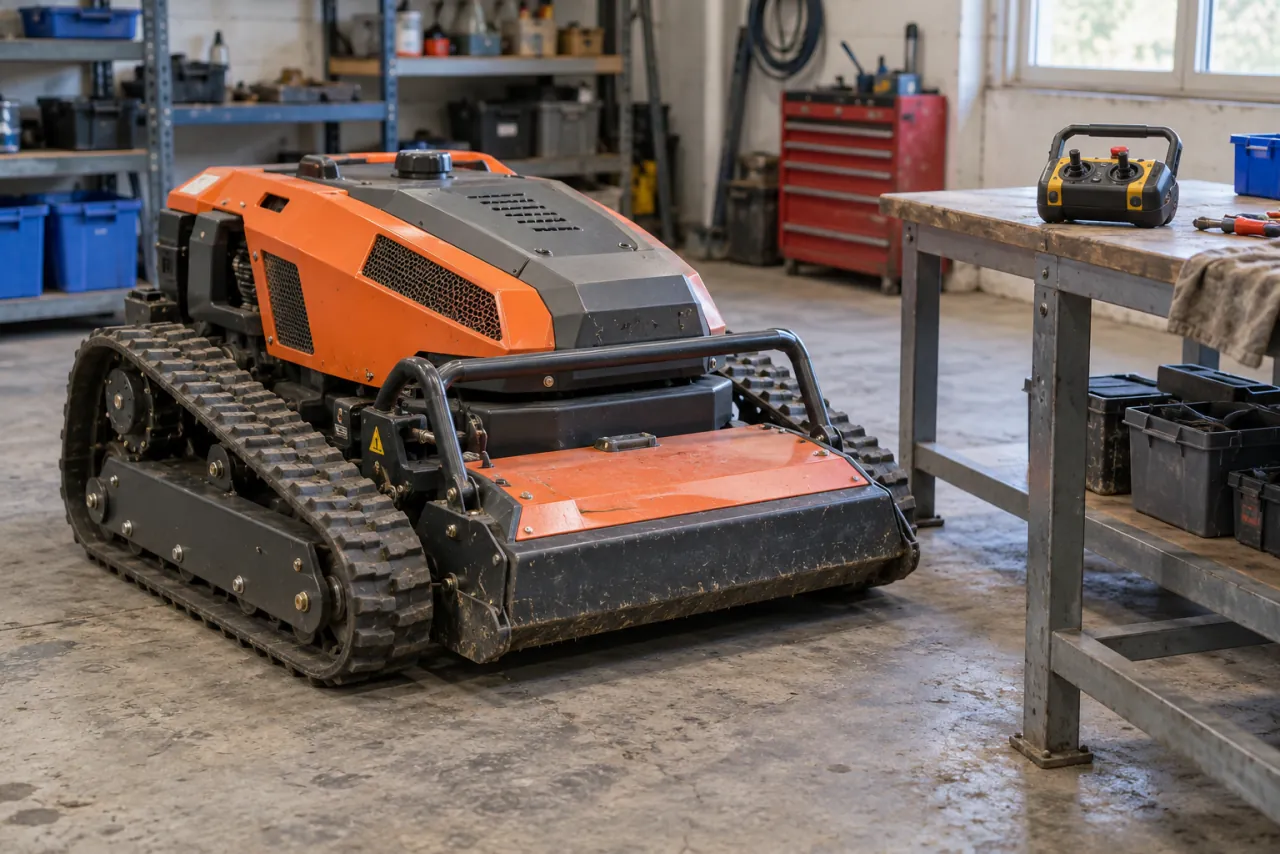
- Which current models have a published operator and maintenance manual available for the destination country?
- Which attachments or cutting decks are documented for the vegetation type in the owner’s plan, and which are excluded by the current manual?
- What safety, emissions, or conformity documentation is required or non-applicable for the destination, and can the supplier provide a written non-applicability statement if a standard does not apply?
- What is the documented parts and service support path for the destination, including lead time for consumables?
- What are the current model dimensions, weight, transport requirements, and control range in the current manual? Do not rely on a website category or an older page parameter.
- Remote-controlled is not autonomous or robotic. Confirm the actual control mode, emergency stop behavior, and operator manual requirements without asking the supplier to approve a slope.
If a supplier cannot provide current manual references, a risk assessment template, or a written non-applicability statement, that is a different sourcing signal than a missing website claim.
Neutral inquiry step
After the owner-approved maintenance plan is compiled, submit the site-specific supplier inquiry. State the worksite conditions, destination, quantity under consideration, and document needs. Do not ask for a machine fit at this stage. A complete brief lets the supplier return current documentation and non-applicability statements instead of a generic product pitch.
Use the site-specific supplier inquiry when the plan inputs are ready.