

 Por Anna
To estimate irrigation water use without a separate meter, use two methods: measure the main water meter before and after a controlled irrigation run, then compare the result with seasonal water bills after subtracting a reasonable indoor-use baseline.
The meter test measures water passing through the meter during a specific run. The bill comparison estimates consumption above your normal non-irrigation use. Together, they help you check whether your numbers are plausible—not prove an exact irrigation-only total for an entire season.

Contents
- Why use two estimation methods?
- Method 1: Measure irrigation water use at the main meter
- Calculate weekly and billing-period use
- Method 2: Compare seasonal water bills
- Cross-check your irrigation water use estimate
- Quick verification checklist
- When better measurement is needed
Why Use Two Estimation Methods?
A main meter records water passing through that supply, not just water used by sprinklers. Indoor fixtures, hoses, pool filling, and leaks can all affect the total. These methods only cover irrigation supplied through the meter and account you are reviewing; water from a separate well or another supply is outside that record.
The two methods answer different questions. A controlled meter test asks, “How much water did this irrigation run use?” A seasonal bill comparison asks, “How much more water did the property use than during the baseline period?”
The Arizona Department of Water Resources’ volume-based audit uses measured zone flow and controller settings to estimate consumption. EPA WaterSense also recommends comparing winter and summer water use to understand additional outdoor consumption.
Method 1: Measure Irrigation Water Use at the Main Meter

You need safe access to a readable meter, a timer, and your irrigation controller settings. Do not force open a locked meter box or disturb utility equipment. Contact the utility when access or the reading method is unclear.
Run a Controlled Zone Test
- Pause all other water use. Include faucets, toilets, washing machines, dishwashers, ice makers, water-softener regeneration, pool autofill, and outdoor hoses.
- Check for background flow. With irrigation off, look for meter movement or a changing reading. Investigate unexplained flow before treating the test as irrigation-only.
- Record the starting volume. Note the units, decimal places, and any multiplier. Use the cumulative volume reading, not an instantaneous flow-rate display.
- Run one zone for a measured period. Use its normal scheduled run or a shorter test that produces a clearly readable change. Low-flow drip zones may need longer observation than spray zones.
- Stop the zone and record the ending volume. Keep other water uses off, note the exact watering time, and allow a digital display to update before recording the final reading.
- Repeat for every zone. Record each zone’s result instead of assuming all zones have the same flow.
The zone-by-zone calculation assumes those test conditions represent normal operation. If zones normally run together, test that operating combination rather than relying only on separate-zone results.
This follows the isolation-and-measurement approach in Arizona’s volume-based audit. Meter displays differ; Otay Water District’s meter-reading guide illustrates the distinction between cumulative readings, flow indicators, and billing units.
Convert the Meter Reading to Gallons
First calculate the change:
Volume used = ending meter reading − starting meter reading
Interpret the register units and any multiplier using the utility’s instructions, then convert the resulting volume. Do not apply the same multiplier twice. All gallon figures below are US gallons, and the conversion factors are rounded.
| Meter or bill unit | Convert to US gallons |
|---|---|
| US gallons | No conversion needed |
| Cubic feet | Multiply by 7.48 |
| CCF or HCF: 100 cubic feet | Multiply by 748 |
| Cubic meters | Multiply by approximately 264.2 |
Do not confuse one cubic foot with one CCF. EPA explains CCF and other billing units in its water-bill guide; the USGS conversion table provides the cubic-meter conversion. You can also keep everything in metric units when your meter and bills use the same units.
Calculate Flow and Water Use per Run
Flow in gallons per minute (GPM) = test gallons ÷ test minutes
Estimated zone gallons per run = measured GPM × watering minutes per run
For an illustrative example, suppose the meter rises from 25,400 to 25,520 gallons during a 10-minute test:
120 gallons ÷ 10 minutes = 12 GPM
If that zone normally waters for 20 minutes:
12 GPM × 20 minutes = 240 gallons per run
The 240-gallon figure assumes the measured flow remains representative. Testing the full scheduled run reduces the need to extrapolate from a shorter sample.
Calculate Weekly and Billing-Period Use
For an unchanged weekly schedule:
Zone gallons per week = gallons per run × runs per week
System gallons per week = sum of all zone weekly totals
Approximate monthly gallons = system gallons per week × 4.33
The 4.33 multiplier is a rounded average-month shortcut, not the exact length of a particular bill. For a bill comparison, use the actual dates and watering events:
Billing-period irrigation water use = sum of each zone’s measured GPM × its total watering minutes during that period
Count Actual Watering Minutes, Not Just Start Times
Review every active program and any manual watering. On controllers such as the Hunter Pro-C, a start time launches all stations assigned to that program—not just one zone. Multiple program start times can therefore repeat the full sequence. See Hunter’s start-time guidance.
Do not count soak pauses as watering minutes. A cycle-and-soak setting can divide an existing run time into shorter segments; it does not necessarily multiply the programmed watering duration. Hunter’s cycle-and-soak explanation shows this distinction.
Also account for rain skips, seasonal adjustments, and weather- or soil-moisture-based changes. EPA explains how smart controllers adjust watering. Use actual run history when available; otherwise, label the calculation as a scheduled-use estimate.
Revisión de la aplicación
Hable sobre su aplicación de corte.
Comparta las condiciones de trabajo, el mercado objetivo, la familia de productos y el alcance del proyecto.
Worked Billing-Period Example
Assume three zones each completed 13 runs during a 31-day billing period, with unchanged flow and watering duration. These figures are illustrative, not recommended watering settings.
| Zone | Measured flow | Minutes per run | Completed runs | Estimated gallons |
|---|---|---|---|---|
| Front lawn | 12 GPM | 20 | 13 | 3,120 |
| Back lawn | 9 GPM | 15 | 13 | 1,755 |
| Drip beds | 2 GPM | 30 | 13 | 780 |
| Total | 5,655 |
For the front lawn, the calculation is 12 × 20 × 13 = 3,120 gallons. Calculate the other zones separately, then add them together.
Method 2: Compare Seasonal Water Bills
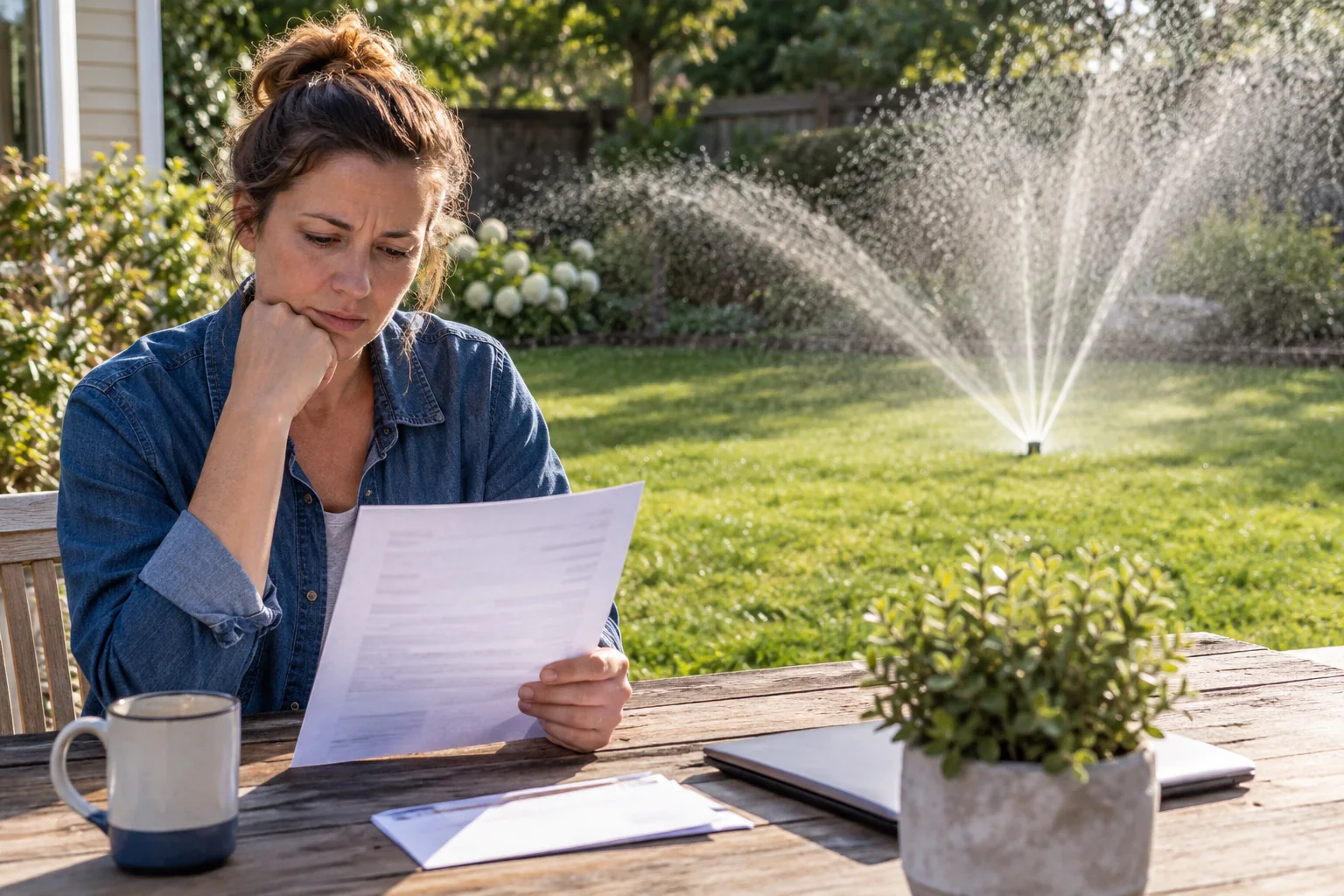
A seasonal comparison provides a broader check on irrigation water use. Start with approximately 12 months of consumption history, using water volume rather than the dollar amount or sewer charge. EPA’s guide to understanding your water bill explains how to identify consumption and compare usage trends.
Establish a Daily Baseline
Choose a period when irrigation was off, household occupancy was similar, and there were no known leaks or unusual water uses. Winter may work, but the appropriate season depends on your climate and schedule.
Baseline gallons per day = baseline-period gallons ÷ baseline-period days
When using several suitable bills, divide their combined gallons by their combined days. Do not simply average bill totals when the periods have different lengths.
For example:
6,000 gallons ÷ 30 days = 200 gallons per day
Treat this as an estimated non-irrigation baseline, not a direct measurement of indoor use. A persistent leak or regular outdoor use during the baseline period can distort it.
Subtract the Baseline from the Irrigation-Season Bill
Estimated use above baseline = bill gallons − (baseline gallons per day × bill days)
Suppose the irrigation-season bill shows 12,100 gallons over 31 days:
12,100 − (200 × 31) = 5,900 gallons above baseline
That 5,900-gallon estimate may include irrigation, hose use, pool filling, and changes in indoor consumption. It is not automatically 5,900 gallons of irrigation water.
If irrigation never stops, a low-use bill is not necessarily an indoor-only baseline. If subtraction produces a negative result, review the baseline, occupancy, bill dates, and units rather than reporting negative irrigation use.
Cross-Check Your Irrigation Water Use Estimate

Compare the two methods over the same billing dates and in the same units.
| Method | Best use | Main limitation |
|---|---|---|
| Main meter run test | Measuring a controlled run and estimating zone or system consumption | Extending the result depends on representative flow and accurate run history |
| Seasonal bill baseline | Estimating total consumption above normal non-irrigation use | Other outdoor uses and changes in indoor use can affect the result |
In the worked example, the zone calculation gives 5,655 gallons, while the bill method gives 5,900 gallons above baseline. The difference is:
5,900 − 5,655 = 245 gallons
That difference is unallocated—it might reflect other water uses, baseline variation, reading resolution, or a combination. It does not identify a particular source by itself.
Do not adjust the numbers just to make them match. When the discrepancy would change your decision, check the underlying readings, assumptions, and controller history.
Quick Verification Checklist

Before relying on an irrigation water use estimate, confirm these points:
- Meter and units: The meter actually supplies the irrigation system, and gallons, cubic feet, CCF, and cubic meters have not been mixed up.
- Controlled test: No other devices operated, and unexplained background flow was investigated.
- Complete schedule: Every zone, active program, repeated start, manual run, and skipped watering event is accounted for.
- Matching dates: Both calculations cover the same meter-reading period, using actual watering minutes where possible.
- Suitable baseline: Occupancy and normal use are comparable, with pool filling, hose use, and known leaks considered separately.
If the meter changes when no water should be used, investigate a leak or an overlooked automatic device. A brief stationary reading does not rule out intermittent water use. EPA’s leak-checking guidance recommends comparing meter readings over a two-hour period without water use as one way to check for leaks.
When Better Measurement Is Needed

Use these methods for preliminary planning and troubleshooting. For formal billing allocation, compliance, water-rights reporting, or decisions requiring a defensible irrigation-only total, confirm the required measurement method with the relevant utility or authority.
Utility interval data can help locate watering periods, but whole-property data does not automatically separate irrigation from other simultaneous uses. When necessary, ask about suitable dedicated metering or a qualified flow assessment.
An irrigation audit can also examine leaks, scheduling, and system performance. EPA describes the role of trained auditors in its irrigation professional guidance.
The practical approach is to measure each zone, calculate use from actual watering time, and compare the result with the seasonal bill baseline. Keep the assumptions visible, investigate meaningful differences, and distinguish an estimate of irrigation water use from a verified irrigation-only measurement.